TL;DR
- The UK AI SEO market is young and crowded, and most vendors fall into one of five archetypes rather than being genuinely unique.
- Knowing the archetype tells you what a vendor is good at and where its blind spot is before you take a single sales call.
- Around 60% of Google searches now end without a click, which is the demand pressure pushing firms to buy AI visibility help (industry analyses, 2026).
- About 45% of marketing leaders cannot measure brand visibility in AI answers, so buyers often cannot tell a good vendor from a confident one (Semrush, 2026).
- This is a vendor-agnostic map. It names no firms. It gives you the axes and the questions to place any vendor yourself.
Key facts
- Around 60% of Google searches end without a click as AI answers absorb the query (industry analyses, 2026).
- About 45% of marketing leaders cannot measure brand visibility in AI answers, and only around 9% track it across platforms (Semrush, 2026).
- GEO extends SEO rather than replacing it, so a credible vendor needs both foundations (industry guidance, 2026).
- Engines share only about 11% of cited domains, so multi-engine capability is a real differentiator, not a slogan (Profound, 2026).
- Structured, attributed content underpins citations across engines, which is the technical core any vendor should demonstrate (Aggarwal et al., arXiv, 2023).
- The UK GEO agency field is populated largely by firms less than two years into the discipline (market landscape reviews, 2026).
Why a buyer needs a map, not a shortlist
Search “best AI SEO agency UK” and you get ranked lists, most of them written by agencies that appear on them. Those lists tell you who paid for placement or who ranks for the term, which is close to useless when you are trying to buy a result. What a buyer actually needs is a way to read any vendor, including ones no list mentions, and understand its likely strengths and blind spots before the first call. That is what a landscape map does, and why this one names no firms. Names date quickly in a market this young. The structure does not.
The demand behind the crowding is real. With around 60% of Google searches now ending without a click as AI answers satisfy the query on the page, firms can feel their traditional traffic thinning and go looking for help. The problem is that about 45% of marketing leaders cannot measure brand visibility in AI answers at all, so they are shopping for something they cannot yet see, which is a market tailor-made for confident sales pitches. A map is the defence.
The two axes that place any vendor
Two axes do most of the work. The first is method: how AI-native the vendor’s approach is, running from a classic-SEO method with AI language bolted on, to a method built around AI citation from the ground up. The second is engagement: how much the vendor does for you, running from self-serve tooling you operate yourself, to full done-for-you delivery. Place a vendor on those two axes and you have a fast read on what you are buying and what you will still have to do yourself.
The five archetypes and their blind spots
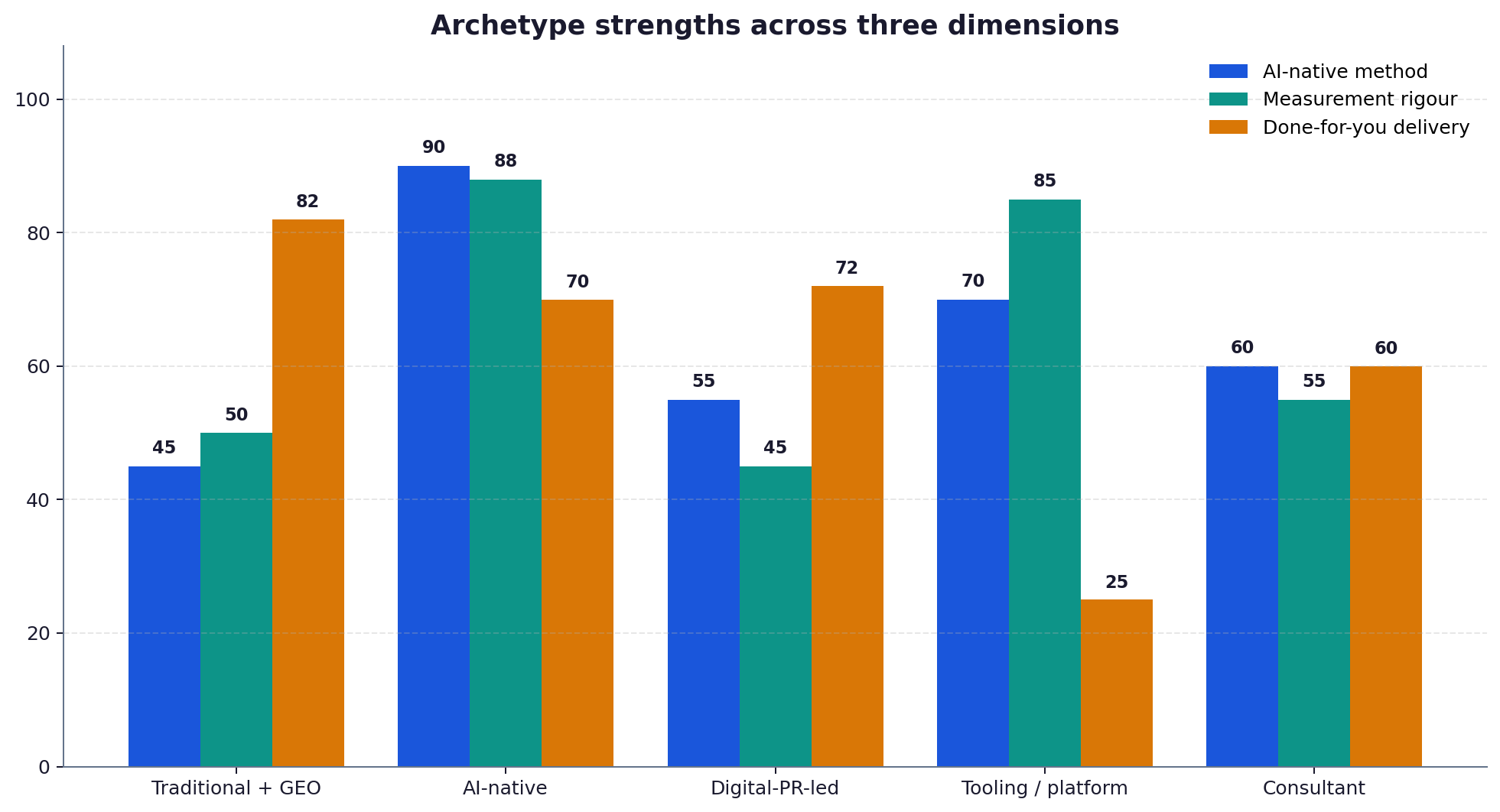
The traditional SEO agency with a GEO add-on brings real technical foundations and existing client relationships, which matters because GEO extends SEO rather than replacing it. Its blind spot is measurement: AI visibility is often bolted onto an SEO dashboard without engine-specific citation tracking. The AI-native specialist is built around AI citation and usually has the sharpest measurement, but can be light on the classic-SEO fundamentals that still underpin what engines retrieve. The digital-PR-led firm excels at the entity and authority building that gets a brand mentioned, and its blind spot is on-page and technical structure. The tooling or platform vendor gives you visibility data cheaply and at scale, but hands you the work of acting on it. The independent consultant offers senior attention and flexibility, with capacity and continuity as the natural limits.
Matching archetype to what you actually need
The map only pays off when you match it to your own gap. A firm with strong content but a weak brand presence in AI answers usually needs the entity and authority work a digital-PR-led vendor does best. A firm with brand recognition but thin, poorly-structured pages needs the technical depth of an AI-native specialist or a strong traditional agency. A firm that mainly lacks visibility into where it stands can start with a tooling vendor and buy services later. Buying the wrong archetype for your gap is the most common and most expensive mistake, because a capable vendor working on the wrong problem still bills.
The proof questions that cut through any pitch
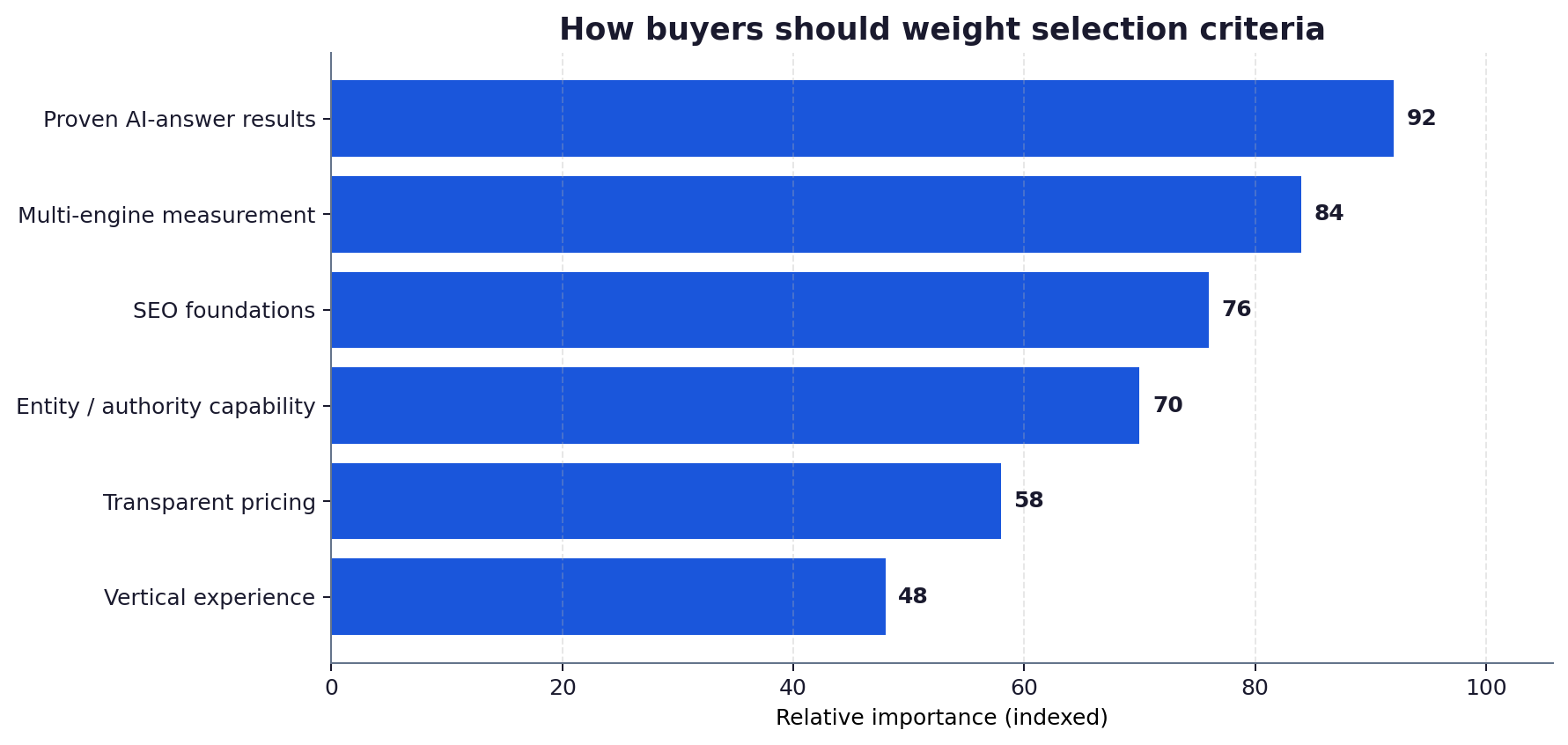
Whatever the archetype, the same small set of questions separates capability from confidence. Ask for concrete examples of clients appearing in AI-generated answers, with the query and the engine named, not screenshots of a rankings dashboard. Ask which engines they measure, since the roughly 11% domain overlap between ChatGPT and Perplexity means single-engine work leaves most of the surface uncovered. Ask how they measure citation over repeated runs rather than one lucky screenshot. Ask how they build entity authority, and how they structure content for retrieval. A vendor that answers these plainly is worth a shortlist place regardless of archetype. One that redirects to traffic or ranking metrics is selling the old product with a new label.
Where the market is heading
Two shifts are coming. First, the archetypes will converge, as traditional agencies build genuine AI-native measurement and specialists shore up their SEO foundations, because buyers increasingly want both. Second, proof will get harder to fake as measurement tooling spreads and buyers learn to ask for repeated-run citation evidence rather than one-off screenshots. The vendors that thrive will be the ones that can show durable, multi-engine citation results for named queries. For a buyer today, that direction of travel is a reason to weight measurement rigour and multi-engine capability heavily, because they are exactly the capabilities the market is about to compete on.
Frequently asked questions
What are the main types of AI SEO company in the UK?
Five archetypes cover most of the market: the traditional SEO agency with a GEO add-on, the AI-native specialist built around AI citation, the digital-PR-led firm focused on entity and authority, the tooling or platform vendor that sells visibility data, and the independent consultant. Each has a natural strength and a predictable blind spot. Placing a vendor into an archetype gives you a fast, reliable read on what it is good at before you invest time in a sales process.
Why does this landscape map name no specific firms?
Because named lists date quickly in a market this young and are often written by the firms that appear on them, which makes them marketing rather than guidance. The archetypes and the two axes, method and engagement, let you place any vendor yourself, including ones no list mentions, and they stay useful as firms enter, exit and reposition. A structure you can apply is more durable and more honest than a ranked shortlist you have to trust.
How do I choose the right archetype for my business?
Match the archetype to your specific gap. If your content is strong but you are absent from AI answers, you likely need the entity and authority work a digital-PR-led firm does best. If you have brand recognition but thin, poorly-structured pages, you need the technical depth of an AI-native specialist or a strong traditional agency. If you mainly lack visibility into where you stand, start with a tooling vendor. Buying a capable vendor for the wrong problem is the costliest common mistake.
What questions separate a real AI SEO vendor from a confident one?
Ask for concrete examples of clients appearing in AI answers, with the query and engine named, not rankings screenshots. Ask which engines they measure, since ChatGPT and Perplexity share only about 11% of cited domains. Ask how they measure citation across repeated runs rather than one screenshot, how they build entity authority, and how they structure content for retrieval. Plain, specific answers signal capability. Redirecting to traffic or ranking metrics signals the old product relabelled.
Is AI SEO different from traditional SEO?
It extends it rather than replacing it. GEO relies on many of the same foundations, technical health, quality content, structured data, so a credible vendor needs classic-SEO competence as well as AI-specific method and measurement. What is genuinely new is engine-specific citation tracking, entity authority building for AI answers, and multi-engine coverage. A vendor that has only the old skills, or only the new language without the foundations, is missing half the job.
Why is measuring AI visibility so hard for buyers?
Because the tools are new and the surface is unstable. Semrush found about 45% of marketing leaders cannot measure brand visibility in AI answers and only around 9% track it across platforms. Answers also change run to run and differ by engine, so a single check is unreliable. That measurement gap is exactly why buyers struggle to evaluate vendors, and why weighting a vendor’s measurement rigour and multi-engine coverage heavily is a sensible defence.
Sources and references
- The best generative engine optimisation agencies in the UK (2026). Passion Digital, 2026
- Semrush releases expanded 2026 AI Visibility Index, analysing 126 million AI search prompts. Semrush, 2026
- Generative engine optimisation: the 2026 UK strategy guide. GrocLiq, 2026
- Most-cited domains across AI answer engines. Profound, 2026
- GEO: Generative Engine Optimization. arXiv (Aggarwal et al.), 2023
- Which sources AI Overviews and chat engines cite. Search Engine Land, 2026
Get your baseline before you brief a vendor: which engines cite you, and where the gap is.
Change log
- 2026-07-14: Initial publication.