
TL;DR
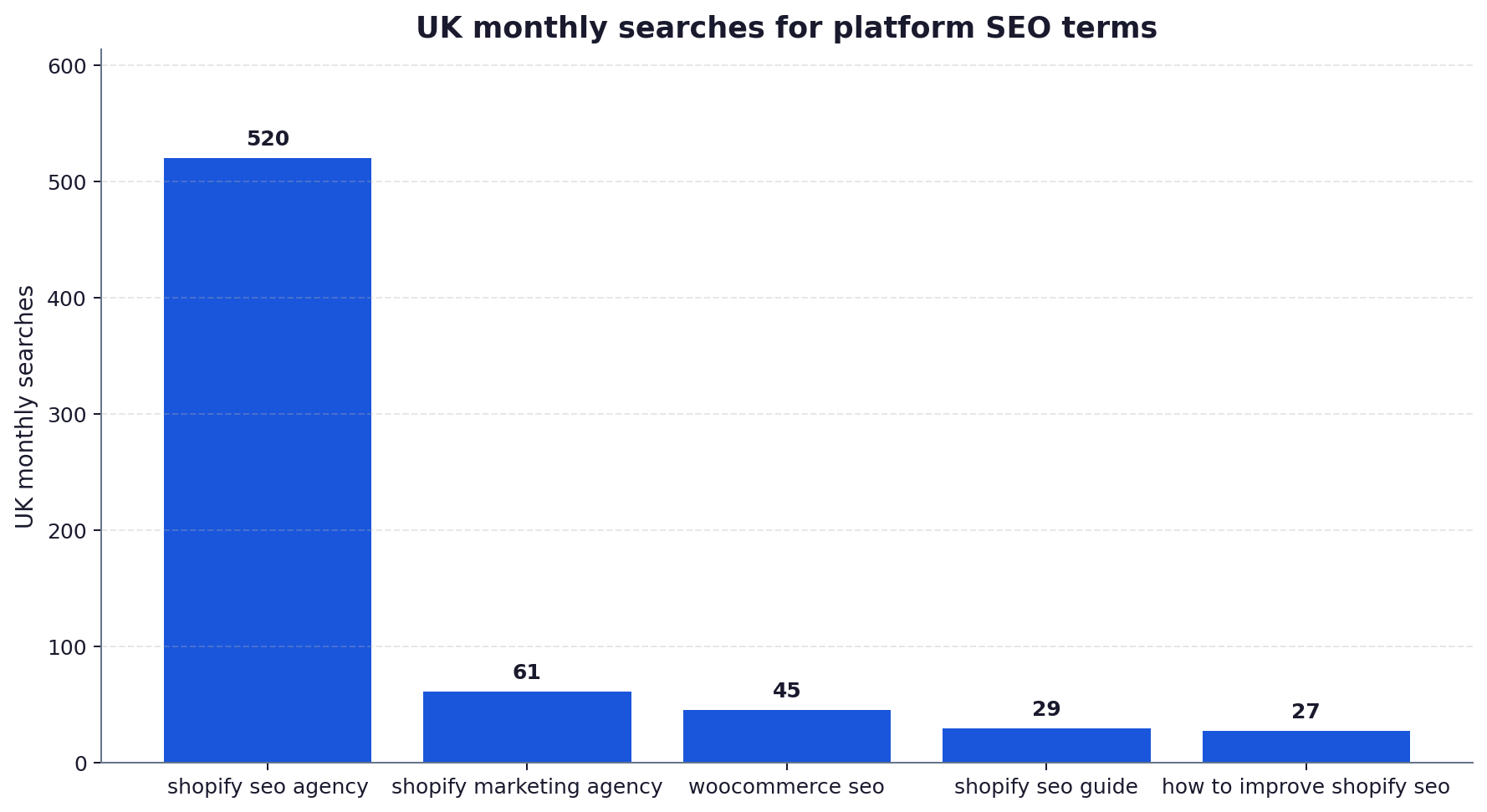
- UK research demand is lopsided. shopify seo agency records 520 searches a month against 45 for woocommerce seo, roughly a 12 to 1 gap in people looking for help (AiBoost analysis of DataForSEO Google Ads data, 11 and 12 September 2026).
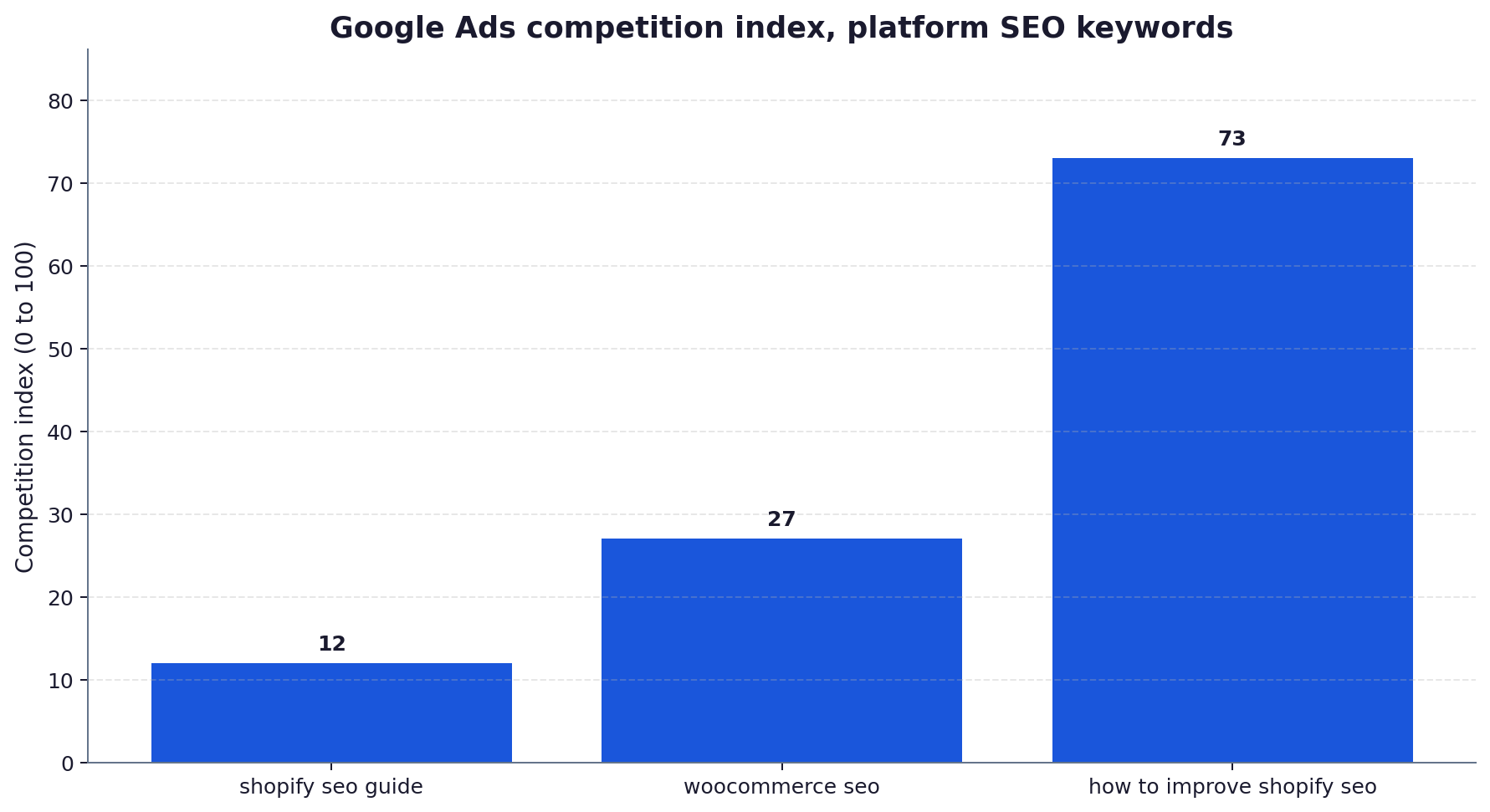
- The competition split inside the Shopify cluster is the interesting part: shopify seo guide is LOW at a competition index of 12, while how to improve shopify seo is HIGH at 73. The commercial phrasing is contested and the informational phrasing is not.
- The real differences are structural, not feature-list differences. URL structure, filter behaviour and how much of the template you control account for most of what changes in practice.
- Shopify fixes your URL shape around /products/, /collections/, /pages/ and /blogs/. WooCommerce lets you define the permalink structure yourself, including removing the product base entirely.
- Shopify hands you managed hosting and a CDN. WooCommerce hands you responsibility for both, which is an advantage only if somebody is actually taking it.
- Neither platform ranks better than the other. What differs is which mistakes are easy to make and which are impossible.
Key facts
- woocommerce seo: 45 UK searches a month, LOW competition, competition index 27 of 100, £11.83 CPC, top-of-page bids £4.31 to £11.12 (AiBoost analysis of DataForSEO Google Ads data, 12 September 2026).
- shopify seo guide: 29 UK searches a month, LOW competition, competition index 12. Same pull.
- how to improve shopify seo: 27 UK searches a month, HIGH competition, competition index 73, top-of-page bids £3.19 to £24.67. Same pull.
- shopify seo agency: 520 UK searches a month, LOW competition, £21.20 CPC (companion 18-term run, 11 September 2026).
- shopify marketing agency: 61 UK searches a month, HIGH competition, £19.78 CPC. Same companion run.
- Shopify collection URLs expose the same product at /collections/name/products/name as well as /products/name, which is why canonical handling is a first-week check on any Shopify audit.
What the demand data says before either platform does
The UK numbers are one-sided in a way that surprises people who spend their days in WordPress. Shopify seo agency records 520 searches a month at LOW competition and a £21.20 cost per click, while woocommerce seo records 45 at LOW competition and £11.83. That is roughly twelve times as many UK businesses looking for Shopify help as WooCommerce help.
Inside the Shopify cluster the split is more interesting than the totals. Shopify seo guide sits at 29 searches a month with a competition index of 12 out of 100, which is close to uncontested. How to improve shopify seo sits at 27 a month, effectively the same volume, but carries a competition index of 73 and a top-of-page bid range stretching to £24.67. The same demand, the same topic, wildly different commercial pressure, because the second phrasing signals a merchant with a problem and a budget.
None of that tells you which platform is better. It tells you where the market’s attention is, and it is a reminder that platform choice is usually made for commercial reasons and then lived with for SEO reasons.
URL structure is the difference that shapes everything else
Shopify fixes the shape of your URLs. Products live under /products/, collections under /collections/, static pages under /pages/ and articles under /blogs/. You choose the handle at the end; you do not choose the segment in front of it. The consequence merchants meet first is that a product reachable through a collection is also reachable at /collections/the-collection/products/the-product, so the same item has more than one address and canonical handling has to be right.
WooCommerce takes the opposite position. Permalink structure is configurable, the product base can be changed or removed, category bases can be rewritten, and nothing stops you building a URL hierarchy that mirrors how customers actually think about the catalogue. That freedom is genuinely useful and it is also how sites end up with three overlapping taxonomies and a crawl budget spent on attribute archives nobody wanted indexed.
In both cases the discipline is the same: decide which address is the canonical one for each sellable item and make every other route agree with it. Google’s canonicalisation documentation is the reference, and the platform only changes how the problem presents itself. We go further into the page-level side of this in ecommerce SEO for UK online shops.
Filters and faceted navigation
This is where the platforms diverge most in daily practice. WooCommerce filtering generally produces parameterised URLs or attribute archive pages, and those archives are indexable unless somebody decides otherwise. A shop with colour, size, material and brand attributes can expose a very large number of thin pages without anyone choosing to.
Shopify’s native filtering is narrower and often extended by apps, which changes the failure mode rather than removing it. Instead of a sprawl of attribute archives you tend to get parameter combinations layered onto collection URLs, sometimes rendered client-side, sometimes not crawlable at all. Both outcomes are problems, and they are different problems.
The decision to make is identical on either platform. Work out which filter combinations are a page a customer would genuinely search for, give those a real indexable URL with their own title and copy, and consolidate everything else. What differs is the mechanism you reach for: rewrite rules and robots directives on WooCommerce, theme and app configuration on Shopify.
How much of the template and server you control
WooCommerce runs on your WordPress install on your hosting, so you can change anything: template output, server headers, redirects at the web-server level, caching strategy, and whatever schema you want emitted wherever you want it. That control is why developer-heavy retailers prefer it, and it is also why a WooCommerce site with nobody maintaining it degrades in ways a hosted platform cannot.
Shopify gives you the theme layer through Liquid and an editable robots file, and keeps the rest. Checkout in particular is Shopify’s, with customisation limited on standard plans. For most merchants that trade is favourable: fewer levers, fewer ways to break something, no server to patch. For a retailer with genuinely unusual requirements it is a ceiling, and it is better to meet that ceiling before migrating than after.
The practical test is whether you have a developer. A platform that permits everything is a liability without one, and a platform that permits little is a constraint with one. Our view on how much of this belongs in the build rather than in an SEO retainer is set out in our ecommerce website builds, and the general argument for treating the platform as an SEO decision is in why every business needs a CMS.
Performance and hosting
Shopify is managed hosting with a content delivery network in front of it, so baseline performance is decent without anyone thinking about it, and the ceiling is largely set by how heavy a theme and app stack you have added. App creep is the real performance risk on Shopify: each one adds script, and nobody removes the ones that stopped being used.
WooCommerce performance is whatever your hosting, caching and plugin discipline make it. A well-run WooCommerce site can be faster than a Shopify site carrying fifteen apps. A neglected one is usually slower than anything hosted. The variable is maintenance, not the platform.
Measure rather than assume, against Core Web Vitals on your actual product template rather than on the homepage, because the homepage is the page least representative of what a shopper loads. Ongoing upkeep is the part people underestimate, which is the case we make in website maintenance.
Structured data and product feeds
Both platforms can emit correct Product markup and both can emit wrong Product markup. Shopify themes vary in what they output and frequently need the review aggregate corrected, because a site-wide seller rating printed on a product page is not what Google’s Product structured data documentation asks for. WooCommerce sites often carry two plugins emitting overlapping markup, which produces conflicting claims about the same item.
Feeds behave the same way. Shopify generates a product feed through its sales channels with limited control over field mapping; WooCommerce generates one through a plugin with a great deal of control and a corresponding capacity to be misconfigured. Either way the feed is where price and stock accuracy is enforced, and it is increasingly where AI assistants read from as well, a point covered in our post on ChatGPT shopping and in getting your products into AI recommendations.
The check that finds most problems takes ten minutes: open one product page, read the markup, and confirm that the price, availability and review aggregate in it match what the page shows a customer. Mismatches are common on both platforms and they are the kind of error that quietly disqualifies a listing.
So which one is better for SEO
Neither, and any answer that picks one without asking about your catalogue is selling something. What can be said usefully is which failure modes each platform makes easy. Shopify makes duplicate collection and product routes easy, app-driven performance decay easy, and structural customisation hard. WooCommerce makes uncontrolled attribute archives easy, plugin conflict easy, and neglect expensive.
Choose on commercial fit: catalogue complexity, team capability, integration requirements, and whether you have development capacity. Then budget for the specific weakness of whichever you pick, because that weakness is predictable and therefore cheap to manage. A migration undertaken for SEO reasons alone almost never pays back, since the cost of getting every redirect right usually exceeds the gain from a tidier URL structure. An ecommerce SEO agency worth paying will tell you when the answer is to stay put and fix what you have, and the wider economics for smaller retailers are in whether SEO is worth it for small businesses. Shopify’s own SEO documentation and the WooCommerce documentation are both worth reading before you commit either way.
How we compiled the numbers
Search volumes, competition labels, competition indices, cost per click and top-of-page bid ranges come from a single AiBoost request to DataForSEO’s Google Ads search volume endpoint on 12 September 2026, location United Kingdom, language English, covering 48 keywords in one session. The shopify seo agency and shopify marketing agency figures come from a companion 18-keyword run on 11 September 2026 using the same endpoint, location and language. Search volumes in this dataset are twelve-month averages, and on half the keywords we checked the September 2025 reading runs at three times the median of the other eleven months or more, which inflates every headline average. Every volume quoted in this post is therefore the corrected mean of the eleven months excluding September 2025, not the figure the source reports as its headline. Currency values are reported as returned. Platform behaviour described in this post is drawn from the vendors’ own current documentation and from hands-on work on both platforms, with no benchmark or ranking claim attached to either.
Limitations
Google Ads search volumes are rounded buckets rather than exact counts, and they measure advertiser demand rather than organic difficulty. A competition label describes the paid auction, so HIGH competition on how to improve shopify seo tells you advertisers are contesting that phrasing, not that the organic result is hard to win. Two terms under 30 searches a month are close enough that the rounding could reverse their order.
We did not run a controlled comparison of the two platforms, we did not measure ranking outcomes across a sample of UK Shopify and WooCommerce sites, and we publish no performance benchmarks here because we have not measured any for this comparison. Platform capabilities change with releases: treat every behavioural statement as accurate on the date of publication. Search demand for a platform reflects its market share and its support culture as much as its SEO qualities, so the 12 to 1 gap in research demand should not be read as a verdict on either product.
Frequently asked questions
Is Shopify or WooCommerce better for SEO?
Neither by default. The differences that matter are structural: Shopify fixes your URL shape and manages hosting, while WooCommerce gives you full control of permalinks, templates and server configuration along with full responsibility for them. Each platform makes different mistakes easy. Choose on commercial fit and catalogue complexity, then budget for the specific weakness of whichever you pick.
How many UK businesses look for Shopify SEO help?
Far more than look for WooCommerce help. In AiBoost’s analysis of DataForSEO Google Ads data, shopify seo agency records 520 UK searches a month (11 September 2026 run) against 45 for woocommerce seo (12 September 2026 run), which is roughly a 12 to 1 gap. That reflects market share and support culture as much as any SEO property of either platform.
Why does Shopify create duplicate product URLs?
Because a product reachable through a collection is addressable both at /products/the-product and at /collections/the-collection/products/the-product. That is by design rather than a bug, and it means canonical handling has to be correct for every product in every collection. Checking it is a first-week task on any Shopify audit, and it is one of the few platform-specific checks that genuinely has no WooCommerce equivalent.
What is the biggest SEO risk on WooCommerce?
Uncontrolled attribute archives and filter URLs. Colour, size, material and brand attributes each generate archive pages that are indexable unless someone decides otherwise, so a moderate catalogue can expose a large number of thin pages without anybody choosing to publish them. The second risk is plugin conflict, particularly two plugins emitting overlapping structured data about the same product.
Should I migrate from WooCommerce to Shopify for SEO reasons?
Rarely. A migration undertaken purely for SEO seldom pays back, because the cost and risk of getting every redirect right usually exceeds the gain from a tidier URL structure. Migrate for commercial reasons such as operational fit, team capability or integration requirements, and treat the SEO work as something you scope carefully into that project rather than as the justification for it.
Which platform handles product structured data better?
Both can do it correctly and both routinely do it wrong. Shopify themes vary in what they emit and often print a site-wide seller rating where a product-level review aggregate belongs. WooCommerce sites frequently run two plugins producing overlapping markup. The reliable check is the same on either: open a product page, read the markup, and confirm the price, availability and review aggregate match what the customer sees.
Does Shopify’s managed hosting make it faster?
It makes the baseline better and the ceiling lower. Shopify’s content delivery network means a stock theme performs reasonably without anyone tuning it, but every added app contributes script, and app creep is the commonest cause of a slow Shopify shop. A maintained WooCommerce site on good hosting can be faster. The variable is maintenance rather than the platform.
Can I control robots and redirects on Shopify?
You can edit the robots file through the theme layer and you can create URL redirects in the admin, so the everyday tasks are covered. What you do not get is server-level control: no web-server rewrite rules, no custom response headers of your own, and limited checkout customisation on standard plans. If your requirements need any of those, establish it before migrating rather than afterwards.
Sources and references
- Google Ads search volume, competition and CPC data for 48 UK keywords. DataForSEO, 2026
- Canonicalization and consolidating duplicate URLs. Google Search Central, 2026
- Product (Product, Review, Offer) structured data. Google Search Central, 2026
- Shopify SEO documentation. Shopify, 2026
- WooCommerce documentation. WooCommerce, 2026
- Web Vitals. web.dev, 2026
AiBoost works on both platforms and will tell you when the right answer is to stay where you are and fix what you have. Ask us to review your catalogue structure before you commit to a migration.
Change log
- 2026-09-23: Initial publication.
- 2026-09-12: Search volumes restated as corrected twelve-month means excluding an anomalous September 2025 reading in the source data. Cost per click and competition figures unchanged.
