
TL;DR
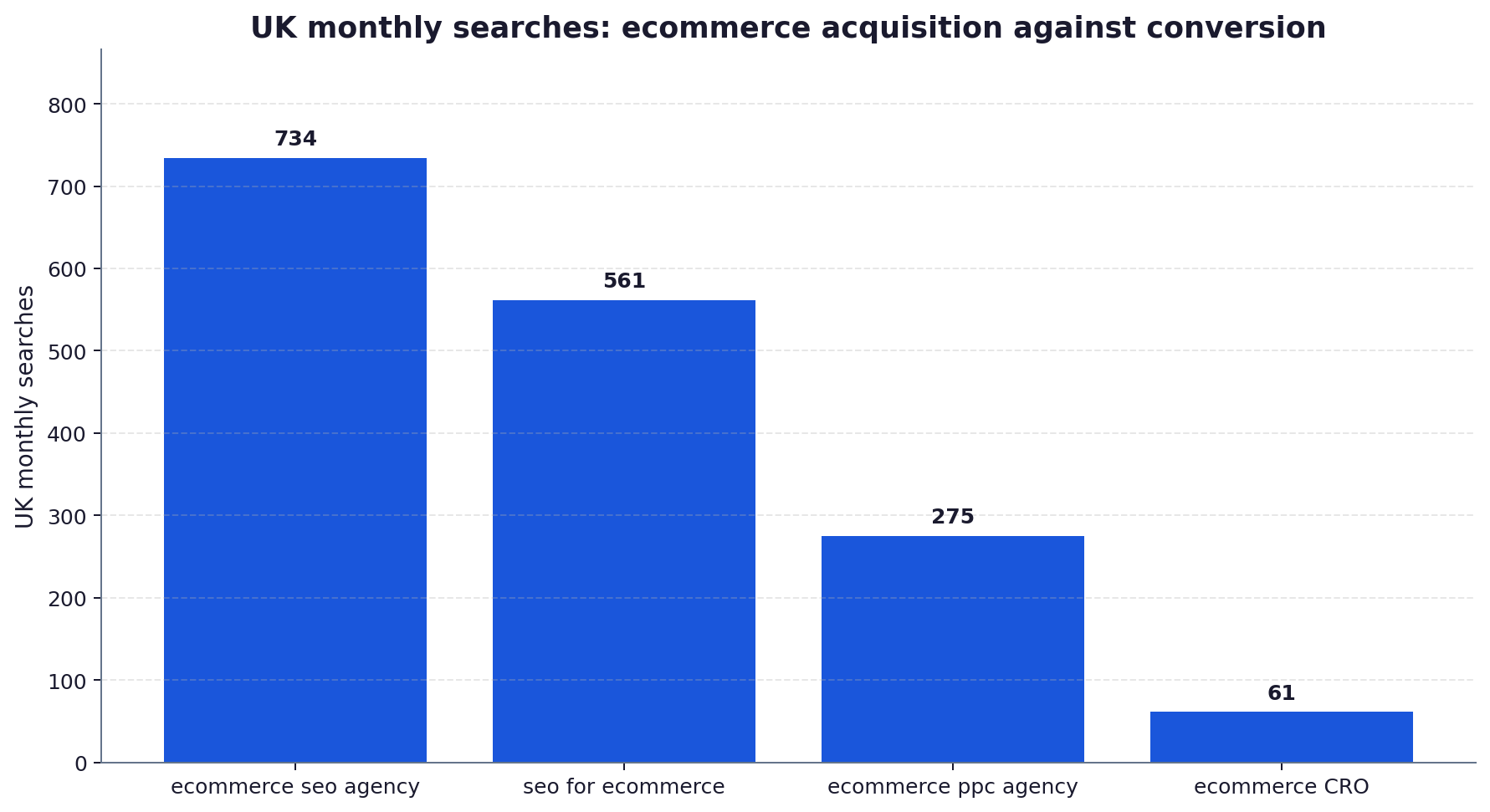
- UK businesses research how to buy traffic roughly sixteen times more often than they research how to convert it. ecommerce seo agency records 734 searches a month and ecommerce ppc agency 275, against 61 for ecommerce conversion rate optimisation (AiBoost analysis of DataForSEO Google Ads data, 11 and 12 September 2026).
- Baymard Institute’s average documented cart abandonment rate is 70.22%, calculated across 50 separate studies. Roughly seven in ten carts never become orders.
- Baymard’s own research puts “too long or complicated checkout process” behind abandonment for 17% of US online shoppers, and “just browsing, not ready to buy” for 42%. Those two numbers should be read together: most abandonment is not fixable, and a real slice of it is.
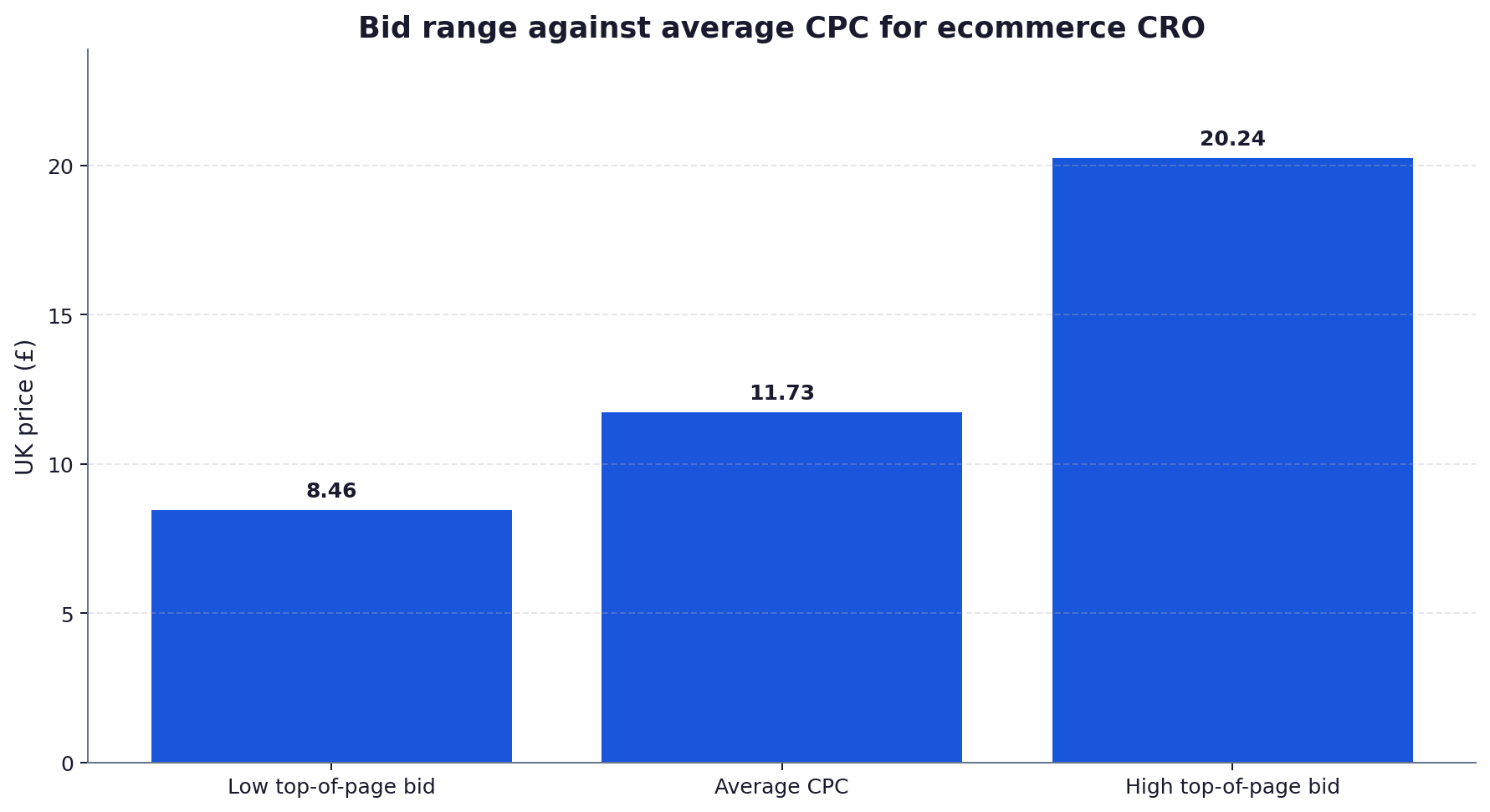
- The CRO keyword itself is MEDIUM competition at a competition index of 55, with a top-of-page bid range of £8.46 to £20.24 and an £11.73 average CPC. It is contested, and it is still cheap next to acquisition terms.
- Conversion work compounds with every channel at once. A checkout fix raises the return on organic, paid, email and AI-assistant traffic in the same week.
- Measure before you redesign. Most checkout redesigns are launched without a baseline, which makes the result unreadable whichever way it goes.
Key facts
- ecommerce conversion rate optimisation: 61 UK searches a month, MEDIUM competition, competition index 55 of 100, £11.73 average CPC, top-of-page bids £8.46 to £20.24 (AiBoost analysis of DataForSEO Google Ads data, 12 September 2026).
- ecommerce seo agency: 734 UK searches a month, LOW, £25.59 CPC (companion 18-term run, 11 September 2026).
- ecommerce ppc agency: 275 UK searches a month, MEDIUM, £68.17 CPC, the highest CPC in the 48-keyword pull.
- Baymard Institute: 70.22% average documented online shopping cart abandonment rate, averaged across 50 studies (Baymard Institute, list last updated September 2025).
- Baymard Institute: 17% of US online shoppers report abandoning an order because of a checkout process that was too long or complicated; 42% report abandoning because they were browsing and not ready to buy.
- The full UK ecommerce marketing cluster measured across 18 terms totals roughly 2,580 searches a month, of which conversion accounts for 61.
Everybody researches traffic, almost nobody researches conversion
Set the UK numbers side by side and the imbalance is hard to miss. Ecommerce seo agency draws 734 searches a month, ecommerce ppc agency 275 and seo for ecommerce 561. Ecommerce conversion rate optimisation draws 61. Across the wider 18-term ecommerce cluster totalling roughly 2,580 monthly searches, conversion accounts for a single small slice.
That is a market telling you where its attention goes. Retailers who are unhappy with revenue look for someone to bring more people, which is a reasonable instinct and an expensive one when the shop those people arrive at loses seven of every ten carts. The conversion term is also MEDIUM competition at an index of 55, which tells you the advertisers who have noticed the gap are already bidding on it.
The arithmetic is the part worth sitting with. A shop converting at 1.5 per cent that reaches 1.8 per cent has increased revenue by a fifth with no additional media spend, no new content and no new suppliers. The same twenty per cent bought through paid search at the prices in what ecommerce PPC costs in the UK is a permanent line on the invoice rather than a one-off piece of work.
What the abandonment research actually says
Baymard Institute’s cart abandonment list puts the average documented rate at 70.22 per cent, calculated across 50 separate studies rather than from a single vendor’s panel. That is the honest headline: roughly seven in ten carts do not become orders, across the industry, consistently, for years.
The more useful figures are underneath it. Baymard’s research records that 42 per cent of US online shoppers have abandoned a cart because they were browsing and not ready to buy, while 17 per cent have abandoned an order because the checkout process was too long or complicated. Those two numbers do different jobs. The first says most abandonment is normal shopping behaviour and no amount of design will recover it. The second says close to one in five shoppers has walked away from a process rather than from a product.
Note the population: these are US shoppers, and we have not seen an equivalently rigorous UK-specific figure to set against them. The pattern is likely to travel; the exact percentages should not be quoted as if they were measured in Britain. What survives the caveat is the shape of the problem, which is that a meaningful and addressable slice of lost revenue sits inside a process you control completely.
Five checkout frictions worth fixing before anything else
Unexpected cost at the final step is the classic. If delivery, surcharges or a minimum order value appear for the first time on the payment screen, you have invited someone to reconsider at the worst possible moment. Show the delivery cost, or the threshold that removes it, from the basket onwards.
Forced account creation is the second. A guest checkout that asks for what you need to fulfil the order, with an optional account offered after payment, removes a decision from the critical path. The account is worth having; it is not worth losing the order for.
Form length is the third, and it is usually the most over-engineered part of the shop. Every field is a chance to stop. Ask what is legally and operationally required, then remove the rest, and use address lookup rather than five separate inputs.
The fourth is payment choice. UK shoppers expect the wallet they already use to be there, and a checkout offering only card entry is asking for more typing than the alternatives. The fifth is error handling: a validation failure that clears the form, loses the entered card details or fails to say which field is wrong converts a minor irritation into an abandoned order. Test your own checkout with a deliberately wrong postcode and see what happens.
Mobile is the default, and it is where the numbers come apart
Most UK retail sessions arrive on a phone and most checkout designs are still reviewed on a laptop. The difference shows up in small, specific places: a keyboard covering the field being typed into, a numeric field that summons a full alphabetic keyboard, a fixed header eating a third of the viewport, a payment button below the fold on a 5.5 inch screen.
Speed is part of the same story. Payment and basket pages are frequently the heaviest on a retail site because they load third-party scripts, and they are the pages where a delay costs most. Measure them specifically against Core Web Vitals rather than measuring the homepage and assuming, because the homepage is the page least like the one that takes the money.
The review that finds the most is also the cheapest. Take your own phone, on mobile data rather than office wifi, and buy something from your own shop. Do it with a card you will actually be charged on. Most teams discover at least one thing they had never seen on a desktop.
Measure before you redesign
The commonest CRO mistake is not a bad hypothesis. It is launching a redesign with no baseline, so the result cannot be read whichever direction it moves. Before changing anything, record the completion rate at each step from product page to basket, basket to checkout, checkout to payment and payment to confirmation, split by device.
That funnel does two things. It tells you where the loss is concentrated, which is frequently not where the team assumed, and it gives you the comparison that makes a later change interpretable. Without it you are left arguing about whether a quiet fortnight was the design or the weather.
Be careful about what your analytics actually counts. If the conversion value recorded in the ads platform disagrees with the order value in the shop, every automated bidding decision downstream inherits the error, and so does every conclusion you draw about which channel deserves more budget. Reconciling the two is dull and it is the highest-return hour in most retail accounts. The same discipline applies to assistant-driven visits, which are covered in tracking AI-driven traffic and conversions.
Trust, delivery and returns are conversion features
UK shoppers abandon on uncertainty as readily as on friction. Delivery timing stated vaguely, a returns policy that has to be hunted for, no company address, no phone number, and a payment page that looks different from the rest of the site all read as risk to somebody spending real money with a shop they do not know.
Some of this is a legal obligation rather than a design preference. The UK rules for online and distance selling require specific information to be given before an order is placed, and the guidance on returns and refunds sets out the cancellation rights that apply. Publishing that information clearly is compliance and conversion in the same action, which makes it unusually good value.
It also feeds visibility. Clear delivery, returns and contact information is exactly the material an assistant reaches for when a shopper asks whether a retailer is trustworthy, and shops that state it plainly are easier to recommend than shops that bury it. The same corroboration logic runs through how AI assistants decide which products to recommend.
Where conversion work fits in the plan
Run it before the next budget increase, not after. A checkout fix multiplies across organic, paid, email, social and assistant-driven traffic simultaneously, which no acquisition channel does for any other channel. That is the whole argument for sequencing it first.
Then keep the two connected. The landing experience is where conversion and acquisition meet, and a campaign pointed at a page that was never designed to convert wastes media budget at landing page level rather than at auction level. Our guides to building a high-converting landing page and using CTA buttons well cover the page-level mechanics, and A/B testing covers how to tell whether a change did anything.
Finally, treat conversion as part of the same programme as organic growth rather than as a separate discipline bought from a separate supplier. The product page work in ecommerce SEO for UK online shops is conversion work as much as ranking work, which is why an ecommerce SEO agency that cannot talk about your checkout is only doing half the job.
How we compiled the numbers
Search volumes, competition labels, competition indices, cost per click and top-of-page bid ranges come from a single AiBoost request to DataForSEO’s Google Ads search volume endpoint on 12 September 2026, location United Kingdom, language English, covering 48 keywords in one session. The ecommerce seo agency, seo for ecommerce and 2,580-search cluster figures come from a companion 18-keyword run on 11 September 2026 using the same endpoint, location and language. Search volumes in this dataset are twelve-month averages, and on half the keywords we checked the September 2025 reading runs at three times the median of the other eleven months or more, which inflates every headline average. Every volume quoted in this post is therefore the corrected mean of the eleven months excluding September 2025, not the figure the source reports as its headline. Currency values are reported as returned. The abandonment figures are quoted directly from Baymard Institute’s published cart abandonment list and its stated research findings, with the population and study count named rather than summarised.
Limitations
Google Ads search volumes are rounded buckets rather than exact counts, and they measure advertiser demand rather than organic difficulty, so a competition label describes the paid auction only. Search demand for a topic is a proxy for attention, not for spending: businesses may be doing conversion work without searching for it, and the sixteen-to-one gap described here should be read as an attention signal rather than a budget measurement.
Baymard’s 70.22 per cent average is drawn from 50 studies of varying age, methodology and market, which is why we quote it as an average of documented studies rather than as the abandonment rate. The 42 per cent and 17 per cent figures are reported by Baymard for US online shoppers; we have not found an equivalently rigorous UK measurement and have not adjusted them. AiBoost ran no conversion experiment for this article, publishes no uplift benchmarks here because we have measured none for this sector, and the 1.5 to 1.8 per cent example is arithmetic used to illustrate a point rather than a result observed on any client account.
Frequently asked questions
What is ecommerce conversion rate optimisation?
It is the work of removing the reasons people who already intend to buy fail to complete the order: unexpected costs, forced account creation, over-long forms, missing payment options, poor error handling and unclear delivery or returns information. It is distinct from acquisition, which brings more people, and it compounds with every acquisition channel at once because all of them run through the same checkout.
What is a normal cart abandonment rate?
Baymard Institute’s average documented rate is 70.22 per cent, calculated across 50 separate studies. That figure is an average of published research rather than a target, and a good deal of what it contains is ordinary browsing behaviour rather than lost revenue. The addressable portion is the part attributable to process, which Baymard’s research associates with 17 per cent of US online shoppers reporting a checkout that was too long or complicated.
Should I fix conversion or buy more traffic first?
Conversion, in most cases. A checkout improvement raises the return on organic, paid, email and assistant-driven traffic simultaneously, which no acquisition channel does for any other channel. The exception is a shop with too little traffic to read any result from, where the first job is getting enough sessions for a funnel measurement to mean anything.
How much does ecommerce CRO cost in the UK?
The published data prices the market for the service rather than the work: ecommerce conversion rate optimisation carries an £11.73 average CPC in the UK with a top-of-page bid range of £8.46 to £20.24 (AiBoost analysis of DataForSEO Google Ads data, 12 September 2026). What an engagement costs depends on whether you need measurement, design, development or all three, and any quote given before somebody has seen your funnel is a guess.
What should I measure before changing the checkout?
Completion rate at each step, split by device: product page to basket, basket to checkout, checkout to payment, payment to confirmation. Record it for long enough to cover a normal trading pattern before you change anything. Without that baseline a redesign is unreadable, because you cannot separate the effect of the change from the effect of the week it launched in.
Does site speed affect conversion?
It affects it most on the pages that matter most, which are usually the heaviest. Basket and payment pages carry third-party scripts and are where a delay costs the most, so measure those specifically against Core Web Vitals rather than measuring the homepage and generalising. The homepage is the page least representative of what a buying customer actually loads.
Do delivery and returns policies really change conversion?
They change it and they are also a legal obligation in the UK. The rules for online and distance selling require specific information before an order is placed, and the guidance on returns and refunds sets out the cancellation rights that apply. Stating all of it clearly is compliance and conversion in one action, and it gives AI assistants something concrete to cite when a shopper asks whether a retailer is reliable.
How does conversion work relate to AI search visibility?
They draw on the same underlying material. Clear pricing, stated delivery timings, accurate stock status and an accessible returns policy are what convince a shopper and what an assistant quotes when asked to compare retailers. Work done for one generally serves the other, which is why we treat product page and checkout content as a single programme rather than as two separate projects.
Sources and references
- Cart abandonment rate statistics: 50 studies, 70.22% average documented rate. Baymard Institute, 2026
- Google Ads search volume, competition and CPC data for 48 UK keywords. DataForSEO, 2026
- Online and distance selling for businesses. GOV.UK, 2026
- Accepting returns and giving refunds: the law. GOV.UK, 2026
- Web Vitals. web.dev, 2026
AiBoost has audited 250+ UK small businesses, and the first question we ask a retailer planning more ad spend is where orders are currently lost between basket and confirmation. Ask us to review your checkout before the budget goes up.
Change log
- 2026-10-09: Initial publication.
- 2026-09-12: Search volumes restated as corrected twelve-month means excluding an anomalous September 2025 reading in the source data. Cost per click and competition figures unchanged.