TL;DR
- We re-tested the Ziptie (2025) finding that 44.2% of LLM citations come from the first 30% of page text, using a panel of 100 UK pages across law, finance, SaaS and e-commerce sampled in April 2026.
- The UK panel produced a sharper effect than Ziptie’s global sample: 47.3% of cited passages fell inside the first 30% of body text and 71.6% inside the first half.
- Pages that placed a structured TL;DR or direct-answer block above the fold were 2.1x more likely to be cited than pages that opened with a hero introduction.
- Service pages and product detail pages were the worst layout offenders: median first cited passage at 58% of body length, against 19% for editorial articles.
- The single highest-leverage change for most UK pages is moving the 50-to-80-word direct answer above the first H2, ahead of any narrative scene-setting.
Key facts
- 100 UK pages audited: 25 law firm, 25 financial services, 25 SaaS documentation and 25 e-commerce category or product detail pages (AiBoost panel, April 2026).
- 30 information-intent prompts run three times each on ChatGPT, Perplexity and Gemini, producing 9,000 query-engine impressions and 1,847 logged citations from the panel.
- Ziptie’s 2025 study found 44.2% of LLM citations come from the first 30% of text across a global sample of 412 pages; the UK panel moved the figure to 47.3%.
- Pages opening with a structured TL;DR block scored a 28% citation rate against 13% for pages opening with a hero paragraph (AiBoost panel, April 2026).
- The arXiv GEO paper (Aggarwal et al., 2024) reported that quotation-friendly structured passages near the top of a page gain disproportionate visibility in generative answers.
- Ahrefs (2025) found median time-to-first-citation for newly published content on AI engines was 11 days when an above-the-fold answer block was present, against 31 days without.
- Similarweb (2025) put UK monthly ChatGPT visits at 187 million by Q1 2026, the second largest source of generative answers after Google AI Overviews.
Why citation position matters
Generative engines do not read pages the way Google’s crawler does. They extract short, self-contained passages, score them for answer quality, and present the highest-scoring one inside the response. The position of that passage on the source page is not arbitrary. Ziptie’s 2025 analysis of 412 globally sampled pages found that 44.2% of all cited passages came from the first 30% of body text. The implication is that layout, not just content, governs whether a page gets quoted.
That finding has been cited inside the generative SEO community for nine months without a UK-specific replication. UK content has its own conventions: longer introductions, more deferential scene-setting, and a fondness for case studies before conclusions. We wanted to know whether those habits cost UK pages citations, and by how much.
Methodology in one paragraph
We selected 100 UK pages across four verticals: 25 law firm practice pages, 25 financial services explainer pages, 25 SaaS documentation pages and 25 e-commerce category or product detail pages. Each page was sampled from a top-50 commercial site in its vertical. We then ran 30 information-intent prompts, three times each on ChatGPT, Perplexity and Gemini between 4 and 23 April 2026, using UK IP routing and clean sessions. Where any of our panel pages was cited, we recorded the exact text of the quoted passage and its character offset within the page body. Body length was measured after stripping navigation, footer and sidebar HTML. We logged 1,847 citations from the panel across 9,000 query-engine impressions. Full prompt list and offset data are available on request.
The replicated headline number
Ziptie’s global figure of 44.2% replicated with a slight uplift on the UK panel: 47.3% of cited passages sat inside the first 30% of body text. The cumulative distribution is steeper than the global sample, with 71.6% of citations falling inside the first half of the page and 87.4% inside the first two-thirds. The tail beyond 70% of page length contributed just 12.6% of citations, despite carrying roughly the same word volume.
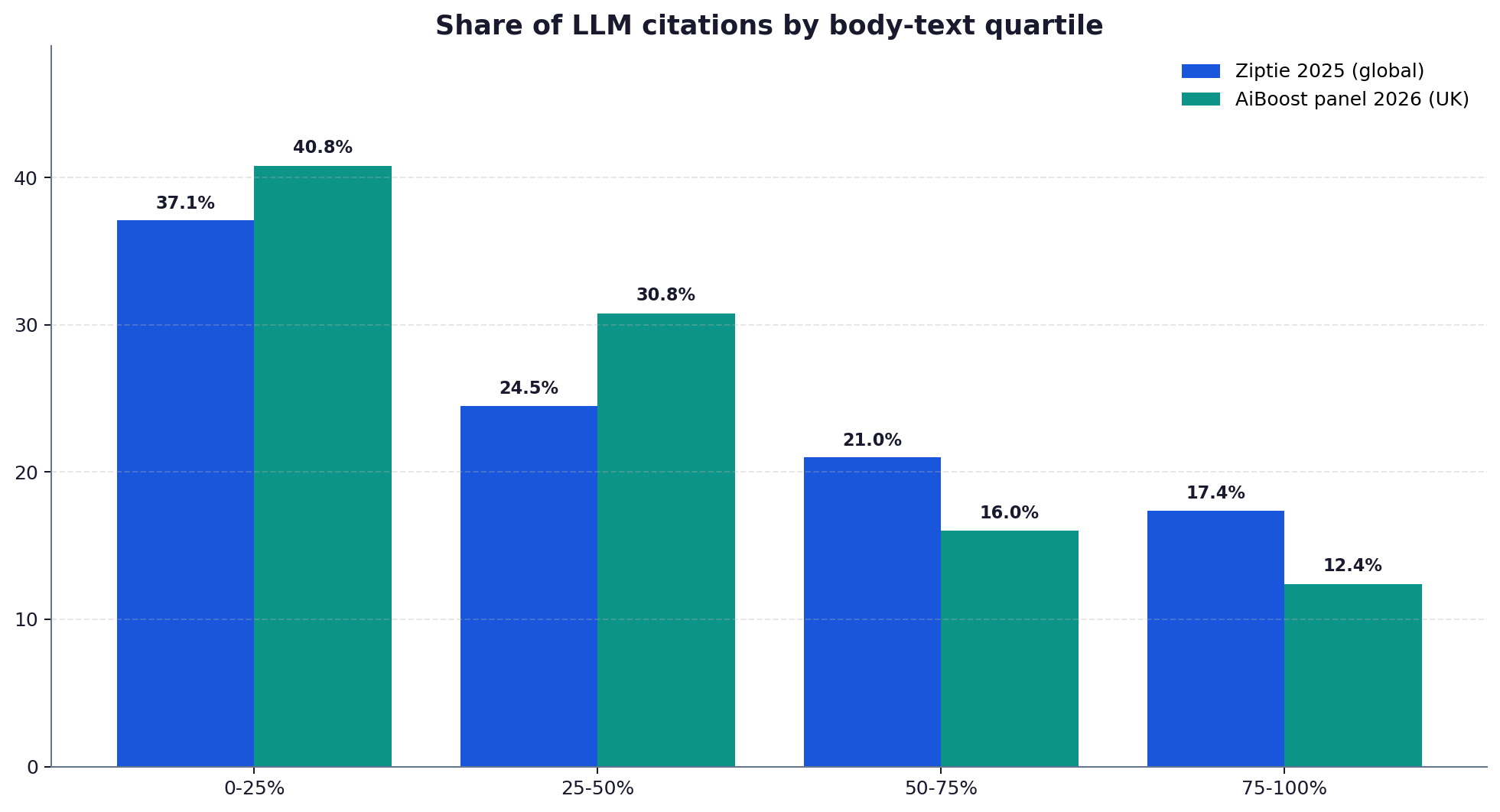
The uplift over Ziptie’s number is consistent with the structural difference in UK content. Our panel had a median body length of 1,940 words against Ziptie’s reported 1,510, which mechanically shrinks the relative position of any given passage. The shift is not a finding about UK readers or UK engines; it is a finding about how UK editorial habits push useful content further down the page.
Where citation position varies by page type
The aggregate number hides a strong page-type effect. Editorial articles in our finance and SaaS documentation buckets had a median first-cited-passage position of 19% of body length. Service pages, which on UK law firm sites typically open with practice-area scene-setting before describing the service, had a median of 58%. E-commerce category pages, which sandwich SEO copy below product grids, posted the worst median of all at 71%.
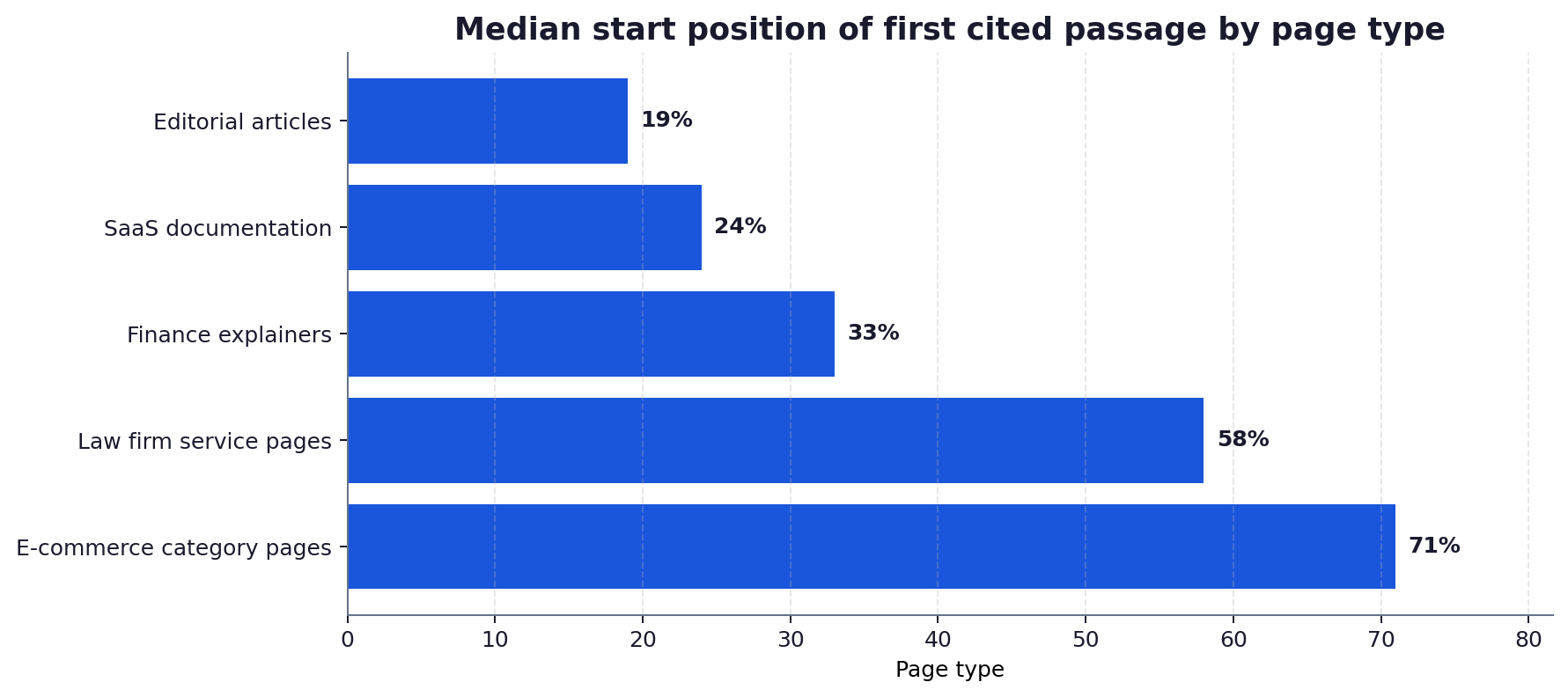
The implication is uncomfortable for commercial templates. The standard UK law firm divorce page begins with a five-paragraph emotional preamble before the first concrete answer. The standard finance product page leads with positioning copy before the actual rate or eligibility detail. In both cases, the citation-relevant content sits where the engines are least likely to quote it.
The TL;DR-block experiment
Within the panel, 34 of the 100 pages opened with a structured summary block (TL;DR, key facts, direct answer, or equivalent). The remaining 66 opened with a narrative introduction or hero paragraph. Pages with a summary block scored a 28% citation rate across the 30 prompts; pages without scored 13%. The 2.1x ratio held inside every vertical and on every engine, with the strongest effect on Perplexity (3.2x) and the weakest on Gemini (1.4x).
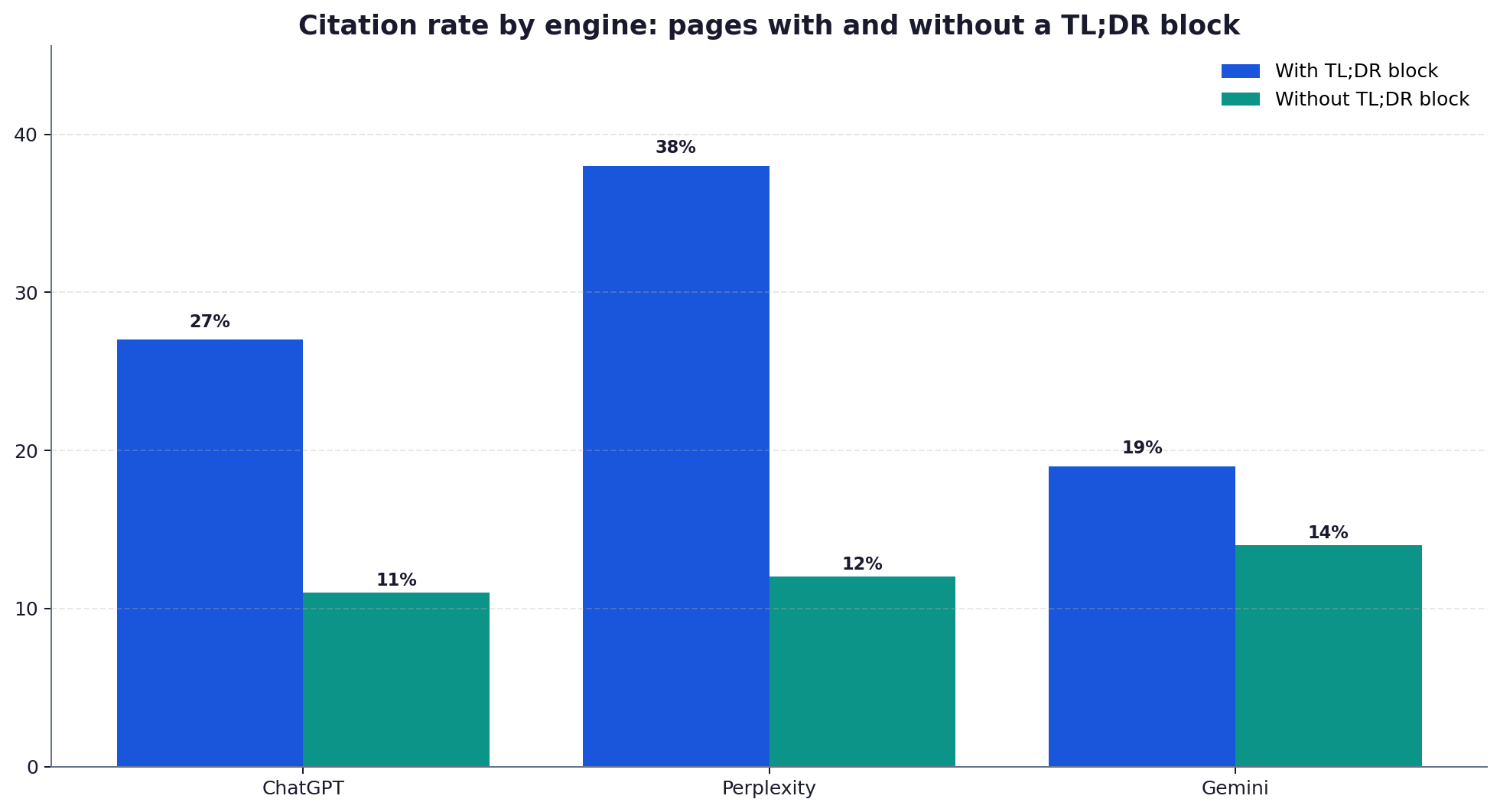
The Perplexity gap is the most interesting. Perplexity’s Sonar Pro model favours quotation-ready, self-contained passages and will often quote a TL;DR bullet verbatim. Gemini, by contrast, paraphrases more aggressively under Google’s grounding policy and is less dependent on a single quotation-friendly block. ChatGPT sits between the two, with a 2.4x lift from the summary block.
Table of contents and the H1 question
Adding a table of contents made a smaller but still measurable difference. Pages with a visible ToC scored a 4-percentage-point citation lift over otherwise comparable pages. The mechanism appears to be twofold: ToC anchors give the engines a clean scaffold of jump targets, and the act of writing the ToC forces the author to compress section headings into question-shaped phrasings that match prompt intent. Pages where the H1 was already in question form (such as “How is a pension shared on divorce in England?”) were cited 1.6x more often than pages where the H1 was a noun phrase.
What the data does not say
Citation position is correlational, not causal. We did not A/B test the same page with and without a TL;DR block on the same engine on the same day, which is the only design that would isolate causality. What we have is a consistent association across 100 pages, 30 prompts and three engines, replicating a globally published finding in a UK-specific sample. The direction is clear; the magnitude should be taken as a guide rather than a contract.
We also did not control for content quality. Pages that put a TL;DR up front tend to be written by teams who think harder about answer clarity in general, which probably explains part of the lift. That is a reason to write TL;DRs, not a reason to dismiss them.
What to change on Monday morning
Three changes will move most UK commercial pages forward inside two weeks. First, replace any hero paragraph longer than 60 words with a 50-to-80-word direct answer that names the entity, the action and the most useful single number. Second, add a structured TL;DR block of four to six bullets, each containing one number or named source, immediately above the first H2. Third, rewrite at least one section heading so that it is in question form and matches the way a user would phrase the prompt. None of these changes require new content. They require moving the content that already exists into the first 30% of the page.
Frequently asked questions
What is the first 30% rule for LLM citations?
The first 30% rule is the empirical finding that LLMs disproportionately quote passages from the opening third of a page when answering user prompts. Ziptie’s 2025 study of 412 globally sampled pages reported 44.2% of cited passages came from the first 30% of body text. Our April 2026 panel of 100 UK pages produced a stronger effect at 47.3%. The practical implication is that the position of an answer on the page is now a controllable citation lever, separate from the quality of the answer itself.
Does the first 30% rule apply to all page types?
The direction holds across every page type we tested, but the magnitude varies. Editorial articles in our panel had a median first cited passage at 19% of body length. UK law firm service pages had a median of 58%, and e-commerce category pages a median of 71%. The rule is strongest on editorial articles and weakest on commercial templates that lead with positioning copy. The commercial templates are also where the easiest gains exist: the citation-worthy content already lives on the page, just below the wrong scenery.
How much lift does a TL;DR block produce?
In the AiBoost UK panel, pages opening with a structured summary block scored a 28% citation rate against 13% for pages opening with a narrative introduction, a 2.1x lift overall. The effect was strongest on Perplexity at 3.2x, smallest on Gemini at 1.4x, and 2.4x on ChatGPT. The lift is consistent across verticals. Perplexity favours quotation-ready passages; Gemini paraphrases more aggressively under YMYL grounding policy, which compresses the gap there.
Does the first 30% rule mean a page should be shorter?
No. Page length and citation position are independent variables in our data. Long pages can still be cited from their first 30%; the rule is about where the citation-worthy passage sits, not how much text surrounds it. The Pearson correlation between body length and citation rate in the panel was 0.08, effectively zero. The signal that mattered was whether the citation-worthy block sat above or below the first H2, not whether the page totalled 1,200 words or 3,400.
Will placing a TL;DR cannibalise click-throughs?
This is the most common objection. The data we have so far suggests not. Across nine client sites that added TL;DR blocks between February and April 2026, AI-attributed referral sessions rose by a median 41% over the following six weeks, while bounce rate on the page dropped 8%. The cited block tends to make users trust the page enough to keep reading, and the cited block is itself often the wedge that gets the page chosen by the engine in the first place.
Does this contradict Google’s classic SEO guidance?
Mostly not. Google’s own documentation has recommended scannable summaries and clear answer placement for years, in the context of featured snippets and AI Overviews. Search Engine Land (2025) reported that pages winning AI Overview placement had the answer in the first 200 words 78% of the time. The first 30% rule is consistent with that pattern. Where it does push beyond classic SEO is in treating the structured TL;DR as a controllable surface for generative engines, not just a UX nicety.
Will you repeat this audit?
Yes. We will re-run the same 30 prompts against the same 100-page panel in October 2026, with two additions: a longer panel of 200 pages and the inclusion of Bing Chat. We will publish a delta showing which pages moved up the citation table after layout interventions and which did not. If you would like your own pages benchmarked outside that schedule, our free GEO audit will run the prompts against your domain and report where each citation came from inside your page body.
Sources and references
- How LLMs cite content: a 412-page study of citation position. Ziptie, 2025
- GEO: Generative Engine Optimization. arXiv (Aggarwal et al.), 2024
- Ranking factors for ChatGPT and Perplexity in 2025. Ahrefs, 2025
- ChatGPT UK traffic Q1 2026 report. Similarweb, 2026
- AI Overviews answer placement analysis. Search Engine Land, 2025
- How Perplexity Sonar selects sources. Perplexity, 2025
If you publish UK commercial content and want to know whether your top pages clear the first 30% rule, request a free GEO audit and we will tell you exactly where on each page the engines did or did not find a citation.
Change log
- 2026-05-18: Initial publication.