TL;DR
- GEO work is bought three ways: a monthly retainer, a fixed-scope project, or an outcome-based fee tied to a measurable result.
- The retainer suits ongoing programmes, the project suits a defined one-off such as an audit and fix, and outcome-based suits mature buyers who can agree a metric.
- Outcome-based pricing only works when both sides accept a measurable outcome, usually citation share gain or freshness compliance, against a dated baseline.
- Each model has a different break-even point and a different risk split between client and supplier.
- The figures in this article are illustrative examples of how each model behaves, not a market rate card.
Key facts
- Citation share, the proportion of relevant AI answers that cite a brand, is the metric most suited to outcome-based GEO pricing (AiBoost, 2026).
- GEO outcomes are measurable across a query set, which is what makes performance pricing possible at all (Aggarwal et al., 2024).
- AI answer sets are volatile week to week, so any outcome metric must be measured over a window, not a single reading (Ahrefs, 2026).
- Tools such as Profound make repeatable outcome measurement practical for both parties (Profound, 2026).
- Measuring GEO success means tracking citations and referrals, not clicks and rankings alone (AiBoost, 2026).
Why GEO pricing needs its own discussion
GEO is young enough that pricing has not settled, and buyers often inherit a model from traditional SEO without checking that it fits. The work is different: outcomes are measurable but volatile, results compound over months, and the core metric, citation share, is newer than the rankings most contracts were written around. Choosing the wrong model means either a client paying a retainer for work that was really a one-off, or a supplier accepting outcome risk on a metric nobody agreed how to measure. The three models below each fit a different situation, and the cost of getting the choice wrong is real: a misaligned model wastes budget on one side and erodes margin on the other. Picking deliberately, rather than defaulting to whatever the last agency used, is the first decision worth making before any work is scoped.
Model one: the monthly retainer
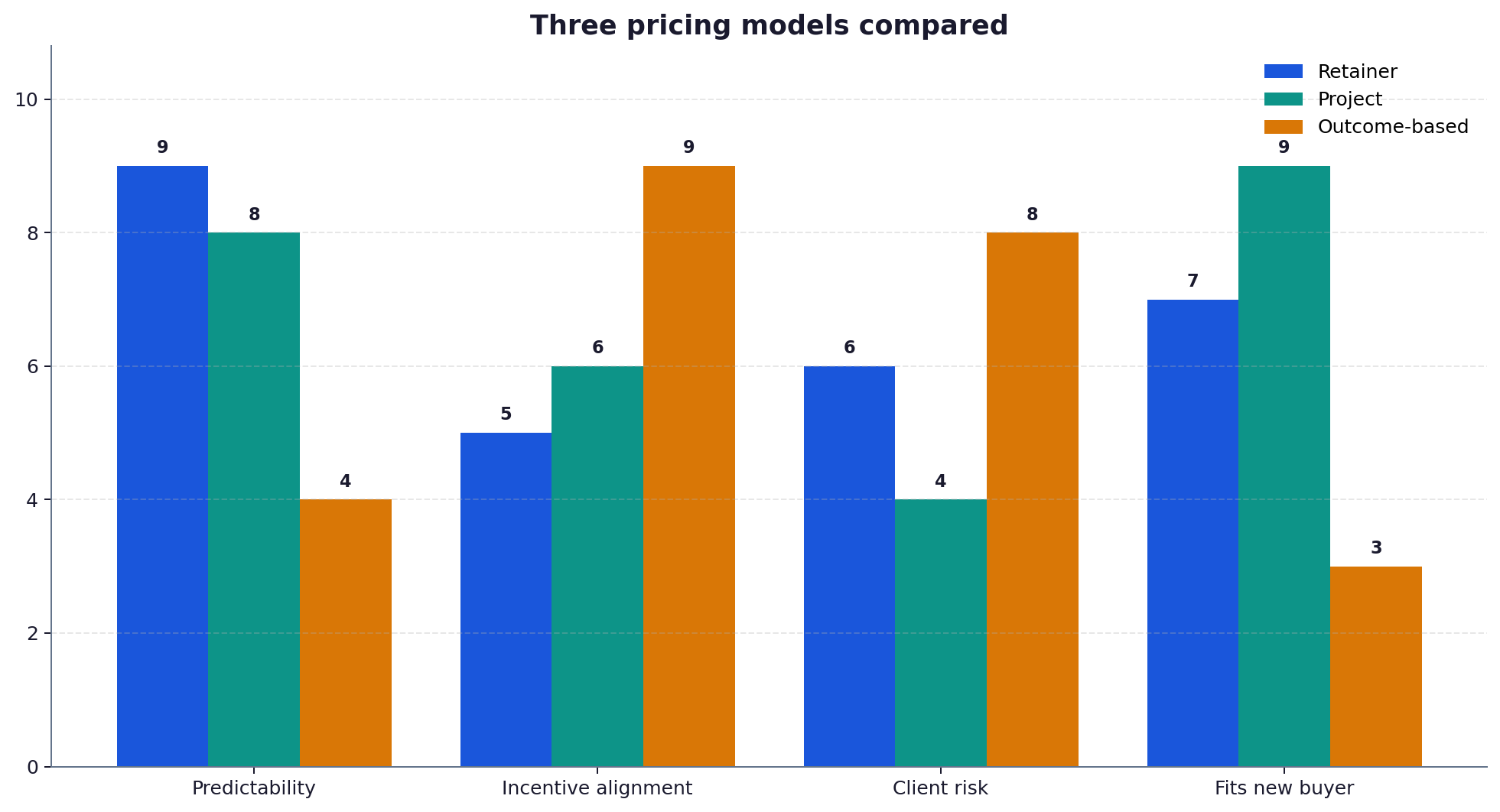
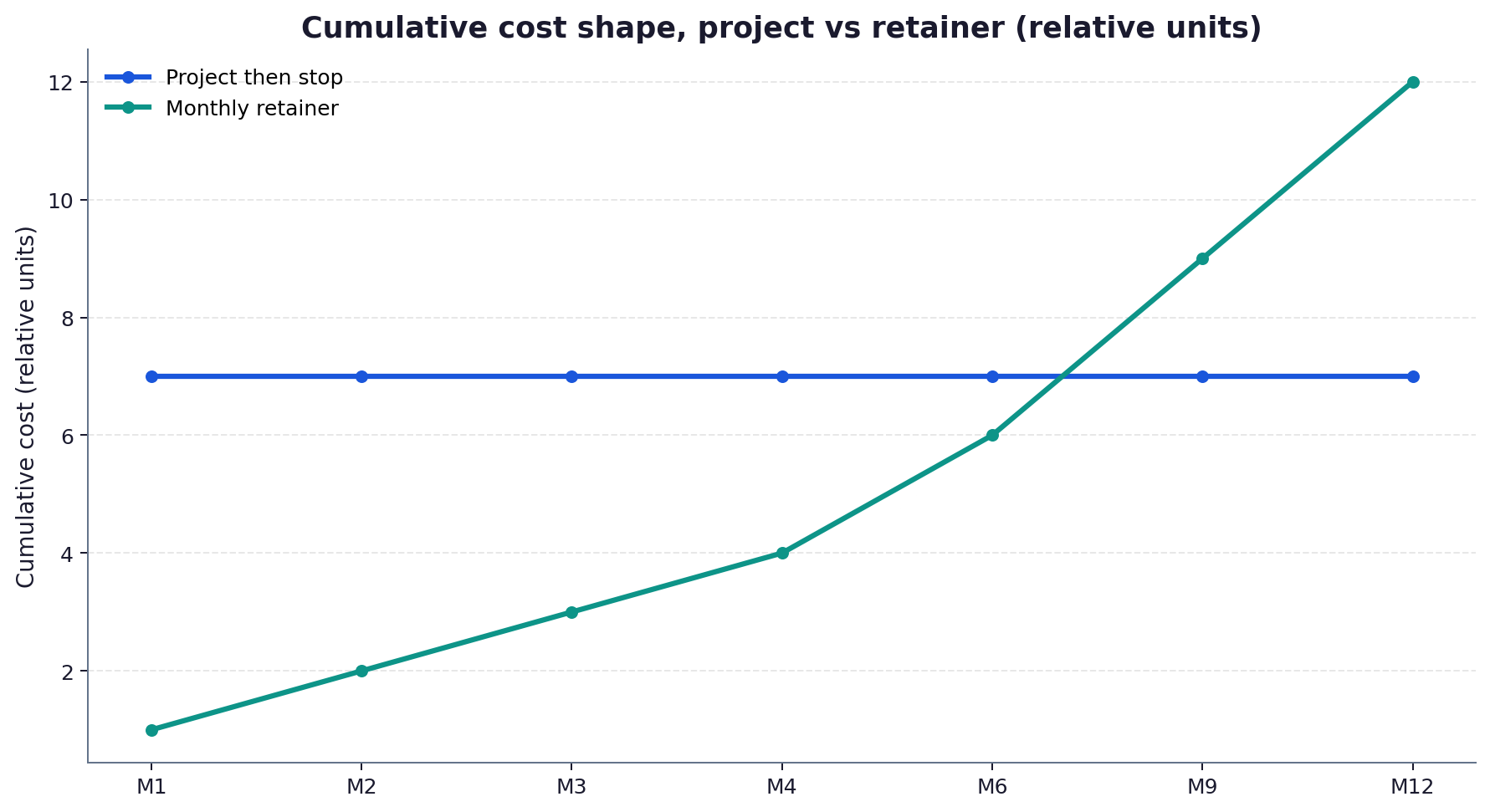
A retainer charges a fixed fee each month for an ongoing programme of work: content, schema, entity coverage, freshness cadence and reporting. Its strength is predictability. The client budgets a known number, the supplier plans a stable team, and the work compounds month over month, which suits GEO because citation gains build slowly. Its weakness is that the client pays for activity rather than result, so a weak supplier can bill for motion. The fee itself is always set per engagement, because scope varies widely: the volume of content, the number of target queries and the depth of technical work differ from one brand to the next, so there is no single rate to quote.
Model two: the fixed-scope project
A project charges a single fee for a defined deliverable: an AI visibility audit, an entity-gap remediation, a schema rollout across a site. Its strength is clarity. Both sides know exactly what is delivered and what it costs, with no open-ended commitment. Its weakness is that GEO results rarely arrive inside a single project window, so a project is best understood as buying a capability or a fix, not a citation outcome. Many engagements start as a project and convert to a retainer once the groundwork is done.
Model three: outcome-based pricing
Outcome-based pricing ties some or all of the fee to a measurable result. In GEO the two outcomes that work are citation share gain, an agreed rise in the proportion of target answers that cite the brand, and freshness compliance, keeping a defined content set updated to a standard. Its strength is alignment: the supplier is paid for the thing the client actually wants. Its weakness is measurement. Both sides must agree the metric, the query set, the baseline and the window before a penny changes hands, or the model collapses into a dispute.
What a fair outcome definition looks like
An outcome-based deal lives or dies on its definition. A workable one specifies the exact query set, the engines measured, the sampling method, a dated baseline taken before work begins, the measurement window, and the threshold that triggers payment. Because AI answers are volatile, the metric must be averaged over a window rather than read on a single day. Without that rigour, outcome pricing rewards luck and punishes noise, which is why it suits mature buyers who already measure their citation share.
How the models split risk
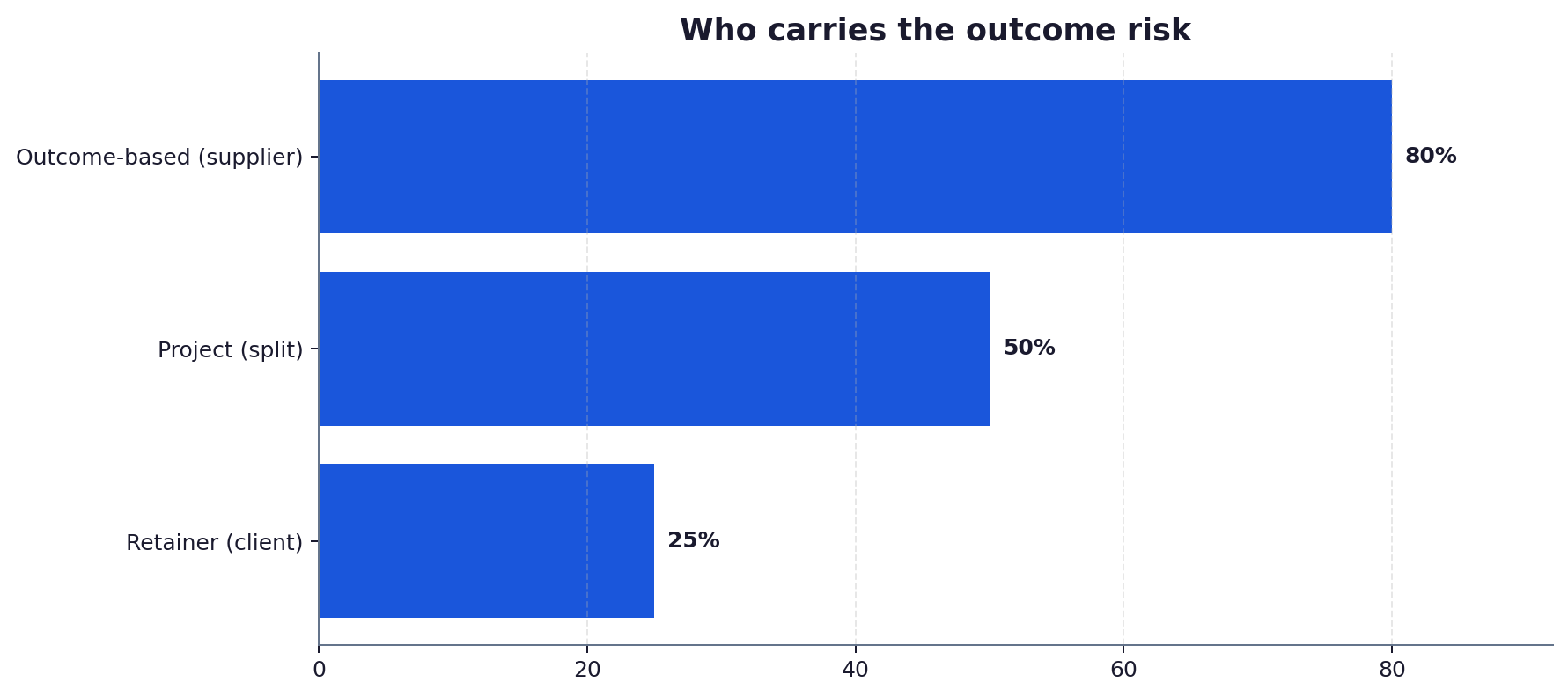
The deepest difference between the models is who carries the risk. A retainer puts most risk on the client, who pays regardless of result. A project splits it: the client risks that the deliverable does not move the needle, the supplier risks underquoting the scope. Outcome-based pricing shifts risk onto the supplier, who only earns in full if the result lands. That is why outcome deals command a premium on the at-risk portion: the supplier is pricing in the chance that volatility, not their work, decides the month.
Which model to choose
Match the model to the engagement. Choose a project when you need a defined fix and want a clean, bounded cost. Choose a retainer when you are running an ongoing programme and value predictability and compounding. Choose outcome-based only when you and the supplier can agree a metric, a baseline and a window, and when both sides are mature enough to measure honestly. Most buyers move through all three over time: a project to set the foundation, a retainer to build, and an outcome component layered on once the measurement is trusted.
Frequently asked questions
What are the three GEO pricing models?
A monthly retainer charges a fixed fee for an ongoing programme of content, schema, entity and freshness work, giving both sides predictability. A fixed-scope project charges a single fee for a defined deliverable such as an audit or a schema rollout, which suits one-off work. Outcome-based pricing ties part or all of the fee to a measurable result, usually citation share gain or freshness compliance. Each fits a different situation, and many engagements use more than one over their lifetime as the work matures.
Is outcome-based pricing realistic for GEO?
Yes, but only with rigour. It works when both sides agree a precise outcome: the exact query set, the engines, the sampling method, a dated baseline, the measurement window and the payment threshold. Because AI answer sets are volatile week to week, the metric must be averaged over a window rather than read on one day. Without that definition, outcome pricing rewards luck and invites disputes. It suits mature buyers who already track their citation share, and it usually carries a premium on the at-risk portion to reflect volatility.
How much does a GEO retainer cost?
It depends entirely on scope, so there is no single rate. The fee is set per engagement, driven by the volume of content, the number of target queries and the depth of technical work involved, which is why a baseline audit usually comes before any quote. Treat any figure quoted as a typical market price with caution, because GEO scope varies enough that a number which fits one brand can be wrong for another by a wide margin. The right figure is the one set against your specific scope.
When should I use a project rather than a retainer?
Use a project when you need a defined, bounded deliverable and want a clean cost with no ongoing commitment: an AI visibility audit, an entity-gap remediation, a one-off schema rollout. A project buys a capability or a fix, not a citation outcome, because GEO results rarely land inside a single project window. Many buyers start with a project to set the foundation and convert to a retainer once the groundwork is done and the work shifts from fixing to building. The two models complement each other.
Why does outcome-based pricing cost more per unit of result?
Because the supplier is carrying the risk. Under a retainer the client pays regardless of result, so the fee is lower per unit of outcome. Under an outcome-based deal the supplier only earns in full if the metric moves, and AI answer volatility means some of that movement is outside anyone’s control. The premium on the at-risk portion prices in that uncertainty. A supplier who offered outcome pricing at retainer rates would either be underpricing their risk or quietly defining the outcome so loosely that it always pays out.
Can I combine the models?
Yes, and combining them is often the most sensible structure. A common pattern is a base retainer that funds the ongoing programme plus an outcome component tied to citation share gain above an agreed baseline, so the supplier has stable income and a shared upside. Another is a project to establish the foundation followed by a retainer to build on it. The point is to match the payment structure to where the engagement actually is, rather than forcing a single model across the whole lifetime of the work.
Sources and references
- Citation Share Is the New Ranking Position: A KPI Framework. AiBoost, 2026
- Measuring GEO Success, Beyond Clicks and Rankings. AiBoost, 2026
- GEO: Generative Engine Optimization. arXiv (Aggarwal et al.), 2024
- Measuring brand presence across AI answers. Profound, 2026
- How agencies structure retainers and performance fees. Search Engine Land, 2026
- AI Overviews and citation volatility study. Ahrefs, 2026
Outcome-based pricing only works if both sides can measure the outcome. A free AI visibility report gives you a dated baseline of your citation share, the starting point any fair pricing model needs.
Change log
- 2026-06-11: Initial publication.