TL;DR
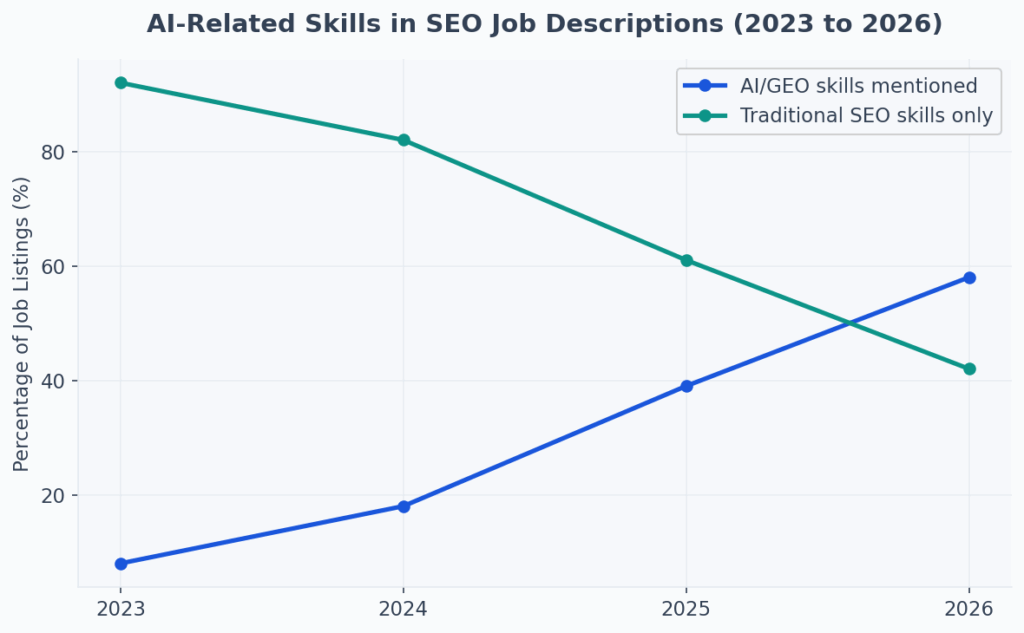
- AI-related skills now appear in 58% of SEO job descriptions, up from 8% in 2023.
- SEO professionals with GEO capability earn 62% more than those with traditional skills only.
- The GEO market is projected to reach $7.3 billion by 2031 at a 34% CAGR.
- You need traditional SEO as a foundation, then layer on AI-specific skills.
- The career path runs from SEO generalist to AI SEO specialist to GEO strategist or consultant.
By the end of this guide, you will have a clear roadmap from where you are now to working as an ai seo expert. You will know which skills to build first, which tools to learn, how to demonstrate GEO competence to employers or clients, and what the salary landscape looks like at each stage. No background in machine learning required. The role is closer to technical marketing than data science.
The AI SEO expert role did not exist two years ago. It emerged because AI search engines evaluate and cite content differently from Google, and businesses need specialists who understand both systems. That dual competence is the career advantage.
Key Facts (2025 to 2026)
- AI-related skills appeared in 58% of SEO job descriptions by early 2026, up from 8% in 2023 (Previsible, 2025).
- 74% of enterprise companies plan to hire SEO specialists with AI expertise within 12 months (Semrush, 2025).
- SEO job postings increased 41% from 2023 to 2024 (Previsible, 2025).
- The GEO market is projected to reach $7.3 billion by 2031 with a 34% CAGR (industry projections, 2025).
- 94% of enterprise CMOs plan to increase GEO investment in 2026 (industry survey, 2025).
- 72% of SEO professionals who upskilled in AI reported career improvements (AI Ranking School, 2026).
- Director and VP-level SEO roles account for 59% of all job listings (Heaven Tech, 2026).
What an AI SEO Expert Actually Does
An ai seo expert bridges traditional search engine optimisation and Generative Engine Optimisation (GEO). The role combines technical SEO skills with the specific competencies needed to make content visible in AI-generated answers from ChatGPT, Perplexity, Google AI Overviews, and similar platforms.
Day to day, the work includes restructuring content for passage-level extraction by AI engines, implementing and validating schema markup (Organisation, Article, FAQPage, Person), monitoring AI citations across platforms, building entity and authority signals through third-party presence, and reporting on AI visibility metrics alongside traditional SEO data.
An AI SEO expert makes content findable by Google and citable by ChatGPT. Both skills are now required for the same role.
New job titles in this space include AI SEO Specialist (Caterpillar posted this role in 2025), AI Search Specialist (Manychat), Head of Organic Growth, and GEO Strategist. The titles are still settling, but the underlying skill set is consistent across all of them.
The Skill Stack: What You Need to Learn (In Order)
The career path has three layers. Each builds on the previous one. Trying to learn GEO without traditional SEO fundamentals is like trying to build a second floor without a ground floor. Start at the foundation.
Layer 1: Traditional SEO Fundamentals (Months 1 to 3)
You cannot optimise for AI search without understanding how traditional search works. The fundamentals you need: keyword research and search intent mapping, on-page optimisation (headings, meta tags, internal linking), technical SEO (crawlability, site speed, indexing, structured data basics), content strategy and editorial planning, and analytics (Google Search Console, GA4, Ahrefs or Semrush).
If you already have these skills, move to Layer 2. If not, invest 2 to 3 months building them through courses (Ahrefs Academy and Semrush Academy are free and thorough) and hands-on practice on your own website or a test site.
At this point, you should be comfortable running a technical audit, writing SEO-optimised content, and interpreting Search Console data.
Layer 2: GEO-Specific Skills (Months 3 to 6)
This is where you differentiate from a traditional SEO specialist. The GEO-specific skills to develop:
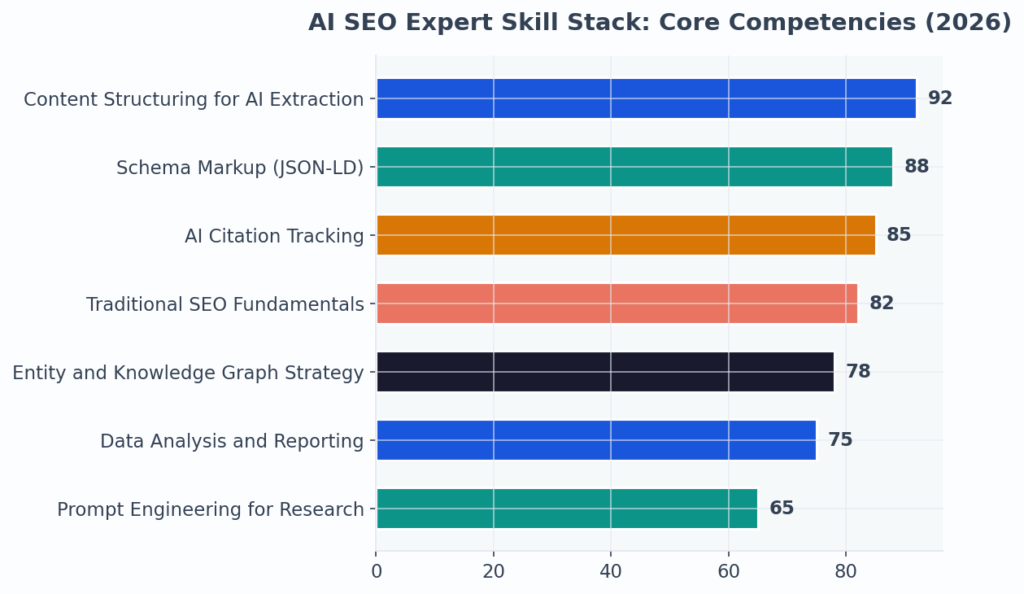
Content structuring for AI extraction. Learn to write answer-first content where every section functions as a standalone, quotable passage. Practise rewriting existing pages so that AI engines can extract clean responses at the paragraph level. This is the highest-rated skill for AI SEO experts in 2026.
Schema markup (JSON-LD). Go beyond basic Article schema. Learn to implement Organisation, FAQPage, Person, HowTo, and Speakable schemas. Understand how AI engines use schema for entity verification and content classification. Validate markup using Google’s Rich Results Test.
AI citation tracking. Learn to monitor where content appears (or does not appear) across ChatGPT, Perplexity, Google AI Overviews, and Gemini. Practise entering target queries and logging citation results weekly. Familiarise yourself with tools like Profound, Otterly.ai, and Ahrefs Brand Radar.
Entity and knowledge graph strategy. Understand how AI engines resolve entities using Organisation schema, sameAs links, and third-party mentions. Learn to build a client’s entity footprint across LinkedIn, YouTube, Google Business Profile, and industry directories.
For a detailed look at the skills employers value most, our post on AI SEO expert skills to look for covers the employer perspective.
If you are building GEO skills and want to see how the work looks in practice at an agency, we are always interested in hearing from people developing AI search expertise. Get in Touch →
Layer 3: Strategic and Commercial Skills (Months 6 to 12)
Senior AI SEO roles require business context. Director and VP-level SEO roles account for 59% of all job listings in 2026 (Heaven Tech, 2026). Companies want people who can connect AI visibility to revenue.
The skills to develop at this stage: AI visibility reporting tied to business outcomes (leads, pipeline, revenue attribution), cross-channel strategy (integrating GEO with traditional SEO, paid media, and content marketing), experimentation and A/B testing for AI citation improvement, and client or stakeholder communication (translating technical GEO concepts into business language).
The Salary Landscape for AI SEO Professionals
The financial case for upskilling is clear. SEO professionals with GEO capability command significantly higher salaries than those with traditional skills alone.
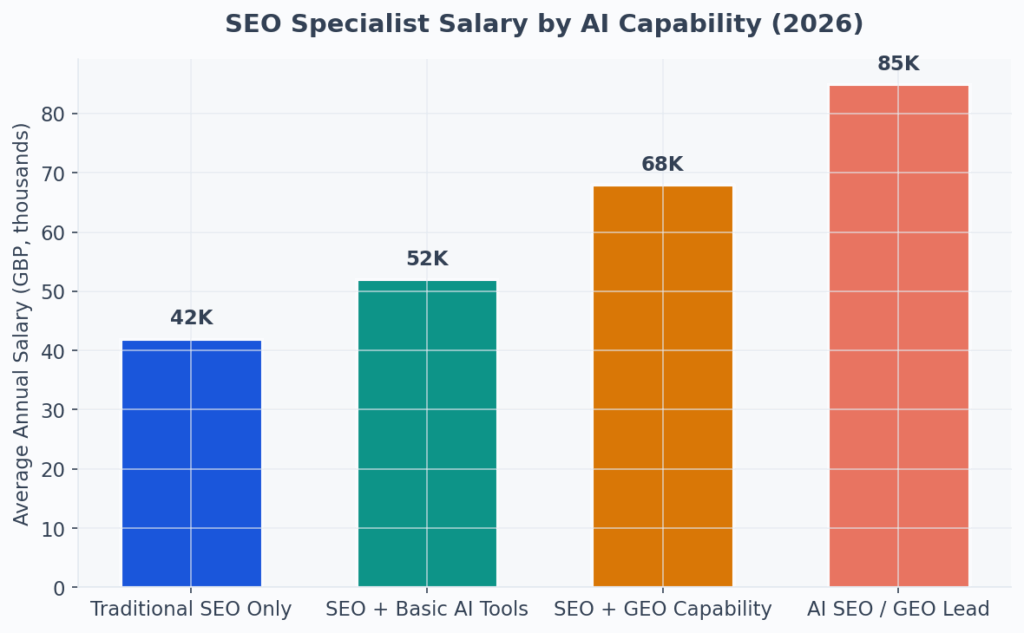
SEO specialist salaries jumped 28% recently, outpacing general marketing roles by 8 percentage points (Conductor, 2025). The premium for AI and GEO skills is on top of that baseline increase. 74% of enterprise companies plan to hire SEO specialists with AI expertise within the next 12 months (Semrush, 2025). Demand is outrunning supply, which drives compensation upward.
The freelance market is equally strong. Beginner freelance rates for AI SEO work start at £50 to £75 per hour. Experienced ai seo consultants with demonstrable citation results charge £120 to £200 per hour or work on retainer models of £3,000 to £8,000 per month per client.
For a broader perspective on the industry, understanding what the rise of the AI SEO consultant looks like in practice helps frame the career opportunity.
This overview from Ahrefs covers the SEO career fundamentals that form the foundation for AI specialisation:https://www.youtube.com/watch?v=DvwS7cV9GmQ
How to Build a Portfolio Without Clients
The biggest barrier to breaking in is the chicken-and-egg problem: you need results to get clients, but you need clients to get results. Here is how to solve it.
Optimise your own site. Build a personal website or blog focused on AI search topics. Implement full schema markup. Structure content for AI extractability. Track your own citations in ChatGPT and Perplexity. Document the process and results. This is your first case study.
Run AI visibility audits for free. Offer 3 to 5 free GEO audits to local businesses or contacts. Enter their target queries into ChatGPT and Perplexity, document where they appear (or do not), and present findings with recommendations. Even without implementing changes, the audit itself demonstrates competence.
Publish your learning publicly. Write about what you are discovering as you build GEO skills. Share citation tracking results on LinkedIn. Document experiments with schema markup. The people hiring for these roles are looking for evidence of hands-on experience, not certifications.
For teams considering whether to build AI SEO capability in-house versus hiring an agency, our guide on building an in-house team for generative SEO covers the trade-offs.
The AI SEO Consultant Path
Many AI SEO professionals choose the consultant route rather than in-house or agency employment. The ai seo consultant model works well in this field because the expertise is scarce, the work is project-based, and businesses need strategic guidance more than they need another full-time hire.
A typical ai seo consultant engagement starts with a paid GEO audit (£1,500 to £5,000), followed by a strategy document with prioritised recommendations, and an optional monthly advisory retainer (£2,000 to £5,000) for ongoing guidance as the client’s team implements changes.
The consultant path works best once you have 2 to 3 documented case studies showing AI citation improvements. Before that point, agency or in-house roles provide the experience and credibility needed to go independent.
Whether you are building a career in AI SEO or hiring someone who has, the skills are clear and the demand is growing. If you want to see how a GEO specialist operates in practice, Talk to Our Team →.
This walkthrough covers GEO implementation and the skills needed to deliver it:https://www.youtube.com/watch?v=E4Y3YKzMRYo
Frequently Asked Questions
What is an AI SEO expert?
An AI SEO expert is a search marketing professional who combines traditional SEO skills with Generative Engine Optimisation (GEO) capabilities. They make content visible in both Google search results and AI-generated answers from ChatGPT, Perplexity, and Google AI Overviews. The role requires content structuring, schema markup, AI citation tracking, and entity strategy skills.
How long does it take to become an AI SEO expert?
With existing SEO knowledge, you can develop GEO-specific skills in 3 to 6 months of focused learning and practice. Starting from scratch, expect 9 to 12 months to reach a competent level. The fastest path combines structured learning (courses, guides) with hands-on practice (optimising your own site, running free audits).
What qualifications do I need?
No specific degree is required. The role values demonstrable skills over formal qualifications. SEO certifications from Semrush or HubSpot provide a foundation. GEO-specific certifications are still emerging. The strongest qualification is a portfolio showing real AI citation improvements from your work.
What does an AI SEO consultant charge?
Freelance rates start at £50 to £75 per hour for beginners. Experienced ai seo consultants charge £120 to £200 per hour. GEO audits are priced at £1,500 to £5,000. Monthly advisory retainers range from £2,000 to £5,000 per client.
Is AI going to replace SEO jobs?
AI replaces tasks, not jobs. 72% of SEO professionals who upskilled in AI reported career improvements (AI Ranking School, 2026). The role is evolving to include AI-specific capabilities, not being eliminated. SEO professionals who add GEO skills are more valuable than ever. Those who do not adapt will face declining demand for their narrower skill set.
What tools should I learn for AI SEO?
Start with traditional SEO tools (Ahrefs or Semrush, Google Search Console, GA4). Add GEO-specific tools: Google’s Rich Results Test for schema validation, Profound or Otterly.ai for AI citation tracking, and manual AI platform queries for baseline audits. Learn to use ChatGPT, Perplexity, and Google AI Overviews from both the user and the optimiser perspective.
Should I specialise in GEO or stay generalist?
In 2026, the highest-value position is a T-shaped profile: broad SEO competence with deep GEO specialisation. Pure generalists face increasing competition from AI tools that handle routine SEO tasks. GEO specialists command premium rates because the skill is scarce and the demand is growing at 34% CAGR. Talk to our team if you want to understand how agencies are structuring GEO roles.
Where are the best AI SEO jobs in the UK?
London has the highest concentration of AI SEO roles, particularly in B2B tech, financial services, and agency sectors. Remote positions are growing (34% fully remote in 2026, trending toward 40% to 45%). Companies hiring include Adobe, Salesforce, Grammarly, and a growing number of specialist GEO agencies across the UK.
The career path is clear, the demand is growing, and the window for early specialisation is still open. If you want to see how AI SEO work looks at agency level, or if you are hiring and need help defining the role, Request a Conversation →.
Change Log
- 2026-04-09: Initial publication.
Pavel Uncuta is the founder of AiBoost, a UK AI marketing agency that builds visibility audit tools for professional services firms. He researches how Large Language Models cite brands across ChatGPT, Perplexity, and Google AI Overviews.
Want to know whether ChatGPT, Perplexity, or Google AI Overviews mention your firm? Run a free first-party visibility audit on your domain in under a minute and see exactly which queries cite you and which do not.