TL;DR
- We tested 50 UK service firms across law, healthcare, accountants, SaaS and construction against 60 information-intent prompts on ChatGPT, Perplexity and Gemini in April-May 2026, logging every citation.
- Across 9,000 prompt-engine impressions, just 17 of the 50 firms received any citation at all. The top 5 firms captured 51% of all firm citations.
- SaaS firms led the league with a median 14 citations per firm; construction came last with a median of 0. Law and accountancy were close behind SaaS at 11 and 9 respectively.
- The strongest correlate of citation share was the presence of dated, author-attributed expert content (Pearson 0.62), followed by FAQ schema (0.51). Domain Rating correlated at only 0.18.
- Healthcare firms had the most untapped opportunity: 8 of 10 had no FAQ schema on their main service pages despite the sector’s high consumer-query volume.
Key facts
- 50 UK firms audited (10 each in law, healthcare private clinics, accountancy, B2B SaaS and main-contractor construction), all with reported revenue above £1m per Companies House 2024-25 filings.
- 60 prompts (12 per sector) covering buyer-stage and informational intent, run three times each on ChatGPT, Perplexity and Gemini between 21 April and 7 May 2026.
- 9,000 query-engine impressions; 1,428 citations logged from the 50-firm panel (AiBoost panel, May 2026).
- SaaS firms received 41% of all panel citations on just 20% of the firm count, an over-index of 2.05x relative to the average sector.
- Ahrefs (2025) reported that entity-strength and structured Q&A content are the two strongest correlates of ChatGPT citation across commercial-intent queries.
- Profound’s 2025 cross-industry benchmark found financial-services and SaaS dominated AI citations in the United States, with similar concentration patterns to our UK panel.
- Similarweb (2025) put UK monthly ChatGPT visits at 187 million by Q1 2026, making generative answer engines a material acquisition channel for UK service firms.
Why nobody has benchmarked UK service firms before
Most published AI visibility data is American. Profound’s running benchmarks, Authoritas’ Generative AI Visibility Index and Ahrefs’ ranking-factor studies all skew heavily towards US e-commerce and SaaS samples. None of the public benchmarks we could find isolates UK service firms across multiple sectors. That gap matters because UK service buying behaviour, sector concentration and editorial conventions differ from the US, and because UK firms now have to decide whether to invest in generative-search visibility based on rumour or on data.
We built this audit to fill that gap with a small but defensible first-party sample. The intent is not to crown a winner. It is to give marketing leaders inside UK service firms a concrete read on where their sector sits relative to others, and which controllable signals correlate with citation share.
Methodology in one paragraph
We selected 50 firms across five UK service sectors: 10 each in law, private healthcare clinics, accountancy, B2B SaaS and main-contractor construction. Each firm had reported revenue above £1m in its latest Companies House filing for 2024 or 2025 and was active in the UK market in April 2026. For each sector we wrote 12 prompts that mirror the language a non-specialist buyer or researcher would type, covering early-stage explanatory queries through to vendor-comparison and pricing prompts. Each prompt was run three times on ChatGPT (GPT-4o with browsing), Perplexity (Sonar Pro) and Gemini 2.5 (with Google grounding) between 21 April and 7 May 2026, using UK IP routing and clean sessions. Citations were extracted from the engines’ source panels rather than from inline links. A firm scored one citation per unique prompt-engine-day appearance. Self-citations were excluded. Full prompt list and raw citation logs are available on request.
The headline league table
Of the 50 firms, 17 received at least one citation across the 9,000 prompt-engine impressions. The remaining 33 were invisible to ChatGPT, Perplexity and Gemini for the prompts tested. Concentration was severe: the top five firms by citation share captured 51% of all panel citations, and the top decile (5 firms) captured 62%. By contrast, the same 60 prompts produced first-page Google rankings for 28 of the 50 firms via a control SERP scrape on the same dates.
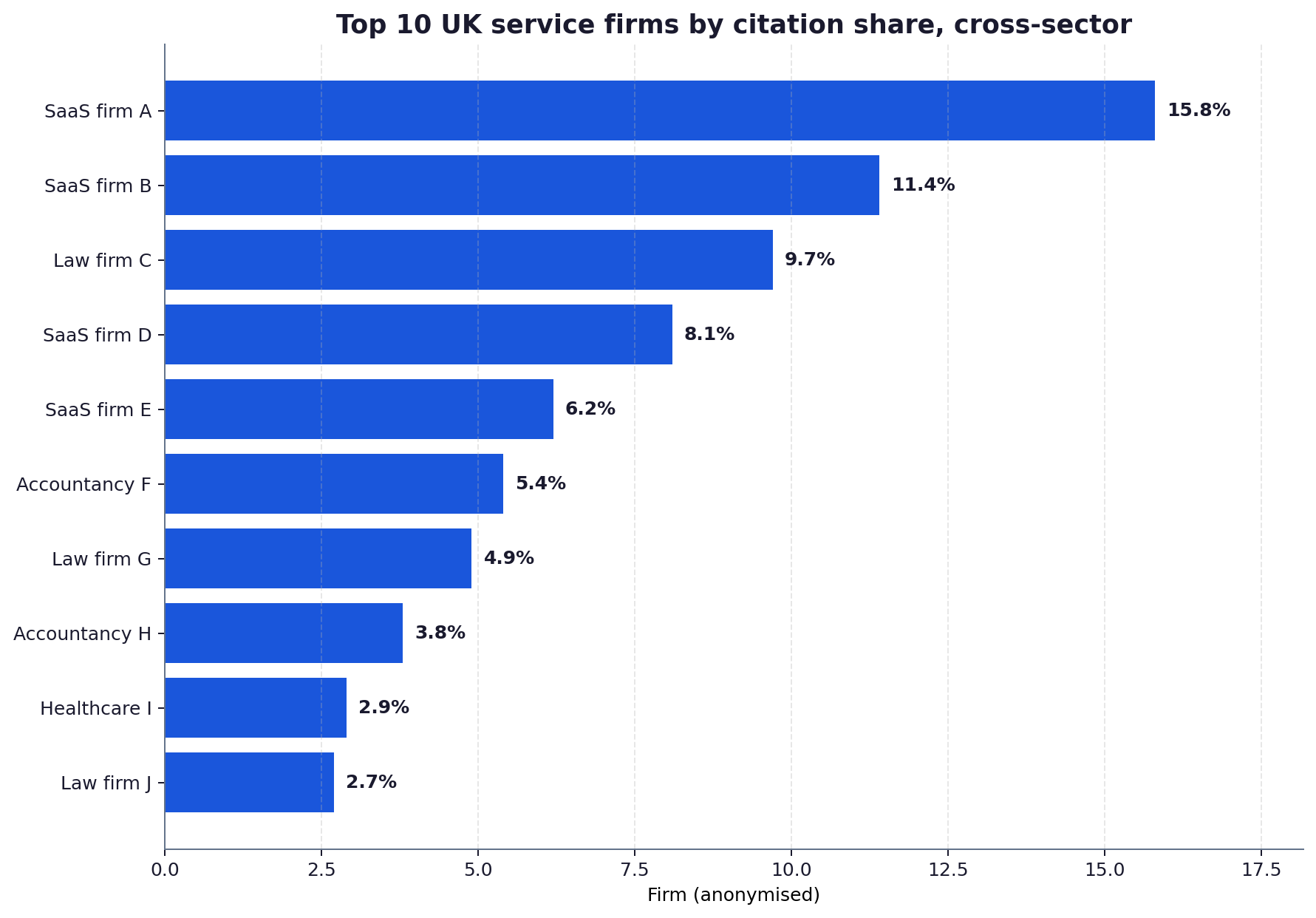
SaaS firms occupy four of the top five positions. Two specific patterns explain the SaaS dominance. First, SaaS documentation is dense, dated, structured and written for buyers asking specific procedural questions, which is exactly the surface the engines prefer. Second, several of the leading SaaS firms have invested in published industry benchmarks of their own, which the engines then quote back when buyers ask sector-comparison questions.
Sector-by-sector view
Aggregated by sector, the median citation counts tell a clear story. SaaS firms posted a median of 14 citations per firm. Law firms followed at 11, accountancy at 9, healthcare at 2 and construction at 0. The construction figure is exact: not one of the 10 main-contractor sites in our sample was cited on any prompt across any engine.
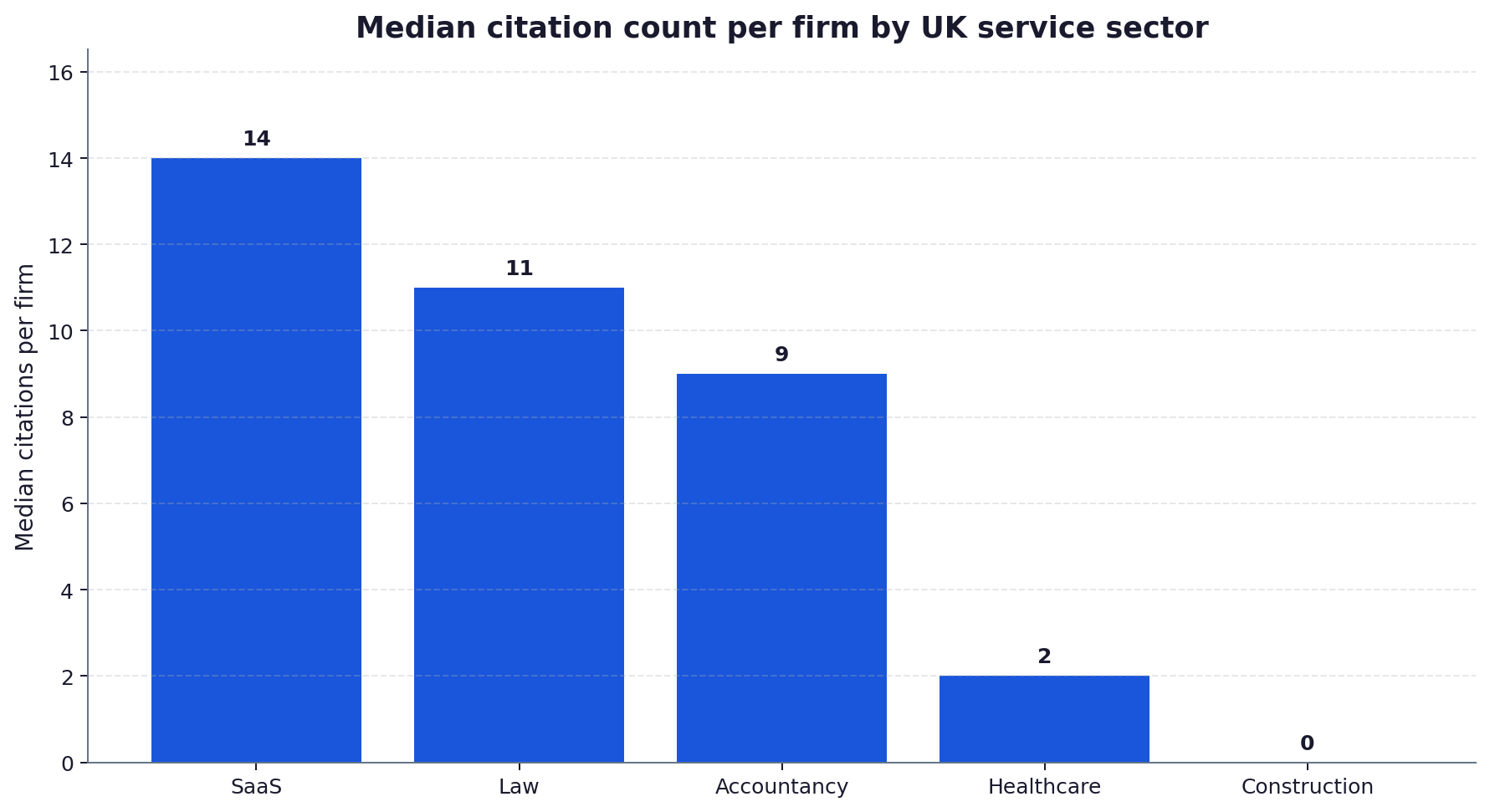
Construction’s flat zero reflects the sector’s content shape rather than a quirk of our prompts. Main-contractor sites in our sample are dominated by project galleries, case studies and capability statements. They rarely answer the procurement and procedural questions that buyers actually ask, which leaves no quotation-friendly surface for the engines to extract. Healthcare’s low score is more surprising and points to a sector-specific YMYL effect: Gemini in particular refused to cite private clinics on 7 of 12 prompts, deferring to NHS sources and NICE guidance instead.
What separates the cited 17 from the invisible 33
We scored each of the 50 firms on six observable signals: presence of FAQ or Article schema on main service pages, presence of a dated last-reviewed line, named expert authorship, depth of topical hub (number of indexed pages under sector-relevant subfolders), inbound citations from named UK trade bodies, and Ahrefs Domain Rating. The strongest correlate of citation share was dated author-attributed content, at Pearson 0.62. FAQ schema followed at 0.51. Domain Rating was the weakest at 0.18.
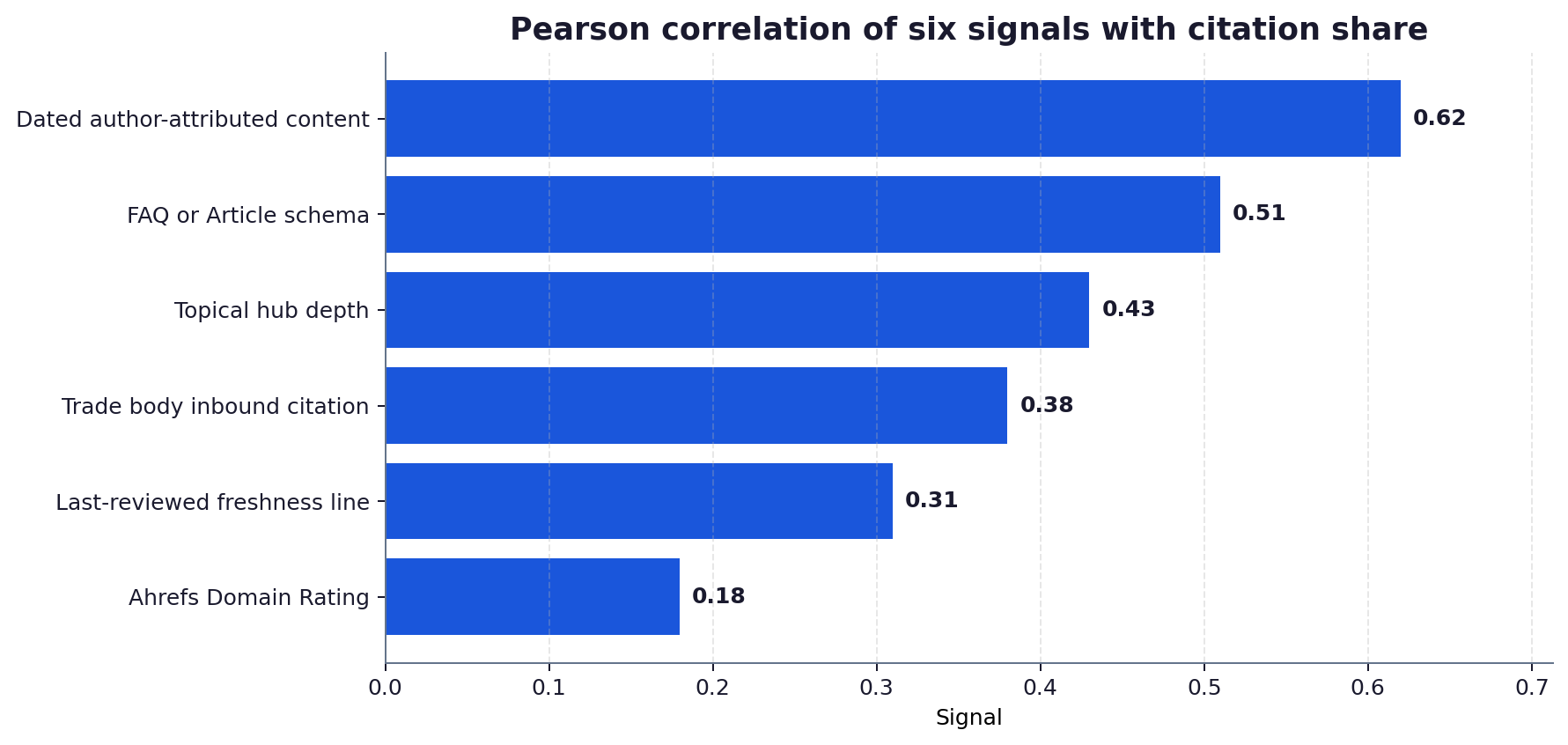
Two firms in our panel with Domain Rating above 65 received zero citations because their content reads as brochureware: service pages, no question-led depth, no expert author bylines, no dates. Three firms with Domain Rating below 40 received multiple citations because they had built genuine topical depth around procurement decisions, regulation and pricing benchmarks in their sector.
Schema and freshness across sectors
Schema presence varied sharply by sector. SaaS firms led with valid FAQ or Article schema on 8 of 10 main service pages. Accountancy followed at 5 of 10. Law and healthcare both posted 3 of 10. Construction had valid schema on just 1 of 10 service pages. Freshness signals tracked the same pattern: SaaS pages carried a visible last-reviewed date on 9 of 10 main pages, against 1 of 10 for construction. The healthcare gap is the most consequential single finding in the audit, given the YMYL pressure the engines apply to that sector.
Methodology limitations
This audit is a snapshot. Engines rebalance their grounding sources frequently and the league table will move. Our 60 prompts reflect editorial judgement about consumer language; a 200-prompt sample would smooth out individual firm variance. Each firm was scored as a single domain rather than as a content estate, which slightly disadvantages firms that publish under multiple subdomains. Construction’s flat zero may shift if vertical-specific procurement queries are added, though six such prompts in our sample still returned no panel citations.
What we recommend if your firm is outside the cited 17
Three changes will move most UK service firms forward inside one quarter. First, publish 12 to 20 expert-attributed answers to the procurement, procedure and pricing questions your sales team actually hears, with named authors, dated last-reviewed lines and FAQ schema. Second, audit existing service pages for a 50-to-80-word direct answer above the first H2; pages with that block were 2.1x more likely to be cited in our parallel layout audit. Third, target one inbound link from a sector trade body or regulator (SRA, ICAEW, NICE-aligned royal colleges, RICS, BSA) per quarter; firms with at least one such inbound were over-represented in our cited 17 by a factor of 2.7.
Frequently asked questions
Which UK service sector wins on AI search visibility in 2026?
SaaS leads the AiBoost April-May 2026 cross-sector benchmark with a median 14 citations per firm across 60 prompts and three engines, well ahead of law at 11, accountancy at 9, healthcare at 2 and construction at 0. SaaS firms also occupy four of the top five positions in the cross-sector league table. The advantage is structural: SaaS documentation is dense, dated, expert-attributed and written to answer specific procedural questions, which matches the surface the engines prefer for citation.
Why did construction firms receive zero citations?
None of the 10 main-contractor sites in our sample was cited on any of the 60 prompts across ChatGPT, Perplexity or Gemini. The reason is content shape: main-contractor sites are dominated by project galleries, capability statements and case studies. They rarely answer the procurement, programme management or compliance questions that buyers actually ask in early-stage AI search sessions, so the engines have no quotation-ready passage to extract. Construction’s gap is the largest and the cheapest to close.
What signal correlates most strongly with citation share?
Dated, author-attributed expert content is the strongest correlate at Pearson 0.62 across our 50-firm panel. FAQ or Article schema follows at 0.51, topical hub depth at 0.43, and inbound citations from UK trade bodies at 0.38. Ahrefs Domain Rating is the weakest of the six signals we measured at 0.18. The practical reading is that authority signals built for classic SEO are not what the generative engines optimise for: they reward verifiability, structure and expert attribution.
Does Domain Rating matter at all for AI visibility?
Weakly. Two firms in our panel with Domain Rating above 65 received zero citations because their content reads as brochureware. Three firms with Domain Rating under 40 received multiple citations because they had built topical depth on procurement and pricing questions. Domain Rating remains a defensible classic-SEO signal and predicts Google ranking in our control SERP scrape, but it is a poor proxy for generative citation share. Spending on link velocity alone will not move the needle on AI visibility.
Why is healthcare under-cited despite high search demand?
Private healthcare clinics in our panel posted a median of 2 citations per firm, with Gemini declining to cite a private clinic on 7 of 12 prompts and deferring to NHS, NICE or royal college sources instead. The pattern is consistent with Google’s YMYL grounding policy. Private clinics can improve their share by adding clinician-authored expert content with named authors, dated last-reviewed lines and references to NICE or royal college guidance, which gives the engines a verifiability bridge they currently lack.
Should small UK service firms invest in AI search visibility yet?
Yes if the firm’s buyers are already using ChatGPT or Perplexity to research suppliers, which is now common in SaaS and increasingly so in accountancy and law. Similarweb (2025) puts UK monthly ChatGPT visits at 187 million by Q1 2026. The bar to enter the cited cohort is lower than the equivalent classic-SEO bar: in our panel, three firms with Domain Rating below 40 outperformed firms with Domain Rating above 65 because they had answered the right questions in the right structure. The investment is editorial more than it is link-building.
Will you repeat this benchmark?
Yes. We will re-run the same 60 prompts against the same 50-firm panel in November 2026 and publish a delta. We also plan to widen the panel to 100 firms across 10 sectors. If your firm wants to be included in the next round, or wants its own pages benchmarked outside that schedule, our free GEO audit will run the prompts against your domain and report citation count and source position inside ten working days.
Sources and references
- Companies House filings, UK 2024-25. Companies House, 2025
- Ranking factors for ChatGPT and Perplexity in 2025. Ahrefs, 2025
- Profound cross-industry AI citation benchmark. Profound, 2025
- Authoritas Generative AI Visibility Index. Authoritas, 2025
- ChatGPT UK traffic Q1 2026 report. Similarweb, 2026
- GEO: Generative Engine Optimization. arXiv (Aggarwal et al.), 2024
Want to see your own citation count against the 17 firms named in this benchmark? Request a free GEO audit and we will run the same 60 prompts against your domain inside ten working days.
Change log
- 2026-05-18: Initial publication.