TL;DR
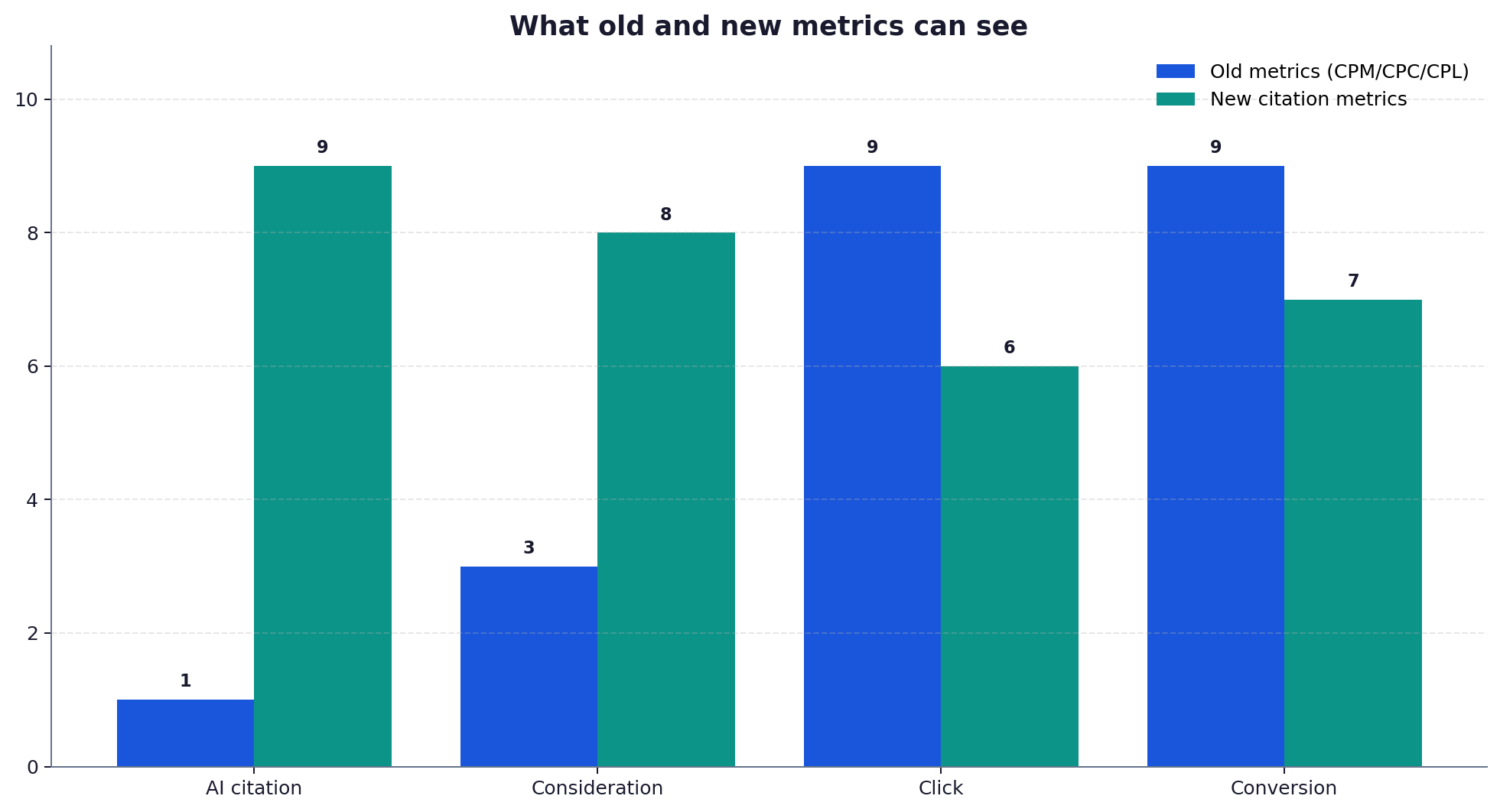
- CPM, CPC and CPL measure paid impressions, clicks and leads. None of them can see an AI citation, which increasingly sits between a buyer’s question and their visit.
- As more journeys begin in an AI answer, the old metrics undercount the demand a brand is actually generating.
- Three new metrics fill the gap: cost per citation, citation share of voice, and citation-influenced pipeline.
- Cost per citation divides relevant spend by citations earned; citation share of voice measures your citations against competitors; citation-influenced pipeline tracks revenue that touched an AI citation.
- These sit alongside the old metrics, they do not replace the parts that still work, such as paid conversion tracking.
Key facts
- Citation share, the proportion of relevant answers that cite a brand, is the foundation metric these three build on (AiBoost, 2026).
- AI search is changing how referral traffic forms, with a growing share of journeys starting in an answer rather than a results page (Similarweb, 2026).
- GEO outcomes are measurable across a query set, which is what makes cost per citation calculable (Aggarwal et al., 2024).
- AI referral sessions can be isolated in GA4 when source and channel data are configured correctly (Google, 2026).
- Tools such as Profound make competitor citation tracking, the basis of share of voice, practical (Profound, 2026).
Why the old metrics are going blind
CPM, CPC and CPL were built for a world where demand was captured through paid impressions, clicks and forms. They still measure those things accurately. The problem is that a growing share of buyer journeys now begins inside an AI answer, where a brand can be cited, considered and shortlisted before any click the old metrics would record. When a buyer asks ChatGPT for the best provider, reads an answer that cites you, and arrives a week later through a branded search, every traditional performance metric credits the branded search and none of them sees the citation that started the journey.
That blind spot grows as AI surfaces take more of the top of the funnel. A performance marketing agency that reports only CPM, CPC and CPL will increasingly understate the demand its client is generating, and will keep optimising the channels it can see while the citation layer goes unmanaged. The fix is to add metrics that measure the citation layer directly.
This is not a hypothetical worry for a distant future. Independent referral data already shows journeys forming inside AI answers rather than on results pages, and the share is rising rather than holding. An agency that waits until the old metrics visibly break before adopting new ones will spend a year reporting decline on channels that are simply being bypassed, while the client quietly loses ground in the answer space it never measured. The point of new metrics is to see the shift while there is still time to act on it.
Metric one: cost per citation
Cost per citation is the AI-era answer to cost per lead. It divides the spend attributable to content and GEO work by the number of AI citations that work earned over the same period. If a quarter of GEO investment produced a measured rise of two hundred citations across the target query set, the cost per citation is that spend divided by two hundred. It turns citation generation into a managed, comparable cost, the same way CPL turned lead generation into one, and it lets an agency justify GEO spend in the language a finance team already understands.
Metric two: citation share of voice
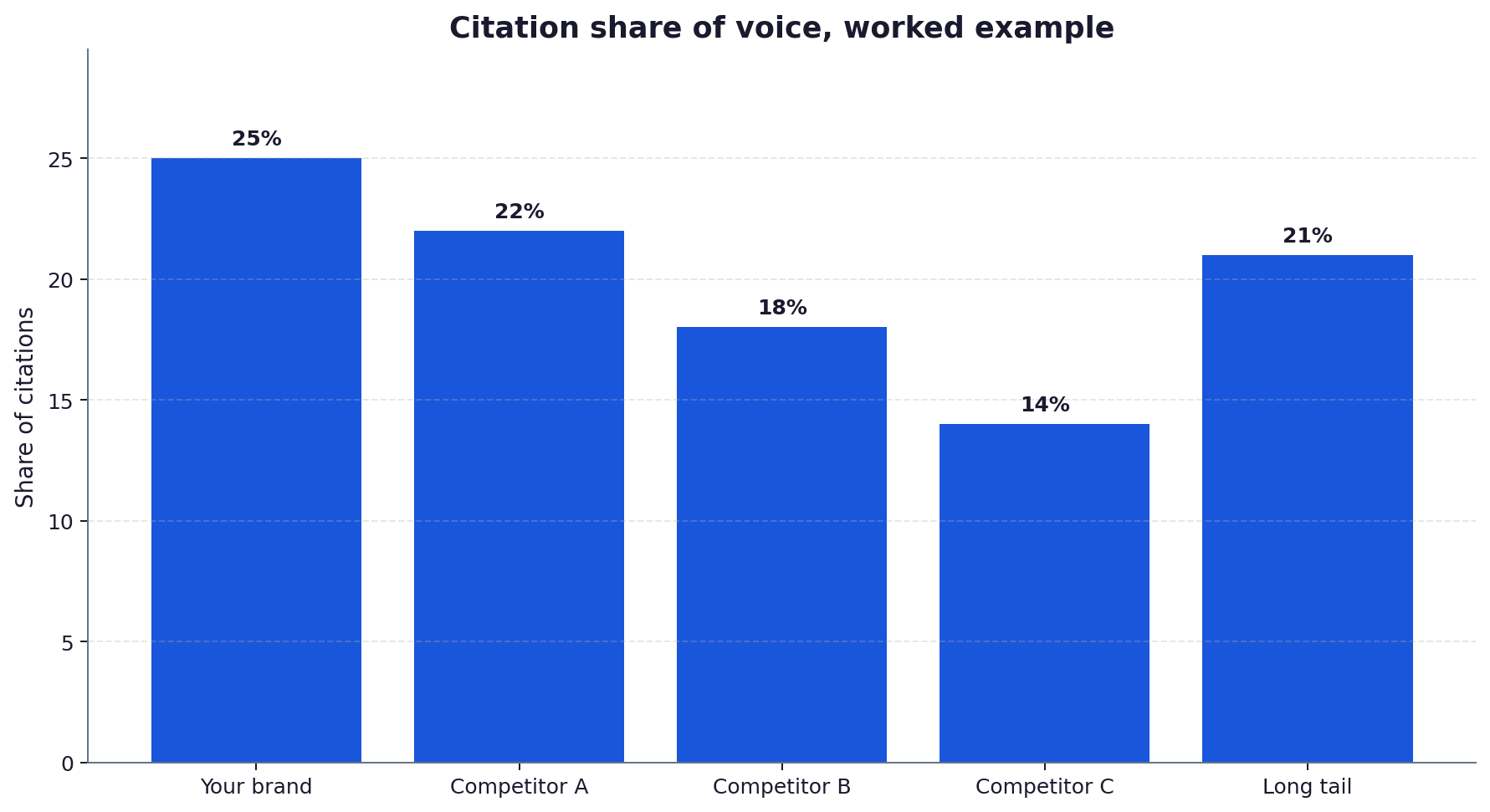
Citation share of voice measures how often you are cited for your target queries relative to competitors. A raw citation count is hard to read in isolation, because a number is only strong or weak relative to the field. Share of voice fixes that: if ten brands are cited across your query set and you account for a quarter of all citations, your citation share of voice is twenty-five percent. It is the AI-era equivalent of share of search, and it tells you whether you are winning or losing the answer space rather than simply whether your own number went up.
Metric three: citation-influenced pipeline
This is the metric that connects citations to money. Citation-influenced pipeline tracks the share of pipeline or revenue from deals that touched an AI citation somewhere in their journey, captured through AI referral data in analytics and, for considered purchases, through a simple how did you hear about us field. It is the hardest of the three to measure cleanly, because attribution across a multi-touch journey is never perfect, but it is the one that answers the question a board actually asks: did the citation work turn into revenue.
How the three metrics work together
The three answer different questions and are strongest in combination. Cost per citation tells you whether you are generating citations efficiently. Citation share of voice tells you whether that efficiency is winning you ground against competitors. Citation-influenced pipeline tells you whether the ground you win converts to revenue. Read alone, each can mislead: cheap citations that no competitor cares about, or a rising share of voice that never reaches a buyer. Read together, they describe the full path from spend to citation to revenue.
Adding them without throwing away what works
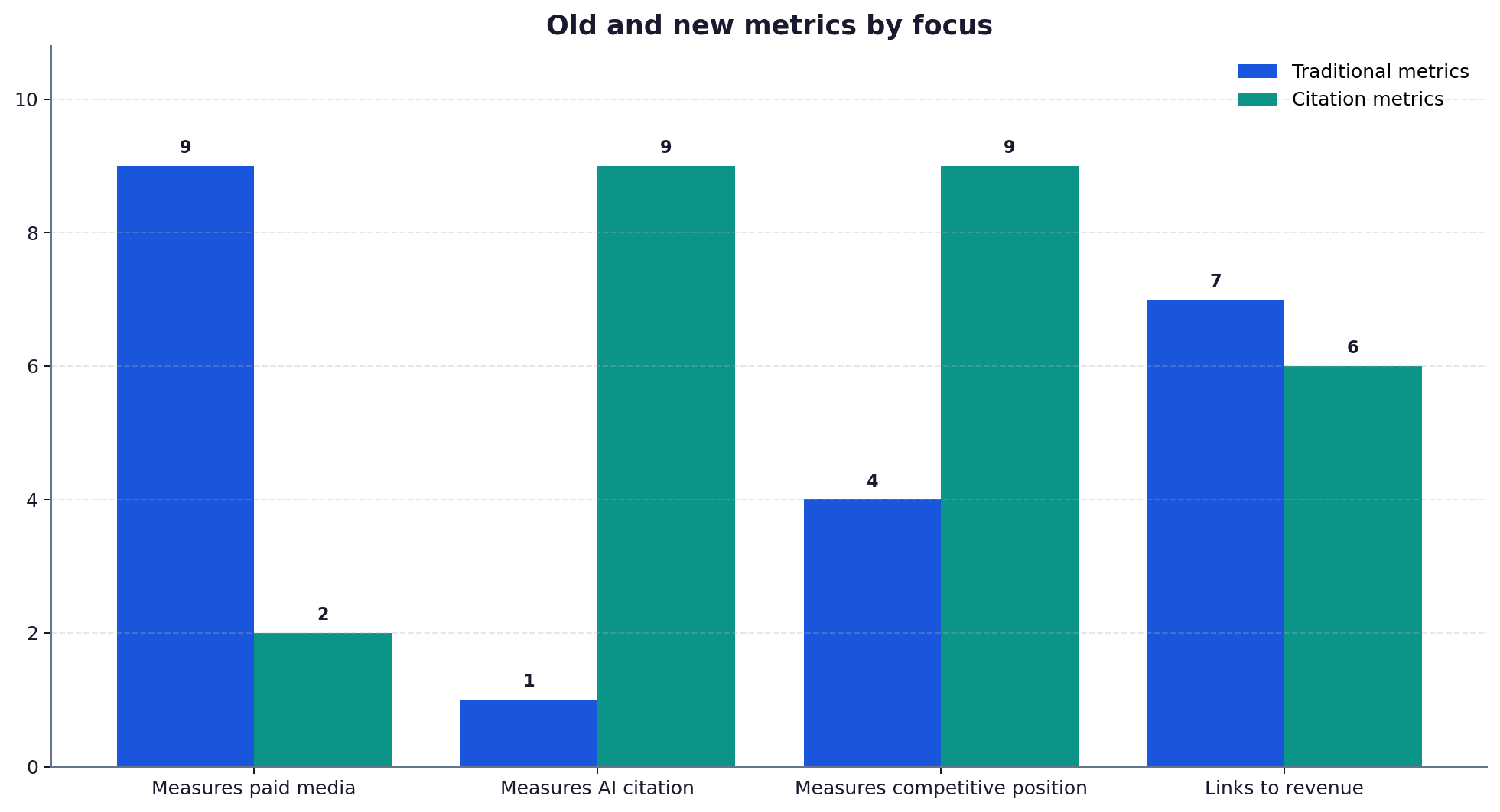
None of this means abandoning CPM, CPC and CPL. Paid media still needs its own metrics, and conversion tracking on paid channels remains accurate for what it measures. The new metrics sit alongside the old ones to cover the part of the funnel the old ones cannot see. A modern performance marketing agency reports both: the paid metrics for the channels that capture demand, and the citation metrics for the AI layer that increasingly creates it. The reporting gets one section longer, and in exchange the client finally sees the demand that was previously invisible.
Frequently asked questions
Why do CPM, CPC and CPL fail in the AI-traffic era?
They were built to measure paid impressions, clicks and leads, and they still measure those accurately. What they cannot see is an AI citation, which increasingly sits at the start of a buyer journey before any click they would record. When someone reads an AI answer that cites you and arrives later through a branded search, the old metrics credit the branded search and miss the citation that began everything. As more of the funnel moves into AI answers, that blind spot makes the traditional metrics understate the demand a brand is generating.
What is cost per citation?
Cost per citation is the AI-era counterpart to cost per lead. It divides the spend attributable to content and GEO work by the number of AI citations that work earned over the same period. If a quarter of investment produced a measured rise of two hundred citations across your target query set, the cost per citation is that spend divided by two hundred. The metric turns citation generation into a managed, comparable cost, which lets an agency justify GEO investment in the same financial language a team already uses for lead generation.
How is citation share of voice different from citation count?
A citation count is an absolute number, which is hard to judge in isolation because it has no reference point. Citation share of voice expresses your citations as a percentage of all citations across your target query set, so it captures your position relative to competitors. If your count rises but a competitor’s rises faster, your share of voice falls even though your raw number grew. Share of voice is the AI-era equivalent of share of search, and it tells you whether you are winning the answer space rather than simply moving.
Can citation-influenced pipeline really be measured?
Partly, and honestly imperfectly. You capture it through AI referral sessions isolated in analytics and, for considered purchases, through a how did you hear about us field at the point of enquiry. Multi-touch attribution is never perfect, so citation-influenced pipeline is an indicative share rather than a precise figure. But it is the metric that answers the board’s real question, whether the citation work turned into revenue, so an indicative answer is far more useful than no answer. Report it with its limitations stated, as you would any attributed pipeline number.
Do these metrics replace traditional performance metrics?
No, they sit alongside them. Paid media still needs CPM, CPC and CPL, and conversion tracking on paid channels remains accurate for what it measures. The three new metrics cover the AI citation layer that the old metrics cannot see. A modern performance marketing agency reports both sets: the paid metrics for the channels that capture demand, and the citation metrics for the AI layer that increasingly creates it. The goal is complete coverage of the funnel, not swapping one incomplete picture for another.
Which of the three should an agency adopt first?
Start with citation share of voice, because it needs only citation measurement and immediately shows competitive position, which clients grasp quickly. Add cost per citation next, once spend can be attributed to the GEO work, since it makes the investment defensible in financial terms. Introduce citation-influenced pipeline last, because it depends on attribution plumbing that takes longer to set up cleanly. Adopting them in that order delivers a useful picture early and builds towards full spend-to-revenue visibility as the measurement matures.
Sources and references
- Citation Share Is the New Ranking Position: A KPI Framework. AiBoost, 2026
- Attribution and conversion reporting in GA4. Google, 2026
- GEO: Generative Engine Optimization. arXiv (Aggarwal et al.), 2024
- Measuring brand presence across AI answers. Profound, 2026
- The impact of AI search on referral traffic. Similarweb, 2026
- How marketers are measuring AI search value. Search Engine Land, 2026
You cannot manage cost per citation without knowing your citation count. A free AI visibility report gives you that baseline across the major engines, so the new metrics have a number to start from.
Change log
- 2026-06-11: Initial publication.