
TL;DR
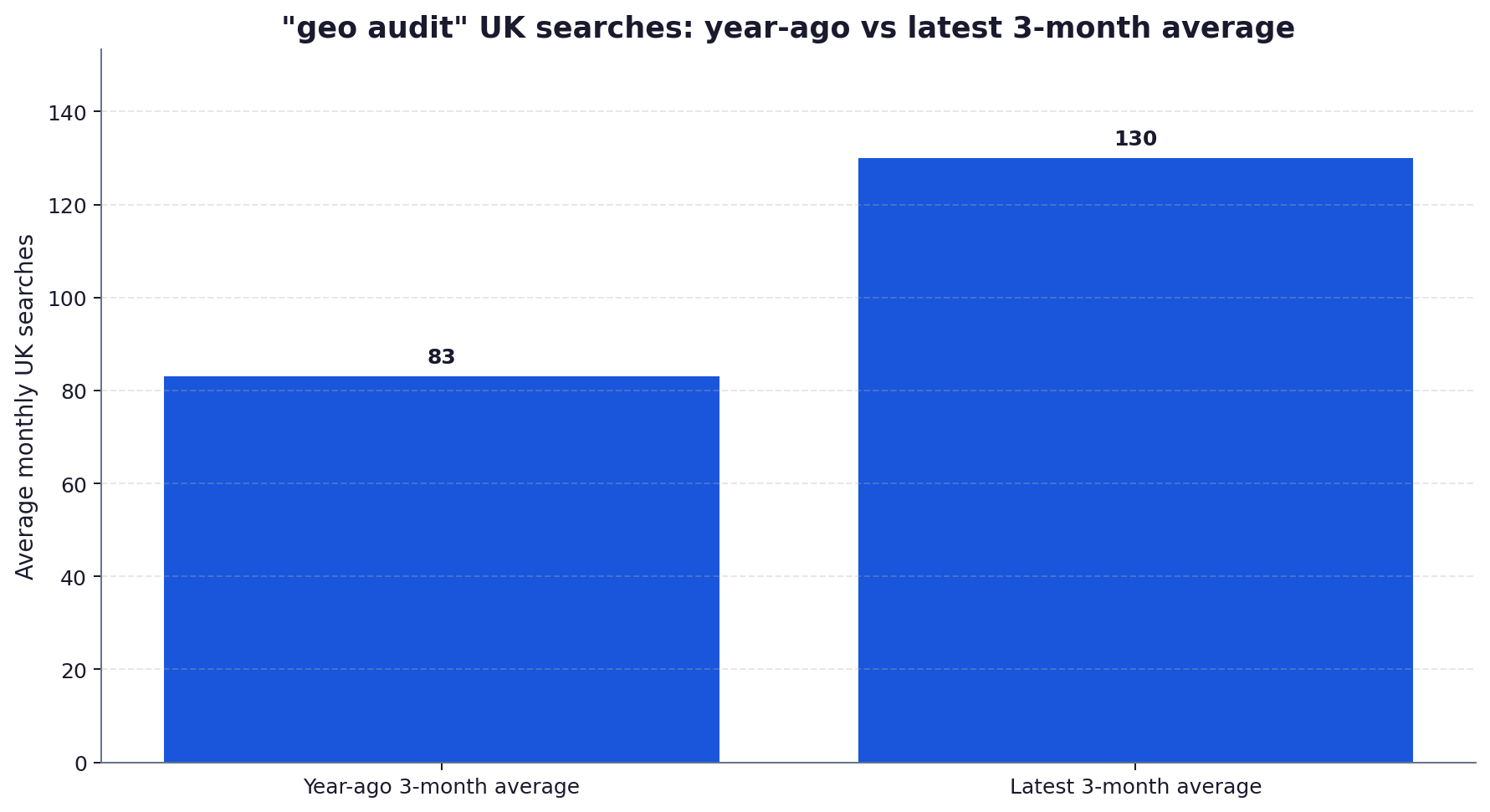
- UK searches for “geo audit” rose from an 83 to a 130 monthly average across the latest 12-month window, a 57% increase (AiBoost keyword analysis of DataForSEO Google Ads data, August 2026).
- The full audit-intent cluster runs to roughly 200 UK searches a month: geo audit at 90-140, ai visibility audit at 50-70 with a £25.67 CPC, and free geo audit at 10.
- AiBoost’s audit methodology, refined across 250+ UK small business audits, scores 12 signals in three layers: the answers engines give, your presence beyond your own site, and your site and operating signals.
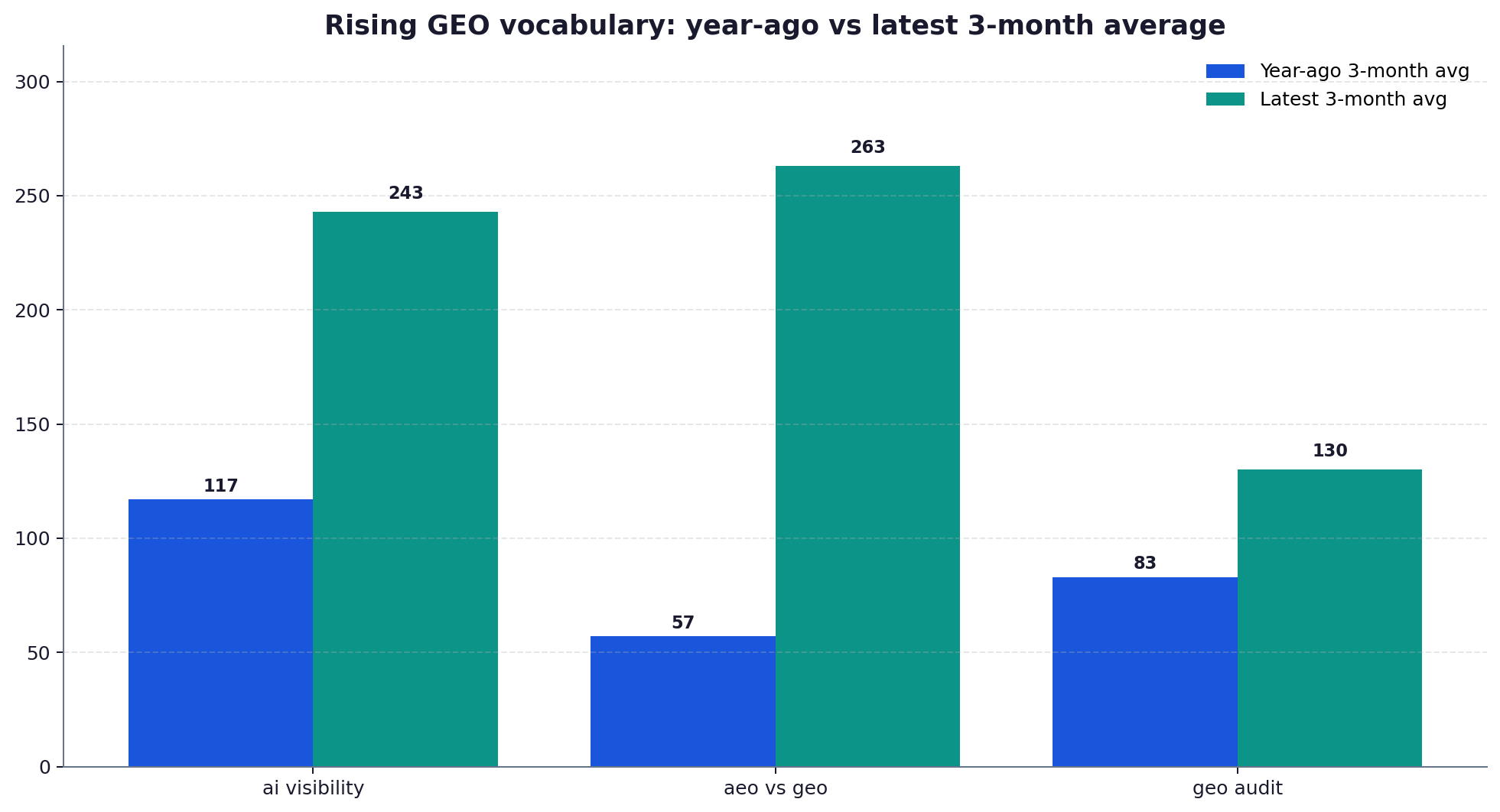
- The category vocabulary is consolidating around plain-English terms: ai visibility grew from 117 to 243 monthly searches and aeo vs geo from 57 to 263, while generative engine optimization fell from 1,400 to 720.
Key facts
- “geo audit” averaged 83 UK monthly searches in the first 3 months of the latest 12-month window and 130 in the last 3, a 57% rise (DataForSEO, 2026).
- “ai visibility audit” draws 50-70 UK searches a month at a £25.67 CPC (DataForSEO, 2026).
- “ai visibility” grew from a 117 to a 243 monthly average and “aeo vs geo” from 57 to 263 over the same 12 months (DataForSEO, 2026).
- generative engine optimization” fell from 1,400 to 720 monthly searches and “llm seo” from 397 to 150, evidence of vocabulary consolidation (DataForSEO, 2026).
- AiBoost has audited 250+ UK small businesses using the 12-signal methodology described here (AiBoost, 2026).
The search demand behind “geo audit”
“geo audit” is a young query. It averaged 83 UK monthly searches in the first three months of the latest 12-month window and 130 in the last three, per AiBoost keyword analysis of DataForSEO Google Ads data, August 2026. That is a 57% rise on a small base, and small bases are where category terms start. The supporting cluster tells the same story: “ai visibility audit” runs at 50-70 searches a month and “free geo audit” at 10, roughly 200 UK searches a month in total.
The price matters more than the volume. Advertisers pay £25.67 a click for “ai visibility audit”, and nobody sustains a £26 click on a term without buyers behind it. The searchers are owners and marketing managers who have noticed that generative engine optimisation exists and want a structured starting point, usually before committing to one of the three GEO pricing models agencies now sell.
What a GEO audit actually measures
An SEO audit inspects a website. A GEO audit inspects a conversation. The object under test is what an AI engine says when a prospect asks a question your business should win. That distinction shapes the method: roughly half of the 12 signals are observed by interrogating the engines directly, the rest by inspecting the assets that feed them.
AiBoost’s methodology groups the 12 signals into three layers. The answer layer covers funnel-stage prompt panels, grounding behaviour and brand knowledge. The presence layer covers directory presence, competitor citation share and location signals. The site and operating layer covers structured data coverage, schema validation, entity clarity, content freshness, AI-bot crawlability and measurement cadence. Our published 10-step framework any agency can copy is a close cousin of it.
Signals 1 to 3: the answer layer
Signal 1 is the funnel-stage prompt panel. We write a fixed panel of prompts for each business at three stages: awareness (“how do I fix a persistent damp problem”), consideration (“best damp specialists in Kent”) and decision (“is [brand] reputable, what do reviews say”). Each prompt runs against ChatGPT, Perplexity and Gemini, and every mention and citation is recorded. A fixed panel makes the numbers repeatable; an ad-hoc question session produces impressions, a panel produces a baseline.
Signal 2 is grounding behaviour. For each prompt we record whether the engine answered from training data or reached for live web search, because the two paths reward different assets. Grounded answers pull from pages the engine can fetch today; ungrounded answers pull from what the model absorbed months ago. Signal 3 is brand knowledge: we ask each engine what it knows about the business, then score accuracy, currency and completeness. Wrong opening hours, or a service you dropped two years ago, are findings, and they echo dealing with AI hallucinations about your brand.
Signals 4 to 6: the presence layer
Signal 4 is directory presence. AI engines lean heavily on aggregators and directories when recommending local and B2B services, so the audit checks whether the business appears, accurately, in the directories the engines cite for its category. Which sources those are is an empirical question, so our approach follows analysing which sources AI engines prefer rather than a generic listings checklist.
Signal 5 is competitor citation share. For every prompt we record who was recommended instead of you, then aggregate into a share figure per engine and funnel stage. It is the audit’s most clarifying output, because it converts a vague worry into a named list of rivals and a percentage, the logic behind treating citation share as the new ranking position. Signal 6 is location signals: whether engines place the business correctly and surface it for geographic phrasings. A business whose address exists only inside a footer image gets scored as location-less and loses every “near me” answer.
Signals 7 to 9: the site layer
Signal 7 is structured data coverage: which pages carry machine-readable markup at all, and whether the money pages, the ones that should anchor recommendations, are covered. Signal 8 is schema validation, a separate check because presence and correctness fail independently. Markup that misdeclares the business type, contradicts the visible page or fails validation can be worse than none. The mechanism, and why it moves citations, is set out in how structured data improves AI search visibility.
Signal 9 is entity clarity: whether the business resolves to one unambiguous entity across its site, its profiles and the wider web. Inconsistent naming, a brand that collides with a common word, or services described differently on every page all blur the entity an engine builds. We test this the way our knowledge-graph entity-gap method describes: ask what the engine believes, compare it with the canonical facts, and log every gap.
Signals 10 to 12: the operating layer
Signal 10 is content freshness. Engines favour recently updated sources for time-sensitive answers, so the audit dates every significant page and flags stale money pages; the cadence evidence is collected in how often you should update content for AI visibility. Signal 11 is crawlability for AI bots, a different check from Googlebot access. GPTBot, PerplexityBot and ClaudeBot each have their own user agents, and we regularly find sites whose firewall or robots.txt configuration blocks some of them, silently removing the site from grounded answers.
Signal 12 is measurement cadence: whether the business has any mechanism to re-run the panel and track movement. AI answers are unstable week to week, a pattern we documented in our work on citation volatility, so a one-off snapshot decays quickly. AiBoost built GEO Pulse, our weekly per-client AI-visibility tracker, for that reason, and the audit report ends with a re-test schedule rather than a full stop. Tooling options are compared in AI citation tracking tools and dashboards.
What the rising vocabulary tells us
The audit cluster is not growing in isolation. Across the same 12-month window, “ai visibility” grew from a 117 to a 243 monthly average, “aeo vs geo” from 57 to 263, and “geo audit” from 83 to 130, per AiBoost keyword analysis of DataForSEO Google Ads data, August 2026. The jargon end is shrinking: “generative engine optimization” fell from 1,400 to 720 and “llm seo” from 397 to 150.
Read together, the pattern is buyers moving from labels to actions. Fewer people search the discipline’s formal name; more people search the thing they want done, a visibility check or an audit, and the comparison term that helps them brief it, which we unpack in AEO vs GEO: the 2026 distinction.
How to read a GEO audit report
A useful report separates observation from inference. The prompt-panel results, grounding log and competitor citation share are observations: they happened, on a recorded date, and can be re-run. The site-layer findings are diagnoses that explain those observations and rank the fixes. Treat any report presenting only scores, with no prompt list and no dated evidence, with suspicion: you cannot re-test it.
Expect three outputs. First, a baseline: mentions and citations per engine per funnel stage. Second, a ranked fix list across the 12 signals, sequenced by expected effect against effort. Third, a measurement plan naming the re-test cadence. That structure is what the AiBoost free GEO audit delivers.
How we run the audit
The 12 signals above are the ones AiBoost’s own GEO audit checks on every engagement. Prompt panels are written per business and split across awareness, consideration and decision stages, then run against ChatGPT, Perplexity and Gemini on a recorded date. Mentions, citations and grounding behaviour are logged per prompt. All search demand figures in this article come from a single DataForSEO Google Ads pull, August 2026, UK location.
Limitations
AI answers are non-deterministic, so the same prompt can return different sources on consecutive runs, which is why the panel is fixed and dated. Engines change retrieval and grounding behaviour without notice, and a finding can age within weeks. The keyword figures sit in small volume bands, so treat direction as the signal rather than any single number. No client scores or results are quoted here.
Frequently asked questions
What is a GEO audit?
A GEO audit is a structured assessment of how visible a business is in AI-generated answers from engines such as ChatGPT, Perplexity and Gemini. It measures whether the engines know the business, mention it, cite its pages and describe it accurately, then diagnoses why. AiBoost’s methodology scores 12 signals across three layers: the answer layer, tested through fixed prompt panels; the presence layer, covering directories, competitor citation share and location signals; and the site and operating layer, covering structured data, schema validation, entity clarity, freshness, AI-bot crawlability and measurement cadence.
How is a GEO audit different from an SEO audit?
An SEO audit inspects a website against a ranking system: crawl health, indexation, links, on-page factors. A GEO audit starts from the answers themselves. It runs a fixed panel of prompts against multiple AI engines and records who gets mentioned, who gets cited and what the engine believes about the brand, then works backwards to the assets that produced those answers. Several checks overlap with SEO, structured data and crawlability among them, but the test object is the engine’s answer, not the search results page, and the KPI is citation share rather than ranking position.
How much search demand does “geo audit” have in the UK?
“geo audit” runs at 90-140 UK searches a month, and its 12-month trend rose from an 83 to a 130 monthly average, per AiBoost keyword analysis of DataForSEO Google Ads data, August 2026. The wider audit-intent cluster adds “ai visibility audit” at 50-70 searches with a £25.67 CPC and “free geo audit” at 10, roughly 200 monthly searches in total. The volume is small, but the trend direction and the click price both point to a commercial category forming rather than a curiosity.
What are funnel-stage prompt panels?
A funnel-stage prompt panel is a fixed set of questions written to mirror how prospects actually use AI engines at three stages: awareness prompts about the problem, consideration prompts asking for recommendations, and decision prompts asking about a named brand. The same panel runs against each engine on a recorded date, and every mention and citation is logged. Fixing the panel is the methodological point: it turns AI visibility from an anecdote into a repeatable measurement you can baseline, re-run and compare over time.
How often should a GEO audit be repeated?
The full 12-signal audit is worth repeating quarterly, because site-layer fixes take weeks to influence answers and a quarterly rhythm matches realistic implementation cycles. The prompt panel itself should run far more often than the full audit. AI answer sets shift week to week, so AiBoost tracks client panels weekly through GEO Pulse, our per-client AI-visibility tracker. A sensible minimum for a business managing this in-house is a monthly panel re-run with a quarterly review of the full signal set.
Is a free GEO audit worth taking?
Yes, provided it shows its working. A worthwhile free audit gives you a dated prompt-panel baseline, the list of competitors currently taking citations that could be yours, and the main site-layer gaps, which is enough to brief work internally or evaluate an agency proposal. AiBoost’s free GEO audit follows the same 12-signal methodology described in this article and has been run across 250+ UK small businesses. A free audit will not include implementation, so judge it on the clarity of its evidence.
Sources and references
- DataForSEO Google Ads search volume data. DataForSEO, 2026
- GEO: Generative Engine Optimization. arXiv (Aggarwal et al.), 2024
- Google Search Central documentation. Google, 2026
Want all 12 signals scored against your own business? AiBoost runs this exact methodology as a free GEO audit, with the prompt-panel baseline, the competitor citation picture and a ranked fix list in one report.
Change log
- 2026-08-10: Initial publication.