
TL;DR
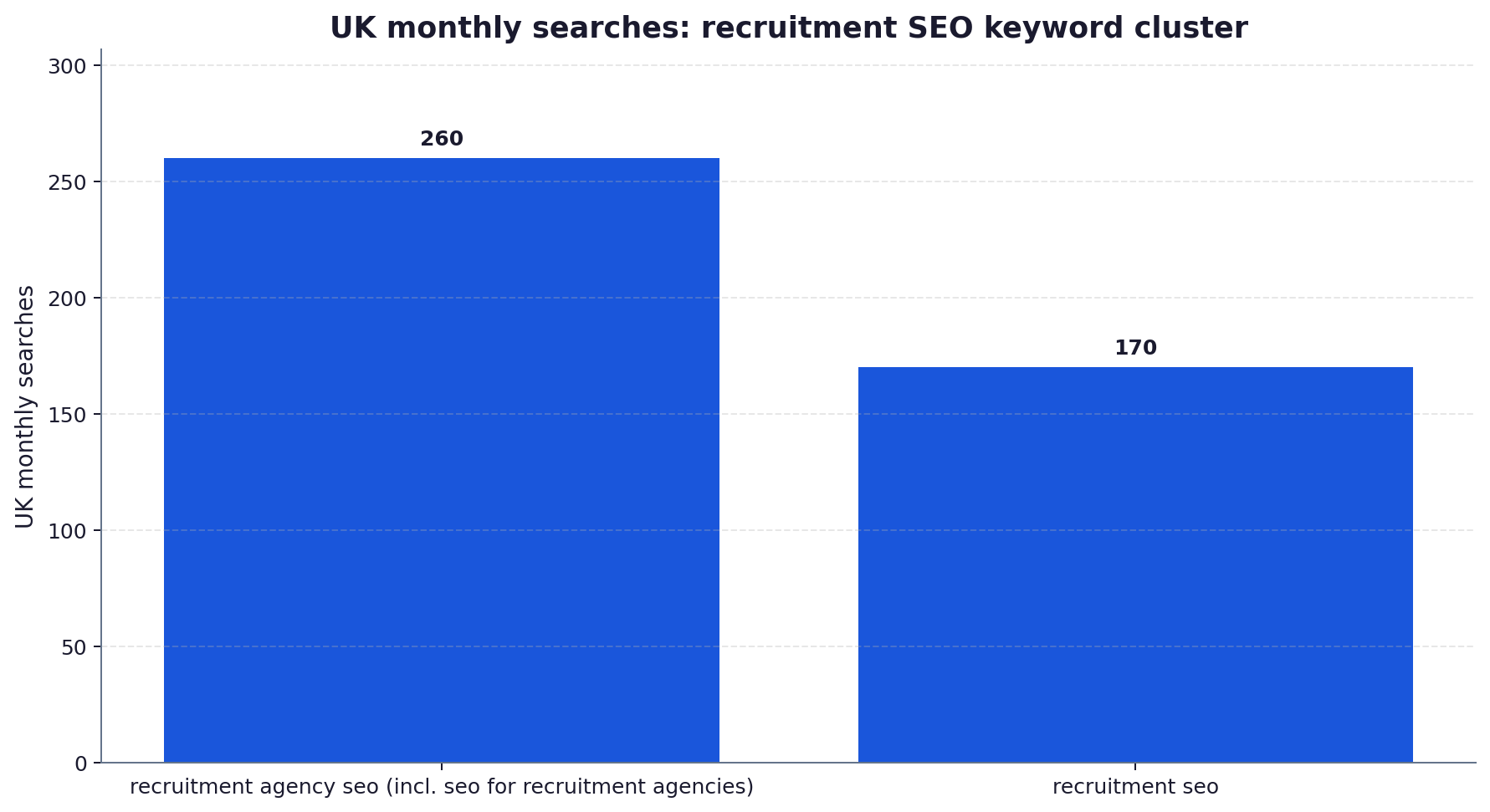
- UK demand for recruitment agency SEO runs at roughly 430 searches a month: 260 for recruitment agency seo and 170 for recruitment seo (AiBoost keyword analysis of DataForSEO Google Ads data, August 2026).
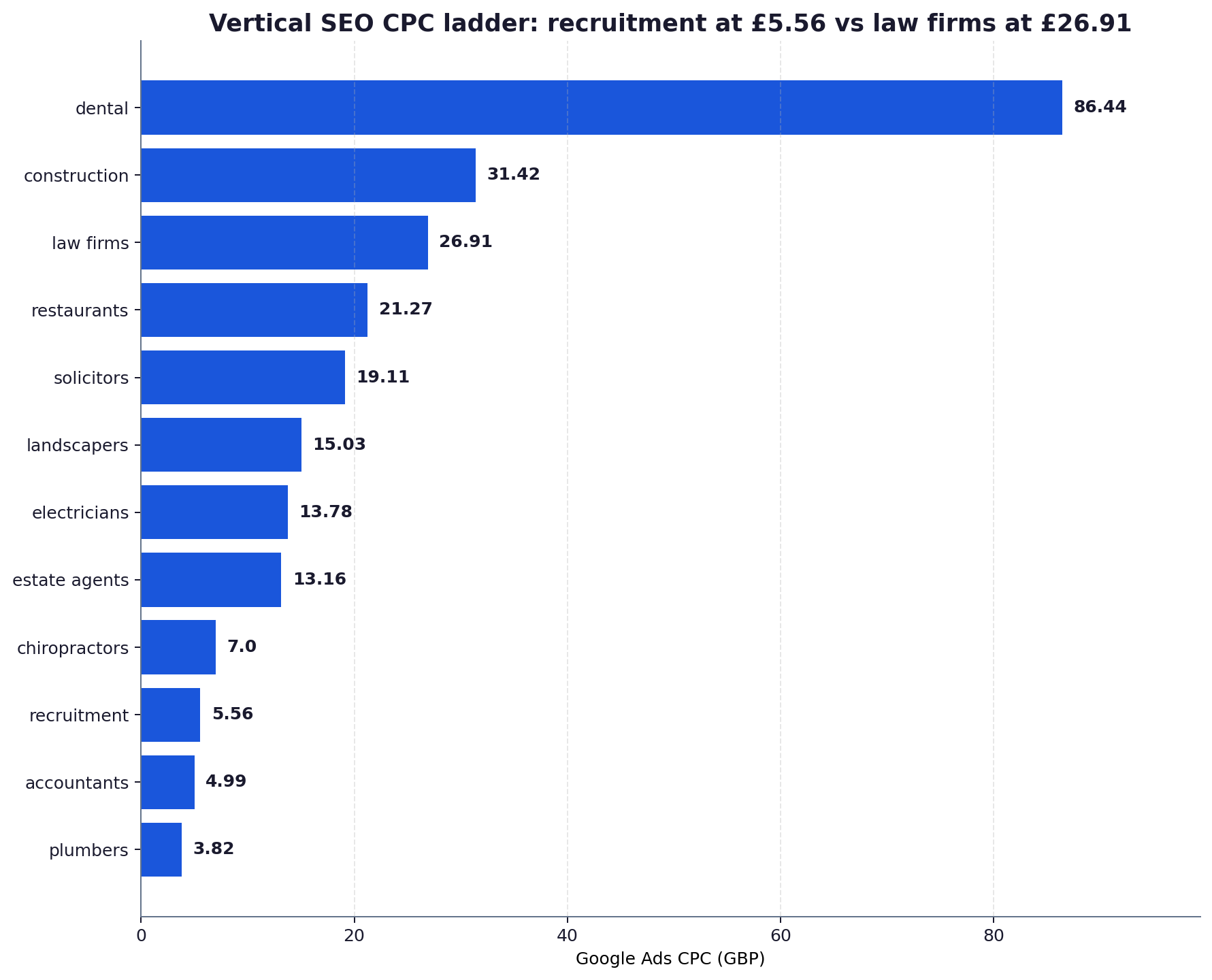
- A recruitment seo click costs £5.56 in Google Ads, against £26.91 for law firms and £86.44 for dental, which puts recruitment near the bottom of our 30-vertical CPC scan.
- Google rates competition LOW across the whole 430-search cluster, so page-one positions are still available to specialist sites without a national brand budget.
- A recruitment website serves 2 audiences, clients and candidates, and only one of them pays fees. Most agency sites optimise for the audience that does not.
- Job boards hold generic listing intent the way property portals hold it in estate agency. The winnable queries are niche-desk, salary-guide and employer-side terms.
- Employers now ask ChatGPT to shortlist specialist recruiters, and UK searches for ai visibility grew from a 117 to a 243 monthly average in 12 months.
Key facts
- recruitment agency seo carries 260 UK searches a month at LOW competition, and seo for recruitment agencies resolves to the same 260 cluster (DataForSEO Google Ads data, August 2026).
- recruitment seo adds 170 UK searches a month at a £5.56 cost per click (DataForSEO, August 2026).
- The full recruitment SEO cluster totals roughly 430 UK searches a month (AiBoost keyword analysis of DataForSEO Google Ads data, August 2026).
- Recruitment’s £5.56 CPC is roughly a fifth of law firms’ £26.91 and less than a fifteenth of dental’s £86.44, the most expensive vertical click in AiBoost’s 30-vertical scan (DataForSEO, August 2026).
- UK searches for ai visibility rose from a 117 to a 243 monthly average over 12 months (DataForSEO trend data, 2025 to 2026).
- AiBoost has audited 250+ UK small businesses for search and AI visibility (AiBoost, 2026).
What 430 monthly UK searches say about this market
The demand side of recruitment agency SEO is small, specific and easy to read. Our keyword analysis of DataForSEO Google Ads data, August 2026, puts recruitment agency seo at 260 UK searches a month, with seo for recruitment agencies resolving to the same 260 cluster and recruitment seo adding a further 170 at a £5.56 cost per click. The full cluster is roughly 430 searches a month, and Google rates competition LOW across all of it.
Two conclusions follow. First, these phrasings are typed by agency principals and marketing managers buying a service rather than by candidates looking for work, so the demand is commercial and converts for whoever holds the rankings. Second, LOW competition at this volume means the territory is unclaimed. In our work across sectors, a LOW rating on a 400-plus cluster usually means page-one positions are reachable within months rather than years, which is rarely true of the head terms we track for law or dental.
Two audiences, one website: clients pay, candidates click
Recruitment is a two-sided business, and most agency websites optimise for the wrong side. Candidate content dominates: job listings, CV advice, register-with-us forms. Yet the fee is paid by the employer, and employer-side queries are the ones with money attached. When we review agency sites, the client-facing layer is usually thin: one generic employers page, no desk-level detail, no explanation of terms, no sector proof.
The fix is structural rather than cosmetic. Split the site by audience the way a well-run agency splits its floor: employer pages organised by desk and sector, candidate pages kept separate with their own navigation and keywords. This is the first discipline we apply in our SEO services engagements, and it decides whether SEO is worth the spend for a small business in this vertical. Traffic that cannot become terms of business is a vanity metric.
The £5.56 click and what the ad market is pricing
Cost per click is a price set by an auction, which makes it the most honest competitive intelligence available. In our 30-vertical August 2026 scan, recruitment seo is priced at £5.56. Law firms pay £26.91, construction £31.42, and dental tops the ladder at £86.44. Recruitment sits near the bottom, above chiropractors at £7.00, accountants at £4.99 and plumbers at £3.82.
The cheap click does not mean recruitment clients are worth little; placement fees say otherwise. It means few marketing buyers are bidding, the same story the LOW competition rating tells on the organic side. The arithmetic favours moving early: £1,000 of budget buys roughly 179 clicks at £5.56, against 37 at the law-firm price. An agency that builds organic positions now buys its future traffic before this vertical’s marketing spend matures the way legal and dental spend already has.
The job-board problem is the portal problem
Estate agents learnt this lesson a decade ago: Rightmove and Zoopla own generic property intent, so the winnable queries are the ones portals cannot serve. Recruitment has the identical structure. Indeed, Reed and Totaljobs own generic job-listing intent, and no agency site will displace them on it. Budget spent chasing those terms is budget taken from positions an agency can actually defend.
The winnable territory is specific: named-sector agency queries, employer-side searches, salary benchmarking, and local hiring intent. These are queries a job board answers badly, because boards aggregate everything and specialise in nothing. They are also the queries that shortlist an agency rather than a vacancy. The local variants behave like classic local search, a discipline changing as assistants absorb these lookups, which we examine in Local SEO in the Age of AI Assistants.
Niche-desk content: publish what the boards cannot
The content strategy that fits this market is desk-level depth. Each desk gets a hub page stating the sector, the roles it fills, typical salary bands and how the desk works, because that is the page an employer-side search should land on. Around each hub sit the data assets: an annual salary guide, quarterly hiring-market notes, and anonymised placement case studies with concrete timelines. Boards cannot produce this, and generalist rivals will not bother.
Two production notes. The data assets need a fixed refresh cadence, because stale salary guides stop earning links and stop being cited; our analysis of how often to update content for AI search visibility sets out the timing logic. And the site has to be fast and crawlable enough to carry the content. For many agencies that means rebuilding, which is the case our websites service exists for.
When an employer asks ChatGPT for a specialist recruiter
A growing share of shortlists now starts inside an AI assistant. An HR director phrases the brief as a recommendation request: name a specialist fintech recruiter in Leeds, or list agencies handling retained search for engineering leadership. The assistant replies with named firms drawn from the sources it can see and trust. Whether your agency appears depends on entity clarity, directory presence, structured data and citable content, the signals generative engine optimisation works on. This is part of the wider shift we describe in how AI search is changing professional services marketing.
We do not publish invented citation percentages for this vertical, so the claim here is methodological. AiBoost has audited 250+ UK small businesses using funnel-stage prompt panels, from awareness through consideration to decision, and tracks clients weekly through GEO Pulse. The pattern our family law citation audit documented, a small set of well-structured firms absorbing most AI mentions, is what any professional-services vertical should expect. UK searches for ai visibility grew from a 117 to a 243 monthly average in 12 months. A free GEO audit shows where your agency stands before rivals think to check.
A demand-led 90-day plan
Days 1 to 30: build the keyword map split by audience, draft the desk hub pages, and fix the technical baseline. Days 31 to 60: publish the hubs and the first salary guide, build employer-side internal linking, and add structured data to the desk pages. Days 61 to 90: publish the first hiring-market note, put case studies live, and run the first AI-visibility test across awareness, consideration and decision prompts. That quarter has the same shape as the one we set out in what to expect in your first 90 days with a ChatGPT SEO agency. For wider context, see our 50-firm cross-sector benchmark and the impact of AI search on website traffic.
Measure four things monthly: employer-side rankings on the cluster terms, organic enquiries from client pages, citations of your data assets, and AI assistant mentions. At 430 searches a month this is not a volume game. It is a share game, in a market where the £5.56 price says almost nobody else is playing it seriously yet.
How we compiled the numbers
Every volume, CPC and competition label above comes from one AiBoost pull of DataForSEO’s Google Ads data in August 2026, UK location, English, captured in a single session that covered 30 service verticals. Recruitment and the comparison verticals were therefore read from the same snapshot, which is what makes the £5.56 to £86.44 spread a like-for-like figure rather than numbers assembled from different tools on different dates.
Limitations
Google reports volume in bands and groups close variants, so cluster totals are approximations, and advertiser CPC measures bidding pressure rather than organic value. Recruitment adds two complications. The vertical serves two audiences whose search behaviour differs, and the keyword tool does not separate them. Job-board dominance of generic listing intent is asserted structurally, from how those queries resolve, rather than measured in this dataset.
Frequently asked questions
Is SEO worth it for a UK recruitment agency in 2026?
The data says yes, with one caveat. The core cluster carries roughly 430 UK searches a month, competition is rated LOW, and the £5.56 click price means even the paid route is cheap by professional-services standards, so the organic opportunity is cheaper still. The caveat is audience: SEO pays back when it targets employer-side queries that produce fee-paying clients. An agency that ranks only for candidate-side terms will grow traffic without growing placements, which is the most common failure mode we see in this vertical.
Should a recruitment agency optimise for clients or candidates first?
Clients first, because clients pay the fee. Candidate attraction matters operationally, but candidate-side rankings do not convert into revenue directly, and job boards already dominate candidate search. Client-side queries, sector agency phrasings, retained search terms and salary benchmarking searches, map to the people who sign terms of business. The practical structure is a split site: employer pages built around the desk and sector, candidate pages kept separate with their own navigation. The 260-a-month recruitment agency seo cluster is itself an employer-side signal.
Why is the recruitment SEO click so cheap at £5.56?
Google Ads prices reflect what advertisers will pay. Dental commands £86.44 and law firms £26.91 because a single patient or case carries high, predictable value and those verticals’ marketing spend is mature. Recruitment fees are substantial, but a placement is harder to predict from a single click and fewer agencies bid on the term, so auction pressure stays low. For a buyer, a cheap click plus LOW competition is an opening: the market has not priced the channel yet, which usually means organic positions are cheaper to win too.
Can a recruitment agency outrank job boards in Google?
Not on generic listing queries, and it should not try. Job boards hold the same position in recruitment that property portals hold in estate agency: generic intent belongs to them. The winnable territory is everything the boards cannot do well: niche-desk pages, named-sector salary guides, employer hiring guides, and local employer-side queries. On those, a specialist agency’s depth beats a board’s breadth, and the LOW competition rating across the 430-search cluster indicates most rival agencies have not built that territory either.
How do I find out whether ChatGPT recommends my agency?
Ask it the way an employer would, in three stages: awareness prompts, consideration prompts naming your sector and city, and decision prompts comparing named agencies. Record whether your agency is mentioned, what is said about it, and which sources the answer cites, then repeat monthly, because AI answers change. This mirrors the methodology AiBoost uses in its free GEO audit and its weekly GEO Pulse tracking. UK interest in this discipline is measurable: searches for ai visibility rose from a 117 to a 243 monthly average over 12 months in DataForSEO data.
What content should a niche recruitment desk publish?
Three layers. First, a desk hub page that states the sector, roles filled, typical salary bands and terms, because this is where an employer-side search should land. Second, recurring data content: an annual salary guide and quarterly hiring-market notes for the sector, which earn links and give AI assistants a citable source. Third, proof content: anonymised placement case studies with concrete timelines. Refresh the data pieces on a fixed cadence, since freshness affects both classic rankings and AI citation behaviour.
Sources and references
- DataForSEO Google Ads search volume and CPC data. DataForSEO, 2026
- GEO: Generative Engine Optimization. arXiv (Aggarwal et al.), 2024
- Google Search Central documentation. Google, 2026
Want the demand numbers for your specific desks, sectors and cities? Request an SEO proposal and we will start with the keyword split for your desks, then turn it into a prioritised 90-day plan.
Change log
- 2026-08-10: Initial publication.