TL;DR
- Most AI SEO contracts pay a monthly fee for activity, with nothing that ties the money to a result. Five KPI clauses fix that.
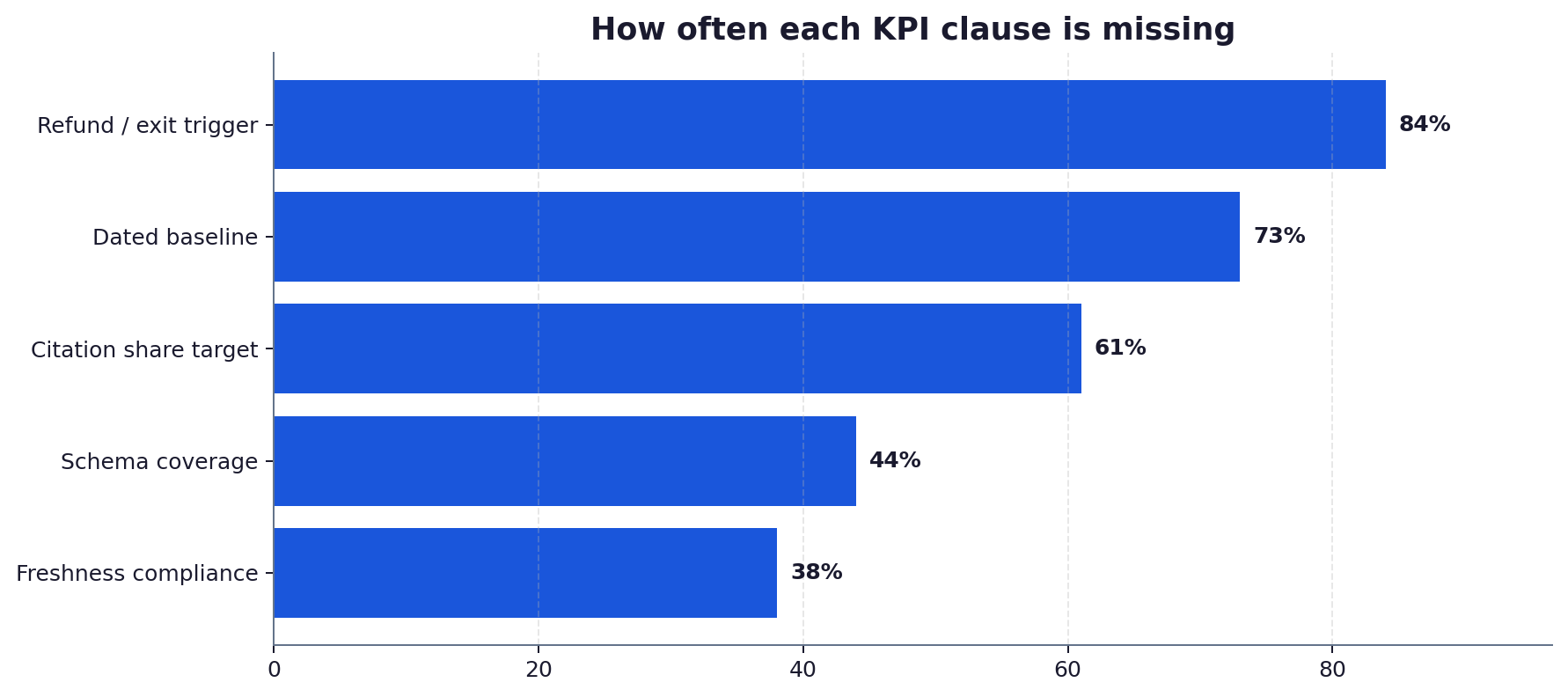
- The five clauses cover citation share gain, freshness compliance, schema coverage, a baseline and reporting cadence, and a refund or exit trigger.
- Every threshold must be measured over a window, not a single day, because AI answer sets are volatile.
- The refund-trigger clause is the one with teeth: it specifies what happens if agreed KPIs are missed for a defined period.
- The sample clause language here is illustrative, to adapt with a solicitor, not legal advice.
Key facts
- Citation share, the proportion of relevant AI answers that cite a brand, is the outcome metric a contract should anchor to (AiBoost, 2026).
- GEO outcomes are measurable across a query set, which is what makes a KPI clause enforceable (Aggarwal et al., 2024).
- AI answer sets shift week to week, so any KPI threshold must be averaged over a window (Ahrefs, 2026).
- Tools such as Profound make the measurement repeatable enough to write into a contract (Profound, 2026).
- Measuring GEO success means tracking citations and referrals, not clicks and rankings alone (AiBoost, 2026).
Why most AI SEO contracts have no teeth
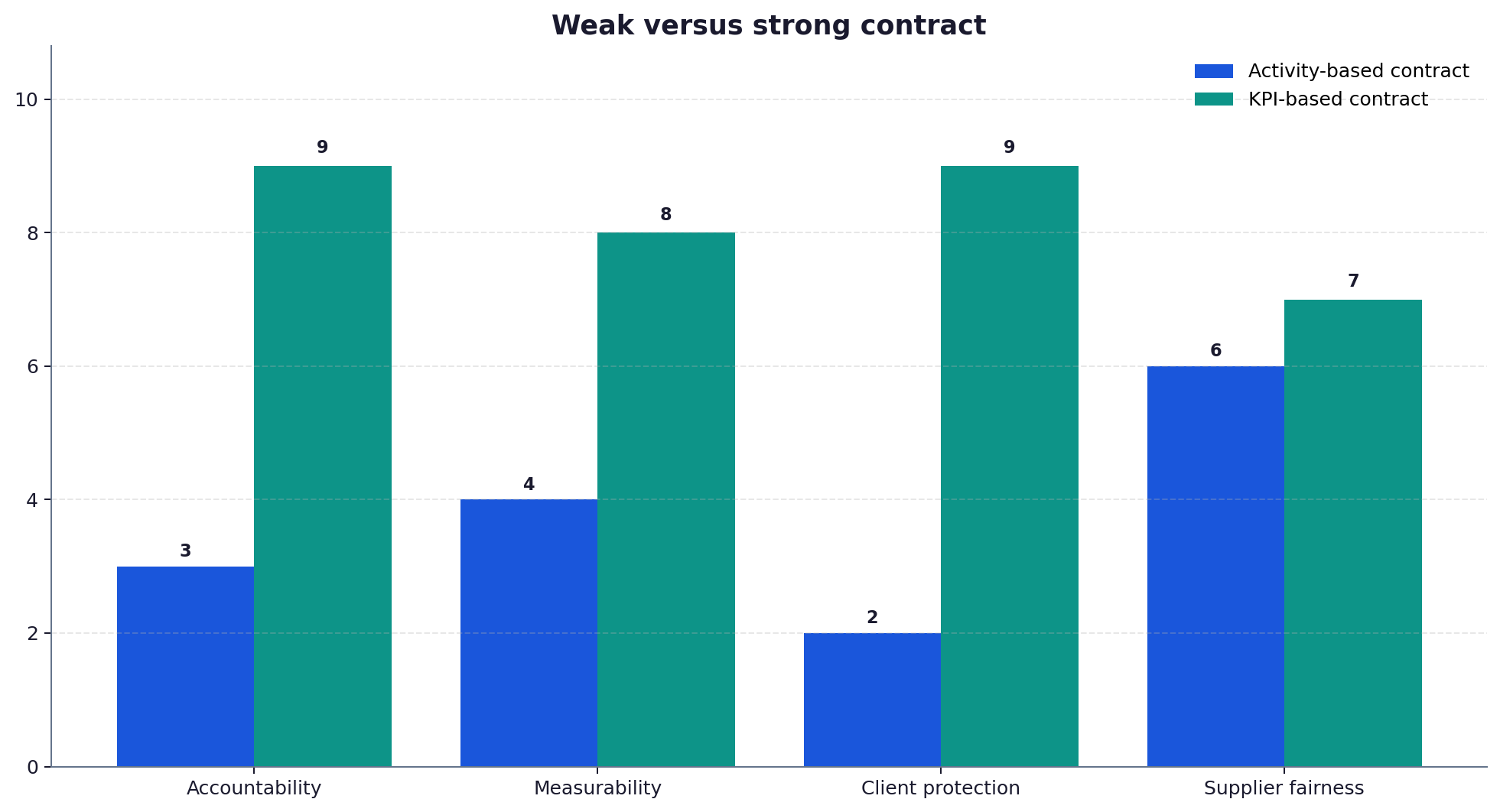
The standard AI SEO contract pays a monthly fee for a list of activities: so many content pieces, so much technical work, a monthly report. Nothing in it connects the money to whether the brand actually became more visible in AI answers. That is comfortable for a weak supplier and expensive for the client, who carries all the risk and has no defined remedy if nothing moves. The fix is to write KPIs into the contract, with a baseline to measure from and a trigger that bites if the targets are missed. The five clauses below are the spine of an accountable agreement.
Clause 1: citation share gain
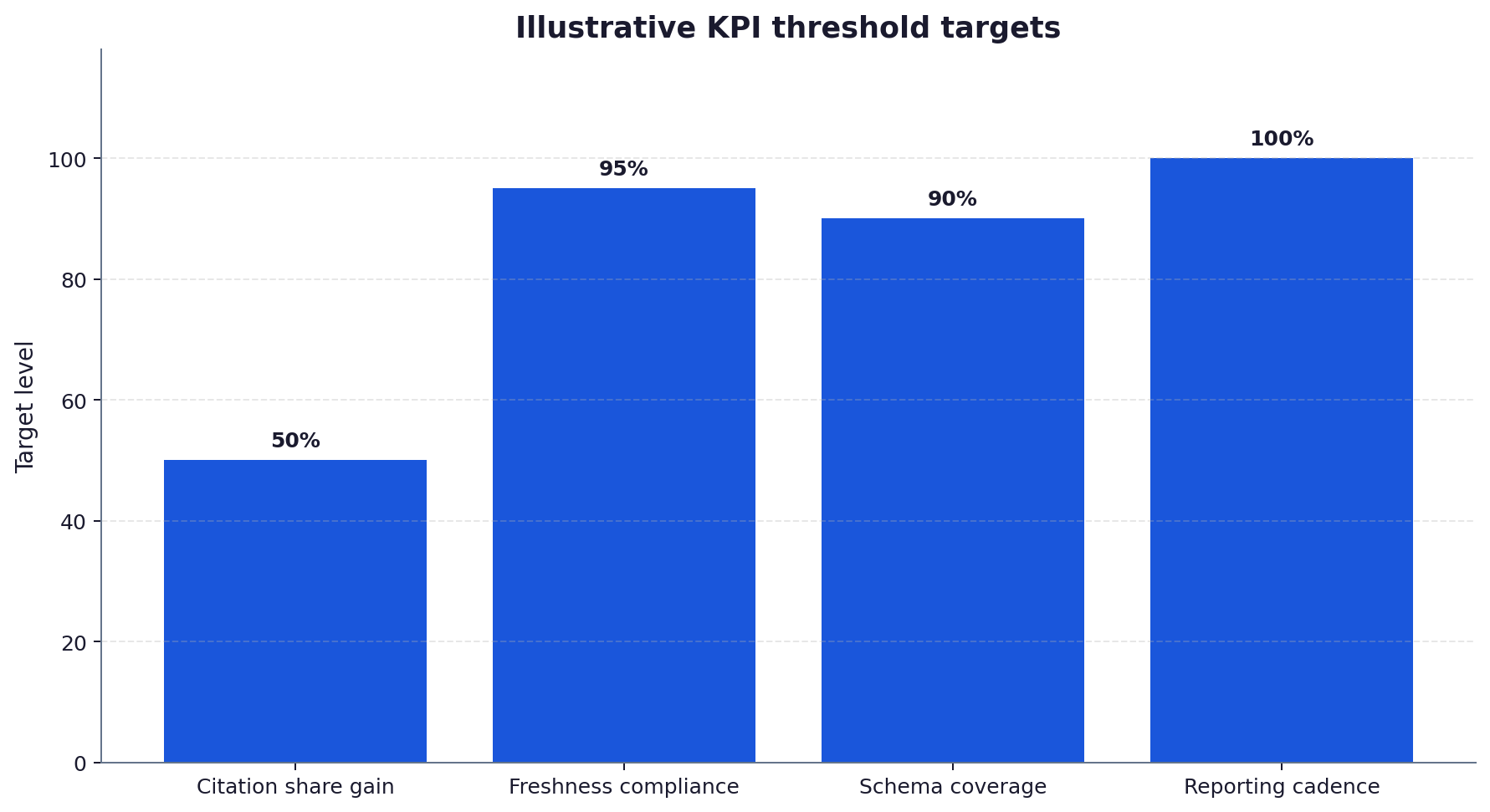
This is the headline outcome clause. It states the target query set, the engines measured, a dated baseline citation share, the gain required and the window over which it is assessed. An illustrative form: the supplier shall increase the brand’s citation share across the agreed forty-query set, averaged over a rolling four-week window, from the baseline recorded on the start date to an agreed target by month six. The specifics matter more than the number, because a clause without a defined query set and window is unenforceable.
Clause 2: freshness compliance
Freshness is a maintenance outcome that is easy to verify, which makes it a strong contractual KPI. The clause defines a content set and a standard, for example that every page in the agreed priority set carries a visible last-updated date within the last ninety days and has been substantively reviewed on that cadence. Freshness compliance is binary per page, so it is simple to audit and hard to dispute, which is exactly what you want in a contract term.
Clause 3: schema coverage
Schema coverage is the most objective clause of all, because it is either present and valid or it is not. The clause requires that an agreed set of page types carry valid Schema.org markup of named types, verified by a structured-data testing tool, by a stated date. Because schema is the highest-leverage retrieval signal, this clause protects the foundation the citation outcome depends on, and its objectivity makes it the easiest KPI to enforce without argument.
Clause 4: baseline and reporting cadence
This clause makes the others enforceable. It fixes the dated baseline taken before work begins, the measurement method for each KPI, the reporting cadence, and the requirement that the supplier track each metric over a window rather than reporting single readings. Without this clause the others float free, because there is no agreed starting point or method to judge them against. It is unglamorous and it is the clause that decides whether a dispute is resolvable.
Clause 5: the refund or exit trigger
This is the clause with teeth. It defines what happens if agreed KPIs are missed for a defined period: a fee reduction, a credit, a refund of a portion, or a right to exit without penalty. An illustrative form: if the citation share and freshness KPIs are both missed for two consecutive assessment windows, the client may reduce the following month’s fee by an agreed percentage or terminate on thirty days notice. The trigger must be specific, time-bound and tied to the KPIs defined above, or it is decoration. Adapt the exact remedy with a solicitor.
Setting thresholds you can actually enforce
The hardest part is choosing thresholds that are fair to both sides given how volatile AI answers are. Three principles help. Measure every KPI over a rolling window so a single bad week does not trigger a penalty unfairly. Set targets against the dated baseline, not against an aspiration plucked from the air. And keep the query set fixed for the life of the contract, because changing it mid-term breaks every comparison. Thresholds built this way protect the client without exposing an honest supplier to pure noise.
One more point separates a workable contract from a punitive one. Make the remedies proportionate and staged rather than all-or-nothing. A first missed window might trigger a review meeting and a remediation plan, a second a fee reduction, and only a sustained miss the exit right. Staging the consequences keeps an honest supplier engaged through a rough patch caused by an engine update, while still giving the client real protection if the work genuinely is not landing. A contract that jumps straight to termination on a single miss tends to make suppliers manage to the clause rather than to the outcome.
Frequently asked questions
What KPIs should an AI SEO contract include?
Five carry most of the accountability. A citation share gain target measured against a dated baseline over a window; a freshness compliance standard for a defined content set; a schema coverage requirement verified by a testing tool; a baseline and reporting clause that fixes how everything is measured; and a refund or exit trigger that defines the remedy if KPIs are missed. Together they move the contract from paying for activity to paying for outcomes, and each is chosen because it can be measured objectively enough to enforce.
How do I write a citation share clause that is enforceable?
Specify everything a dispute would turn on: the exact query set, the engines measured, the sampling method, a dated baseline recorded on the start date, the gain required, and the rolling window over which it is assessed. A clause that says the supplier will improve AI visibility is unenforceable because none of those terms are defined. One that names a forty-query set, a four-week rolling window and a target measured from a recorded baseline can actually be tested. The precision is what gives the clause force.
Why measure KPIs over a window instead of a single date?
Because AI answer sets are volatile, so a single reading can swing for reasons unrelated to the work. A page might appear in many answers one week and few the next with no change to the page. Measuring over a rolling window of, say, four weeks averages out that noise and gives a figure that reflects the brand’s real standing. Writing single-day measurement into a contract would expose both sides to luck: an honest supplier could be penalised for noise, or a weak one rewarded for it.
What should a refund-trigger clause actually say?
It should define the remedy, the condition and the timing precisely. A workable shape: if named KPIs are missed for a stated number of consecutive assessment windows, the client may reduce the next fee by an agreed percentage, take a credit, or terminate on a stated notice period without penalty. Tie it to the KPIs defined earlier in the contract, make it time-bound, and keep the remedy proportionate. Because this clause carries legal and financial consequences, draft the exact wording with a solicitor rather than copying a template verbatim.
Is freshness compliance a fair thing to put in a contract?
Yes, and it is one of the fairest, because it is largely within the supplier’s control and easy to verify. Unlike citation share, which depends partly on engine behaviour, keeping a defined content set updated to an agreed cadence is a maintenance task the supplier can simply do. The clause is binary per page, present or not, so it is simple to audit and hard to dispute. That objectivity makes freshness compliance a low-friction KPI that protects the client without creating arguments about measurement.
Do these clauses replace a good working relationship?
No, and they are not meant to. KPI clauses protect both sides when something goes wrong, but the day-to-day value still comes from a supplier who communicates, explains trade-offs and does good work. Think of the clauses as the floor, not the relationship: they ensure the client is not paying indefinitely for no result, and they give an honest supplier clear, fair targets to be judged against. The best engagements rarely invoke the refund trigger, because the KPIs are being met, which is the entire point of writing them down.
Sources and references
- Citation Share Is the New Ranking Position: A KPI Framework. AiBoost, 2026
- Measuring GEO Success, Beyond Clicks and Rankings. AiBoost, 2026
- GEO: Generative Engine Optimization. arXiv (Aggarwal et al.), 2024
- Measuring brand presence across AI answers. Profound, 2026
- AI Overviews and citation volatility study. Ahrefs, 2026
- How SLAs and performance terms work in marketing contracts. Search Engine Land, 2026
Every KPI clause needs a baseline to measure against. A free AI visibility report gives you a dated reading of your citation share before you sign, so the thresholds in your contract are anchored to real numbers.
Change log
- 2026-06-11: Initial publication.