TL;DR
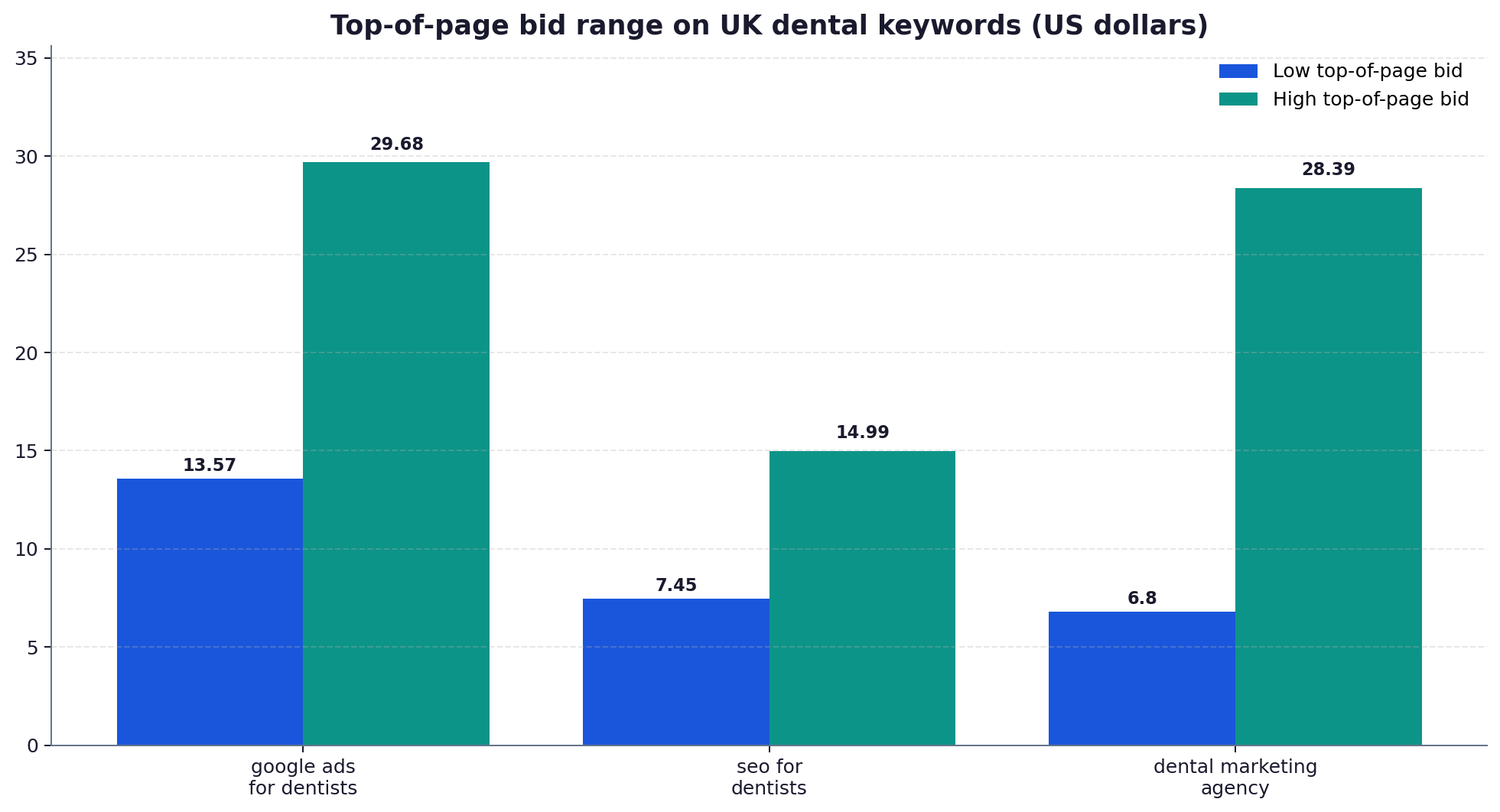
- google ads for dentists reports 90 UK searches a month at a $19.07 average CPC, inside a top-of-page bid range of $13.57 to $29.68 (UK Google Ads pull, 12 September 2026).
- The paid terms are the least contested part of the dental cluster. On Google’s 0 to 100 competition index, facebook ads for dentists scores 2 and google ads for dentists scores 14, against 37 for seo for dentists and 70 for dental marketing agency.
- A dental click costs roughly twice an organic-intent click. seo for dentists reports $9.95 against $19.07 for the Google Ads term, on five times the volume.
- GDC guidance requires a dental practice website to display the practice name and geographic address, email and telephone, the GDC’s contact details or a link, the complaints procedure including the Dental Complaints Service for private treatment, and the date the website was last updated. A standalone paid landing page sitting outside your main navigation still has to carry all of it.
- Only dentists on a GDC specialist list may use “Specialist” or “specialist in”. Everybody else uses “special interest in”, “experienced in” or “practice limited to”. That constraint shapes your ad headlines before it shapes your website.
- Botox is a prescription-only medicine and cannot be advertised to the public. The ASA treats almost any reference, direct or indirect, as likely to breach, which rules it out of ad copy entirely.
Key facts
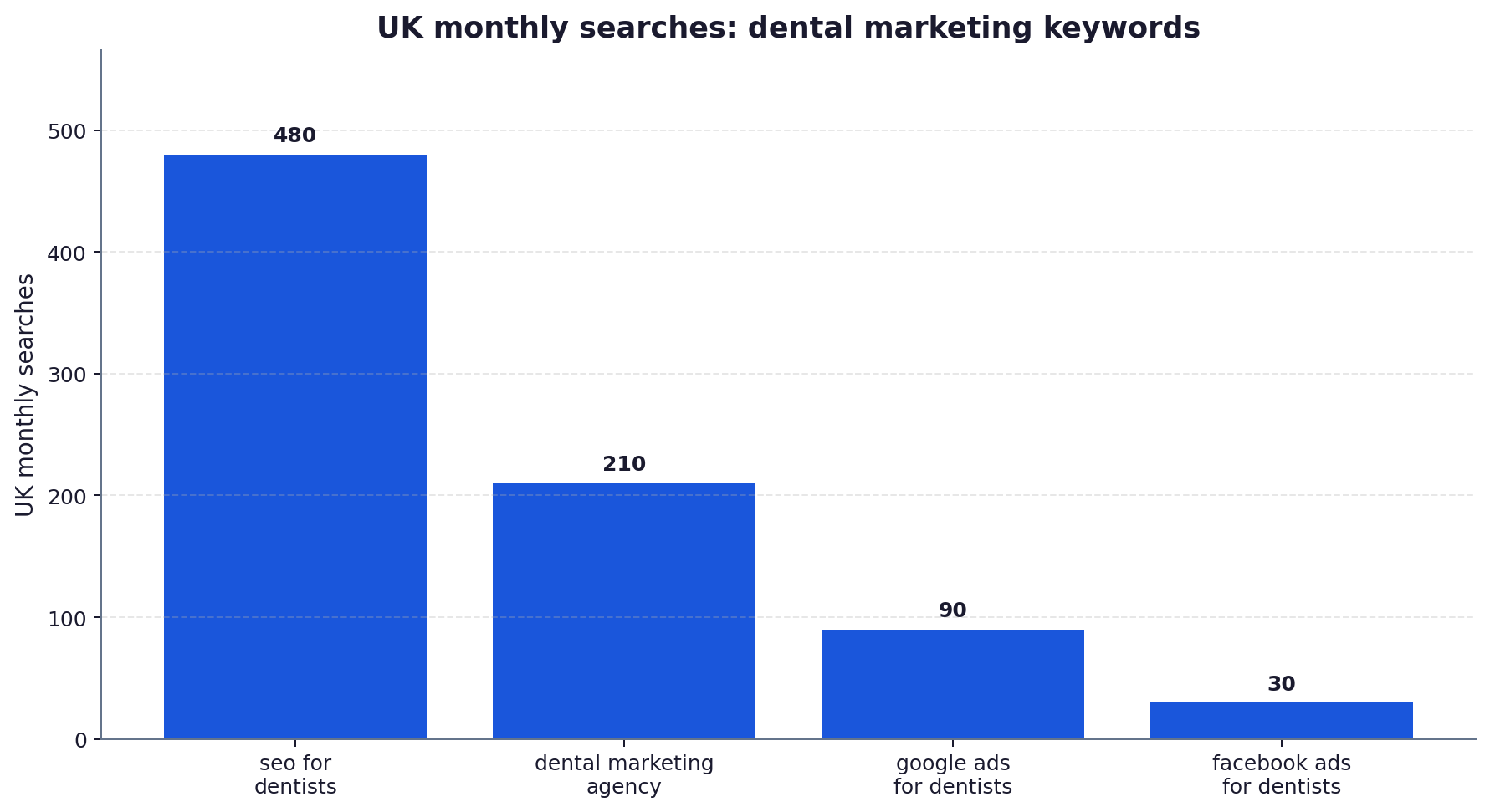
- google ads for dentists: 90 UK searches a month, LOW competition (index 14), reported CPC $19.07, top-of-page bids $13.57 to $29.68 (UK Google Ads pull via DataForSEO, 12 September 2026).
- facebook ads for dentists: 30 UK searches a month, LOW competition with an index of 2, the least contested term in the dental set.
- seo for dentists: 480 a month, MEDIUM competition (index 37), reported CPC $9.95 (11 September 2026 run).
- dental marketing agency: 210 a month, HIGH competition (index 70), reported CPC $19.58. The agency term is the fight; the practice terms are not.
- GDC Standard 1.3.3 of Standards for the Dental Team requires advertising to be “accurate and not misleading, and complies with the GDC’s guidance on ethical advertising”.
- CAP advice on tooth whitening: it “may only be carried out by registered dentists, dental therapists, dental hygienists and clinical technicians working to the prescription of a dentist”, and work by non-dental professionals “could be illegal”.
What a dental click costs in the UK
The September 2026 UK Google Ads pull puts google ads for dentists at 90 searches a month with a reported average CPC of $19.07. The top-of-page bid range around it runs $13.57 to $29.68, so the average sits a little above the middle. Compare that with seo for dentists, which draws five times the volume at 480 a month but clears at $9.95 with a $7.45 to $14.99 range. The paid-intent term costs roughly twice as much per click as the organic-intent one.
As with the legal cluster, these are prices for clicks on keywords about dental marketing services, which is the auction a practice enters when it goes looking for an agency. They are not the prices for emergency dentist Leeds or invisible braces near me, which is the auction the practice’s own campaign will enter. The value of the marketing cluster is as a read on how contested the advice market is, and on that reading the dental advice market is contested at the agency end and wide open at the practice end.
The paid terms are the least contested part of the cluster
Google publishes a competition index from 0 to 100 alongside its competition labels, and on the dental set the spread is unusually wide. facebook ads for dentists scores 2. google ads for dentists scores 14. seo for dentists scores 37. dental marketing agency scores 70, which is a HIGH label.
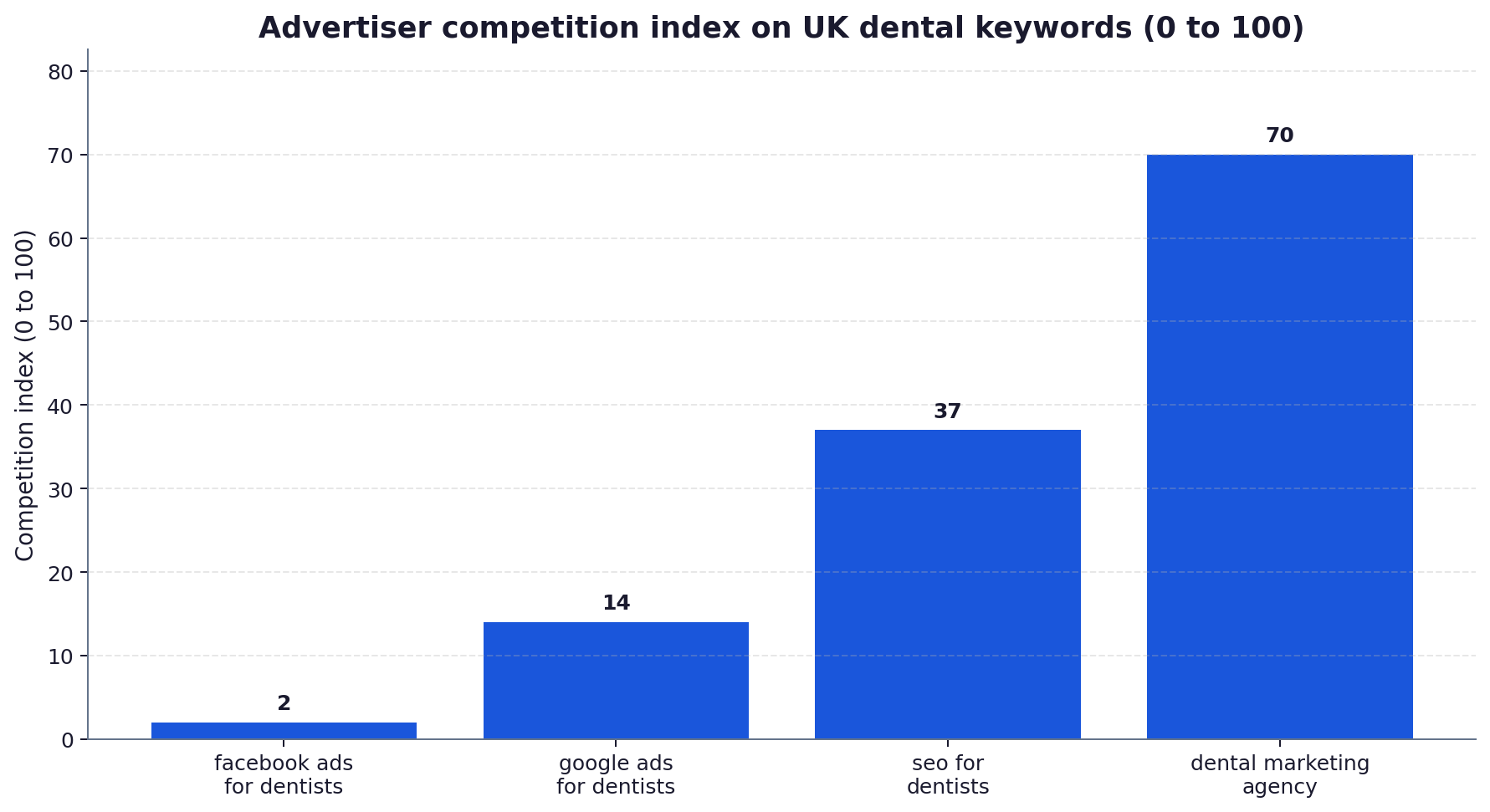
That ranking says something practical. A practice searching dental marketing agency lands in the most expensive, most crowded auction in the sector, where every agency in the country is bidding. A practice searching facebook ads for dentists lands in an auction with almost nobody in it. The same asymmetry runs through the organic results, which is why our work on healthcare marketing agency services starts from what a specific practice type needs rather than from a generic package.
The GDC rules that govern your landing page, not only your homepage
This is where UK dental paid media differs from the American advice most practices find online. Standard 1.3.3 of the GDC’s Standards for the Dental Team requires advertising to be accurate, not misleading and compliant with the Council’s ethical advertising guidance, and the GDC Guidance on advertising sets out what a dental practice website must display:
- “the name and geographic address at which the dental service is provided”
- “contact details of the dental service, including e-mail address and telephone number”
- “the GDC’s address and other contact details, or a link to the GDC website”
- “details of the practice’s complaints procedure and information about who patients may contact if they are not satisfied with the response”
- “the date the website was last updated”
Where a named dental professional appears on the site, the guidance also requires “your professional qualification and the country from which that qualification is derived” and “your GDC registration number”.
The reason this bites in paid media is that campaign landing pages are usually built outside the main site navigation, precisely so the message can be matched to the ad. Those pages are still part of the practice website. A stripped-back implant landing page with a form, three photographs and no complaints procedure, no GDC link and no last-updated date is a compliance gap, and it is the commonest one we see. The complaints information has to name the route as well: the relevant NHS body for NHS treatment, and the Dental Complaints Service for private treatment. Building that requirement into the page template once solves it for every campaign, which is how we approach landing page builds for regulated practices.
The specialist rules then shape the ad copy itself. A dentist on a GDC specialist list “can use the title ‘Specialist’ or describe yourself as a ‘specialist in….'”. A dentist who is not on a list “must not use titles which may imply specialist status such as Orthodontist, Periodontist, Endodontist etc.”, and dental care professionals “must ensure that you do not mislead patients by using titles which could imply specialist status, such as ‘Smile specialist’ or ‘Denture specialist'”. The permitted alternatives are “special interest in..”, “experienced in..” or “practice limited to…”. Those phrases are longer than the ones they replace, which matters when a Google Ads headline gives you thirty characters. Plan the headline around the permitted wording rather than writing it first and editing it down.
What the ASA will not let a dental ad say
The CAP Code applies to your ads and to your website, and the ASA has ruled on dental advertising repeatedly. Three rules do most of the work.
Prescription-only medicines cannot be advertised to the public. Botox is a prescription-only medicine, and CAP’s guidance on advertising Botox is that it “cannot be advertised to the public, full stop”, with the ASA treating “almost any reference to Botox, direct or indirect, as likely to breach the rules”. There is a narrow website exception where a casual browser should not be able to find any reference easily and it may be named as a possible treatment option after a consultation. In a paid campaign, where the whole point is to put the message in front of people who were not looking, that exception is no help. Facial aesthetics campaigns have to be built around the consultation, not the product.
Before and after photos must be genuine. CAP’s dental advertising advice requires that before and after photos of dental treatment, whitening or straightening “must be genuine and representative”, and that “marketers must hold signed and dated proof of this”. Stock imagery in a before-and-after frame is the fastest way to a ruling. If your ad creative relies on results photography, the consent and dating paperwork has to exist before the campaign goes live.
Whitening claims and price claims both need backing. CAP’s advice on teeth whitening confirms it may only be carried out by registered dentists, dental therapists, dental hygienists and clinical technicians working to a dentist’s prescription. On price, marketers promoting savings claims “should be able to provide evidence that their service was sold at the ‘was’ price”, with sales invoices as the evidence. A “was £450, now £299” whitening ad needs invoices showing the treatment actually sold at £450.
One smaller point catches practices out. CAP advises that dentists who refer to themselves as “Dr” “should take care not to imply that they hold a general medical qualification if they do not”. In an ad headline, where context is thin, that risk is higher than on a biography page.
Google or Meta for a UK dental practice
Split the treatments, not the budget. Search works for treatments with a trigger: emergency appointments, a broken crown, a lost filling, pain. Somebody typing that query has already decided. Paid social works for treatments people consider for months before acting, which in dentistry means implants, aligners and cosmetic work. Nobody wakes up and decides to start orthodontic treatment because of a Facebook ad, but the ad is what puts your practice on the list they think about.
Our study of how clinics get more private patients through Facebook ads covers the paid social mechanics, and our piece on whether private clinics should invest in Google Ads covers the search side across clinic types. For the organic half of dentistry specifically, our UK dental SEO demand study has the search volumes, and local SEO for healthcare and private doctors covers the map pack work that feeds both channels. Wider benchmarks sit in UK Google Ads costs for 2026 and UK Facebook ads costs for 2026, and the failure patterns are in our list of mistakes businesses make with Meta ads.
Whichever channel you pick, the account needs conversion tracking that reflects how dental enquiries actually arrive. Most arrive by phone. An account optimising on form fills alone will quietly defund the campaigns producing the calls, and the reporting will look fine while it happens. Practices building the wider picture will find the sequencing in our guide to growing a private clinic with digital marketing, and the Meta ads and Google Ads service pages set out how we run each one.
Working backwards from a click price
Do not start with a monthly figure. Start with the treatment. Decide how many new patients of a given type you want in a month, apply your own historical enquiry-to-booking rate and your own website conversion rate, and multiply the resulting click requirement by a realistic click price for your treatment terms. If the answer is uncomfortable, the problem is usually the conversion rate rather than the click price, and fixing the page is cheaper than buying more clicks.
We deliberately do not publish a cost-per-new-patient figure for UK dentistry, because we do not hold first-party conversion data across dental practices and an invented benchmark would be worse than no benchmark. Your own numbers from the last twelve months beat any published average, and if you do not have them, collecting them is the first project rather than the campaign.
How we compiled these numbers
Search volumes, competition indices, average CPCs and top-of-page bid estimates come from UK Google Ads search-volume pulls run through DataForSEO on 11 and 12 September 2026, location United Kingdom, language English, saved in Prism/data/. Dental terms were captured in the same two sessions as 50-plus other service verticals, so cross-sector comparisons read across one snapshot rather than numbers stitched together from different tools. Twelve-month series come from the same response objects. Every regulatory statement in this post was checked against the regulator’s own published page and quoted rather than paraphrased: the GDC’s Guidance on advertising and Standards for the Dental Team for the dental requirements, and CAP’s published advice pages for the advertising rules. Where we could not verify a rule against a published source, it is not in the article.
Limitations and caveats
Google Ads search volumes are rounded buckets rather than counts, and they measure advertiser demand, not organic ranking difficulty. A LOW competition label means few advertisers bidding and says nothing about how hard the first page of organic results is to reach. Cost figures are reported by the source in US dollars and we have not converted them, because applying one exchange rate to a twelve-month average implies a precision the figure does not have. Across the 60 keywords in these pulls that carry a twelve-month series, 39 show a September 2025 reading at least three times the median of their other eleven months, google ads for dentists among them at 390 against a median of 40. That pattern spans unrelated verticals and looks like a reporting artefact, so annual averages in this dataset run high. We have flagged it rather than adjusted for it. We did not model cost per enquiry or cost per new patient, because we hold no first-party dental conversion data. Nothing here is regulatory or legal advice, and practices should read the GDC’s and CAP’s published guidance in full and take their own advice.
Frequently asked questions
How much does a Google Ads click cost for a UK dental practice?
On the keyword google ads for dentists, the September 2026 UK data reports an average CPC of $19.07 inside a top-of-page bid range of $13.57 to $29.68, with LOW advertiser competition. That is the market for dental marketing services rather than for dental treatment terms, so a practice bidding on dental implants or emergency dentist in its own town will see different figures. The useful comparison is that the paid-intent term costs roughly twice the organic-intent term, seo for dentists, which reports $9.95.
What must a dental practice landing page include under GDC guidance?
The GDC’s Guidance on advertising requires a dental practice website to display the name and geographic address at which the service is provided, contact details including email address and telephone number, the GDC’s address and contact details or a link to the GDC website, details of the complaints procedure with who to contact if the patient is not satisfied, and the date the website was last updated. Where a named professional appears, their qualification, the country it came from, and their GDC registration number are also required. A campaign landing page is part of the website, so it carries the same requirements.
Can a UK dental practice advertise Botox?
No, not to the public. Botox is a prescription-only medicine, and CAP’s guidance states it cannot be advertised to the public at all, with the ASA treating almost any reference, direct or indirect, as likely to breach the rules. A narrow exception exists on a website where a casual browser could not easily find any reference and it is named only as a possible treatment option following consultation. That exception does not help a paid campaign, whose purpose is to put the message in front of people who were not looking. Build facial aesthetics advertising around the consultation instead.
Can a dentist call themselves a specialist in an ad?
Only if they are on a GDC specialist list. The GDC guidance permits those on a list to use the title “Specialist” or describe themselves as a “specialist in”. Those not on a list must not use titles implying specialist status such as Orthodontist, Periodontist or Endodontist, and dental care professionals must avoid constructions such as “Smile specialist” or “Denture specialist”. The permitted alternatives are “special interest in”, “experienced in” and “practice limited to”. Since these phrases are longer, write ad headlines around them rather than trimming a non-compliant headline afterwards.
Is Google or Facebook better for a dental practice?
They serve different treatments. Search captures triggered demand: emergency appointments, pain, a broken crown, where the patient has already decided and is choosing a practice. Paid social reaches people considering elective treatment over months, which in dentistry means implants, aligners and cosmetic work. The data shows both auctions are lightly contested, with a competition index of 14 for the Google term and 2 for the Facebook term. A practice with budget for one should pick based on which treatments it wants to fill, not on which channel is cheaper.
Do the ASA rules apply to a practice’s own website as well as its ads?
Yes. The CAP Code covers marketing communications on a company’s own website, which is why the before and after photography rule matters as much on your treatment pages as in a paid ad. CAP requires that before and after images of dental treatment, whitening or straightening are genuine and representative, and that the marketer holds signed and dated proof. Savings claims need evidence the service actually sold at the higher “was” price, with sales invoices as the standard evidence.
Why is search volume for dental paid media so low?
google ads for dentists records 90 UK searches a month and facebook ads for dentists records 30, against 480 for seo for dentists. Most UK practices research organic search before they research paid media, so the paid terms sit in the long tail. Low volume is not the same as low value: the competition index on both paid terms is in single or low double figures, meaning very few advertisers are contesting them, and the treatment-level auctions a practice actually bids in are a separate and much larger market.
Sources and references
- Guidance on advertising. General Dental Council, 2026
- Standards for the Dental Team. General Dental Council, 2026
- Advertising advice: Dental, general. Advertising Standards Authority and CAP, 2026
- Advertising advice: teeth whitening. Advertising Standards Authority and CAP, 2026
- UK Google Ads search volume and cost data, September 2026 pulls. DataForSEO, 2026
If your practice is already spending on Google or Meta and nobody has read the landing pages against the GDC guidance, that is worth checking before the budget goes up. Our free paid ads audit covers the account structure and the pages the money points at.
Change log
- 2026-09-28: Initial publication.