TL;DR
- UK electricians generate around 260 searches a month for SEO help, combining “electrician seo” and “seo for electricians” into one cluster (AiBoost keyword analysis of DataForSEO Google Ads data, August 2026).
- A click on electrician SEO terms costs advertisers £13.78, which is 3.6 times the plumber equivalent at £3.82. Competition on the keyword is rated LOW.
- The plumber SEO cluster runs at roughly 600 searches a month, 2.3 times the electrician cluster, yet plumber clicks are the cheapest of any trade we measured.
- £1,000 of ad budget buys roughly 72 electrician clicks at £13.78 and roughly 261 plumber clicks. Expensive clicks are the strongest argument for organic visibility.
- AiBoost has audited 250+ UK small businesses, and this scan covered 30 UK service verticals.
Key facts
- “electrician seo” and “seo for electricians” form a single UK cluster of about 260 searches a month (AiBoost keyword analysis of DataForSEO Google Ads data, August 2026).
- Cost per click on the electrician cluster is £13.78 with competition rated LOW (DataForSEO, August 2026).
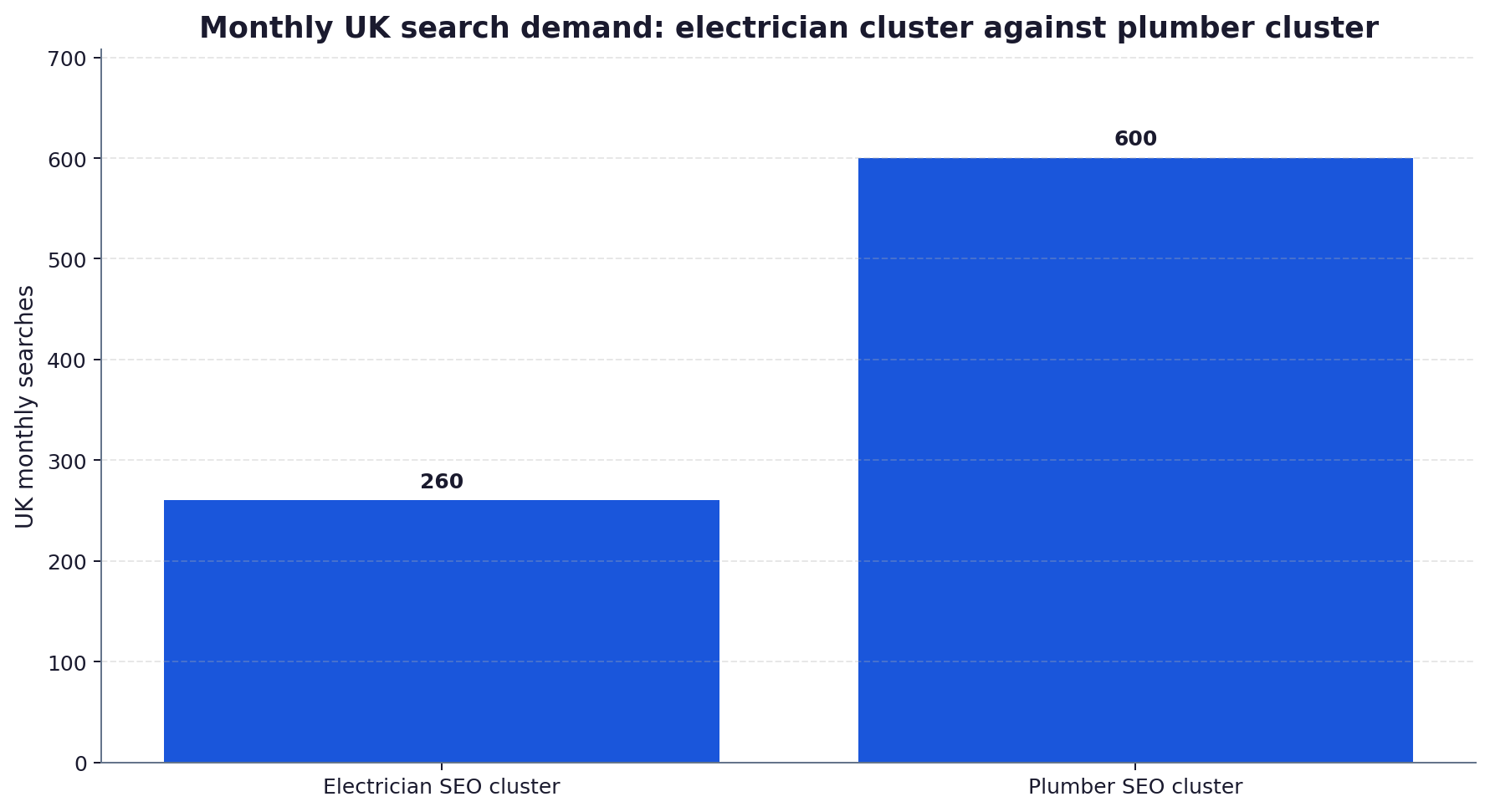
- The plumber SEO cluster is around 600 searches a month, against 260 for electricians, and a plumber click costs £3.82 (DataForSEO, August 2026).
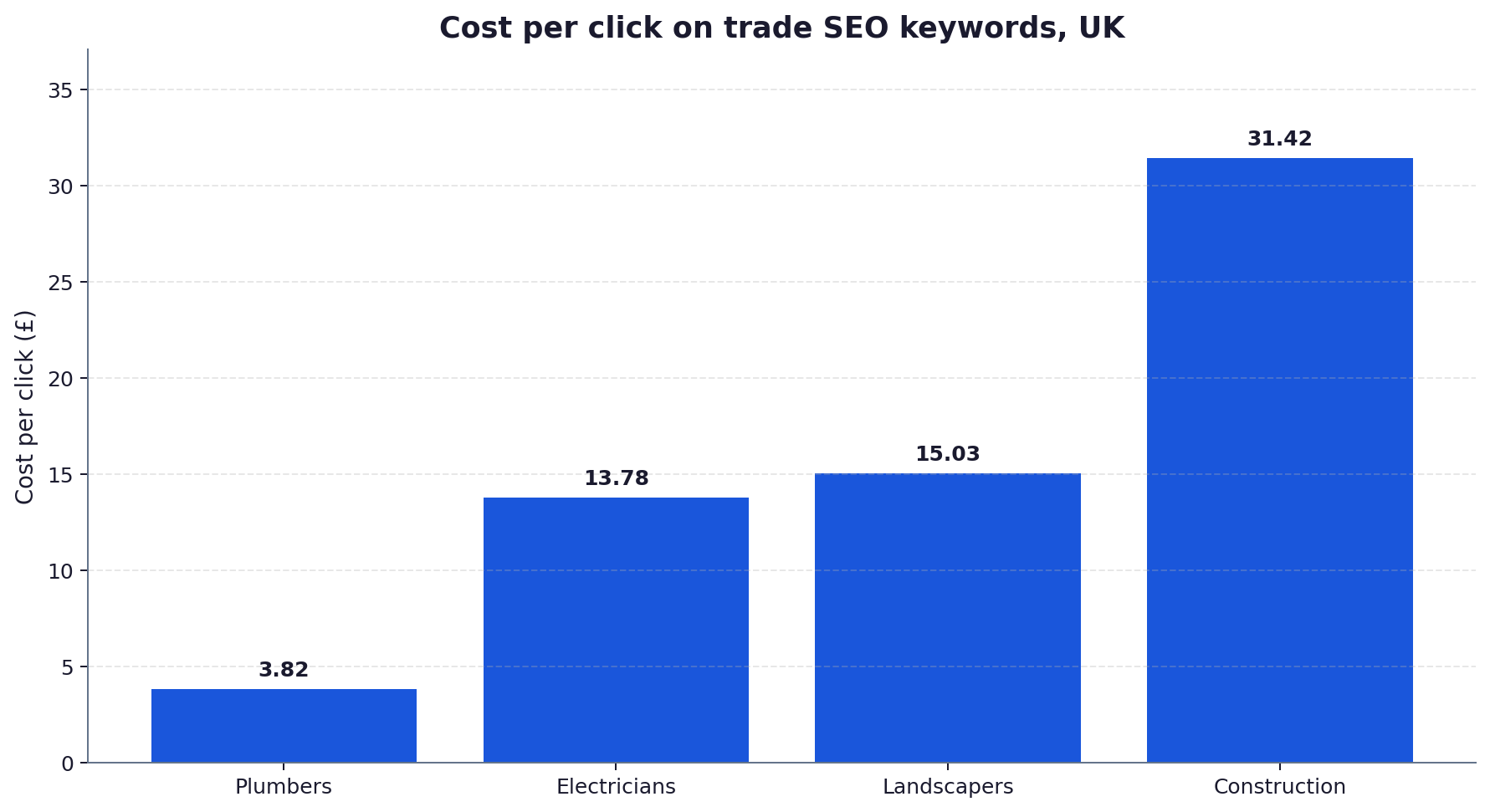
- Trades cost ladder: plumbers £3.82, electricians £13.78, landscapers £15.03, construction £31.42 per click (DataForSEO, August 2026).
- £1,000 of ad spend buys roughly 72 clicks at electrician rates and roughly 261 at plumber rates (arithmetic on DataForSEO CPCs, August 2026).
- AiBoost has audited 250+ UK small businesses across its GEO and SEO audit programmes (AiBoost, 2026).
The electrician SEO market in numbers
Our August 2026 scan of UK service verticals, built on DataForSEO Google Ads data, puts the electrician SEO cluster at roughly 260 searches a month. “electrician seo” and “seo for electricians” resolve to the same cluster, so demand is concentrated rather than spread across dozens of phrasings. The keyword carries a £13.78 cost per click and a LOW competition rating.
Those three numbers describe the whole opportunity. Volume of 260 shows a steady stream of UK electrical firms shopping for search help every month. LOW competition shows few agencies have built serious content for these terms. And £13.78 shows what advertisers believe an electrician lead is worth at the click stage, the most honest valuation signal available because it is set by people spending their own money.
Why an electrician click costs 3.6 times a plumber click
A plumber click costs £3.82. An electrician click costs £13.78. The 3.6x gap is the ad market’s verdict on job values, and it matches how the two trades earn. A large share of plumbing call-outs are small, urgent, one-visit jobs. Electrical work skews towards bigger tickets: consumer unit replacements, partial and full rewires, EICR reports for landlords, and EV charger installations. Advertisers bid up to the margin a job supports, so higher-value work produces dearer clicks.
The wider trades ladder makes the same point. Landscapers sit at £15.03, just above electricians, and construction companies at £31.42, reflecting project values that run into six figures. Electricians occupy the middle of the ladder, well clear of plumbers. The dearest click in the scan was dental at £86.44.
Plumbers get searched more, electricians pay more
The plumber SEO cluster runs at roughly 600 searches a month, 2.3 times the electrician cluster at 260. We covered that market in our companion analysis of SEO for plumbers. Read together, the two datasets describe an inverse relationship: plumbers search for SEO help more often but their clicks are the cheapest of any trade we measured, while electricians search less often and their clicks cost 3.6 times as much.
For an electrical firm the practical reading is favourable. Fewer competitors are actively investing in search, the competition rating is LOW, and each visitor a ranking page captures replaces a £13.78 paid click rather than a £3.82 one. The economics of organic visibility improve in direct proportion to the click price it displaces.
Emergency call-outs and planned work are different funnels
Electrical demand splits the same way plumbing demand does. Emergency searches, a tripped board that will not reset, happen on a phone, resolve in minutes, and are won in the local pack by proximity, reviews and an answered call. Planned work, a rewire, an EV charger, an EICR for a rental portfolio, involves research, comparison and two or three quote requests spread over days or weeks.
Most electrician websites serve neither funnel well: a single generic homepage where the emergency searcher cannot find a phone number in one glance and the researcher cannot find evidence of similar completed jobs. The fix is structural, a fast homepage built for the emergency case plus separate service pages for each planned-work category with photographs, timescales and certification details. We build this architecture as standard in our website projects for trades.
The local pack is the battleground
For every emergency query and most planned-work queries, the Google local pack sits above the organic results and takes the majority of clicks. Local pack position is governed by the Google Business Profile far more than by the website: category selection, review count and velocity, photographs of real jobs, and consistency between profile and site. The website’s role is to reinforce the profile with a page per service area and per service, backed by the structured data that lets engines match firm to query across its coverage patch. This layer is changing shape as assistants take over more local queries, a shift we track in our post on local SEO in the age of AI assistants.
The high-value end: EV chargers, rewires and consumer units
The £13.78 click price is an average across the vertical, which means the work behind it is not evenly valued. EV charger installation is the clearest growth category in domestic electrical work, and it behaves like a planned purchase: homeowners research hardware, compare installers and check certification before booking. Rewires and consumer unit upgrades carry similar research behaviour and larger invoices.
Certification is the trust signal that decides these comparisons. Firms certified through NICEIC or an equivalent scheme should say so on every service page, in text rather than in a footer badge alone, because “NICEIC certified electrician” is what cautious homeowners type. A dedicated page per high-value service, carrying certification, location and recent job evidence, is the highest-return content an electrical firm can build, and we set out the wider payback case in our cost-benefit analysis of AI-era SEO.
What happens when a prospect asks ChatGPT for an electrician
A growing share of planned-work research now starts as a question to an assistant: who is a good electrician near me for an EV charger install. We test this systematically rather than guess. Our methodology runs funnel-stage prompt panels, awareness, consideration and decision questions, against ChatGPT, Perplexity and Gemini, recording which firms are named and which sources are cited. It is the approach we applied in our 50-firm UK service benchmark and it underpins the wider shift we describe in how AI search is changing professional services marketing.
What the engines reward is legibility: a firm whose name, location, services and certification appear consistently across its site, its Google Business Profile and directory listings is far easier for an assistant to recommend than one whose evidence is thin or contradictory. Making a business legible to these engines is the discipline of generative engine optimisation, and the fastest way to see where you stand today is our free GEO audit.
A realistic budget for a one-van or small firm
The click arithmetic frames the budget decision honestly. At £13.78 per click, £500 a month of Google Ads buys roughly 36 visits and £1,500 buys roughly 108, before any become enquiries. Paid traffic stops the day the budget stops. Organic pages carry a build cost instead of a per-click cost, and a page that ranks keeps producing visits at no marginal price.
For a one-van firm the honest starting point is doing the foundations yourself: complete the Google Business Profile, ask every satisfied customer for a review, and write one plain page per service and per town served. Where an agency earns its fee is the layer above that, keyword selection against real data, page structures that rank, certification and schema markup done properly, and measurement. That is the scope of our SEO services, and the £13.78 click price is the benchmark any proposal should be judged against.
How we compiled the numbers
Every volume and cost per click in this article comes from a single AiBoost pull of DataForSEO Google Ads data in August 2026, set to the United Kingdom location and English language. We captured 30 service verticals in one session, so the figures are directly comparable with each other. Cluster volumes add the monthly searches Google groups under one keyword idea. Cost per click is the advertiser figure DataForSEO reports for that keyword.
Limitations
Google reports volume in bands, so a figure of 260 is a rounded estimate rather than a count. Close variants are grouped, which means “electrician seo” and “seo for electricians” share one number. Cost per click measures bidding pressure among advertisers, not the organic value of a visit. For electricians specifically, EV charger and rewiring demand is discussed qualitatively because those queries sit outside this keyword set, and seasonality is not quantified here.
Frequently asked questions
Is SEO worth it for a small electrical firm?
The ad market suggests yes. Advertisers pay £13.78 per click on electrician terms, 3.6 times the plumber rate, which means every visitor an organic page captures replaces a comparatively expensive paid click. Keyword competition on the cluster is rated LOW, so the content bar for ranking is modest. The value case is strongest for firms selling planned work such as rewires, EICRs and EV charger installations, because those buyers research and compare before booking, which is exactly the behaviour organic pages intercept. A firm relying purely on emergency call-outs should prioritise its Google Business Profile.
Why do electrician clicks cost more than plumber clicks?
Because advertisers bid up to the margin a job supports. Plumber clicks cost £3.82 and a large share of plumbing work is small, urgent, single-visit jobs. Electrician clicks cost £13.78, 3.6 times as much, because electrical work skews towards bigger invoices: consumer unit replacements, partial and full rewires, landlord EICR reports and EV charger installations. The same logic runs up the trades ladder, with landscapers at £15.03 and construction companies at £31.42 per click (AiBoost keyword analysis of DataForSEO Google Ads data, August 2026).
How long does electrician SEO take to show results?
Local results move faster than national ones. Improvements to a Google Business Profile, categories, reviews, photographs and service descriptions, can shift local pack visibility within weeks. New service and area pages typically need several months to establish rankings, because Google needs time to crawl, index and test them against incumbents. Our practitioner observation across the 250+ UK small businesses AiBoost has audited is that firms starting from a thin site see the profile-level gains first and the page-level gains second, which is why we sequence work in that order.
Should electricians build pages for EV charger installation?
Yes, and it should usually be the first dedicated service page built. EV charger installation is the clearest growth category in domestic electrical work, it behaves like a researched purchase rather than a distress call, and buyers compare certification, hardware options and prices across several installers before booking. A dedicated page carrying certification details, supported charger brands, real installation photographs and the towns served gives an assistant or a search engine something concrete to match against those comparison queries.
Can electricians do their own SEO?
The foundations, yes. Completing the Google Business Profile, collecting reviews consistently, and writing one clear page per service and per town are tasks any firm can do without an agency, and they deliver most of the local pack gains. The layer above that is harder to self-serve: choosing keywords against real volume and cost data, structuring pages to rank, implementing schema markup and measuring citation in AI assistants all benefit from specialist tooling. A sensible path is to do the foundations in-house and judge any agency proposal against the £13.78 paid click it would replace.
Do AI assistants like ChatGPT recommend specific electricians?
They do, when asked for local recommendations, and which firms get named depends on how legible each business is to the engine. Our testing methodology runs awareness, consideration and decision prompts against ChatGPT, Perplexity and Gemini and records the firms and sources cited. Consistent naming of services, locations and certification across the website, Google Business Profile and directories makes a firm markedly easier to recommend. We do not publish universal citation statistics for the trade because answers vary by area and week, which is why we test per firm through the free GEO audit.
Sources and references
- Google Ads search volume and CPC data. DataForSEO, 2026
- NICEIC certification scheme. NICEIC, 2026
- Google Ads Help. Google, 2026
- Google Search Central documentation. Google, 2026
Get this analysis run on your own postcode, services and competitors instead of national averages. We will map the electrician queries your next customers actually type and price the work honestly.
Change log
- 2026-08-10: Initial publication.