TL;DR
- AI engines do not weight every schema type equally, so a single schema strategy leaves citations on the table.
- JSON-LD is the shared standard that Google, Bing, Perplexity and ChatGPT all rely on to read structured signals (BrightEdge, 2026).
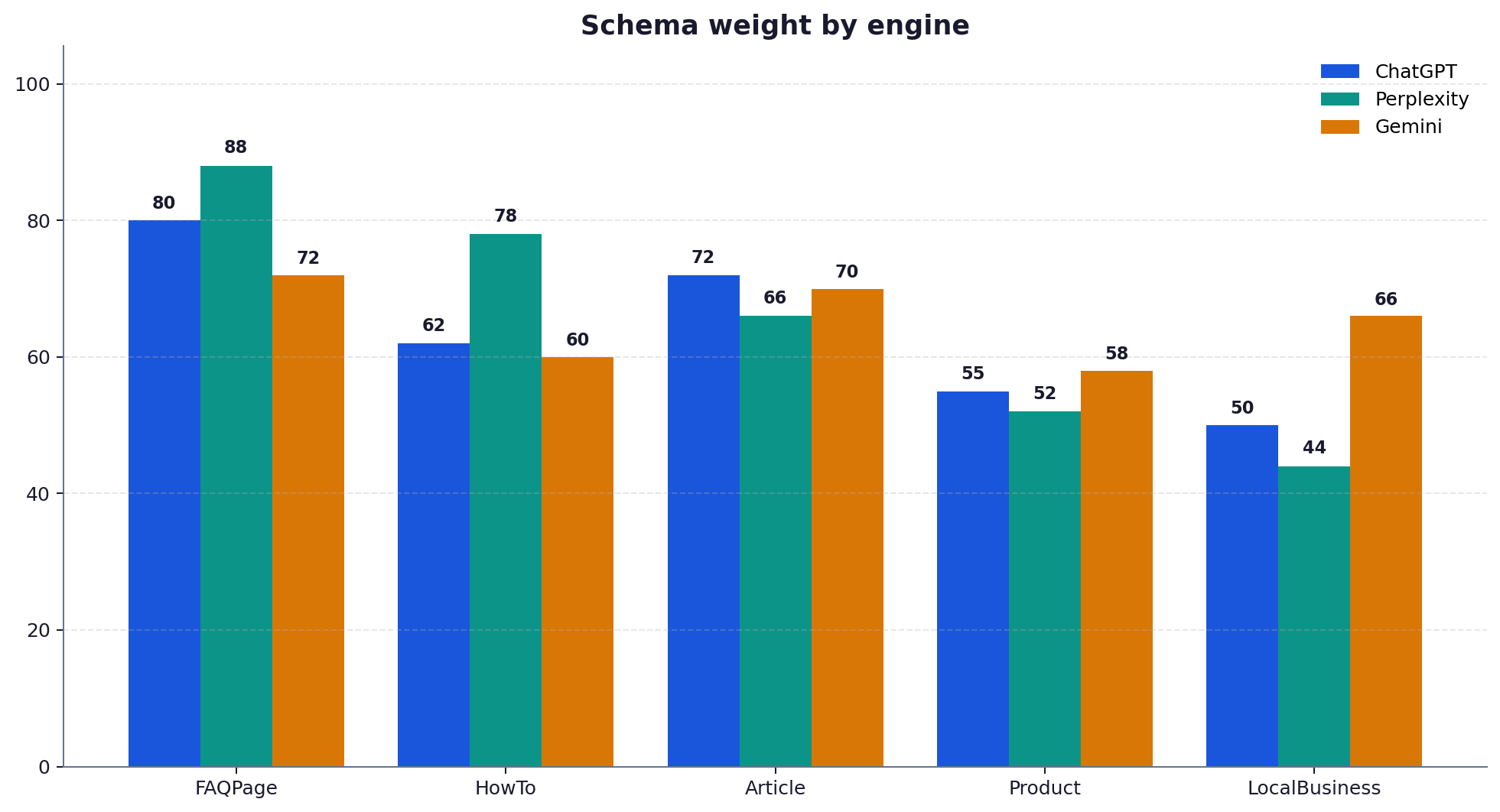
- FAQPage tends to carry the most AI leverage because question-and-answer pairs match how models are trained, with HowTo second for procedural content (structured-data analyses, 2026).
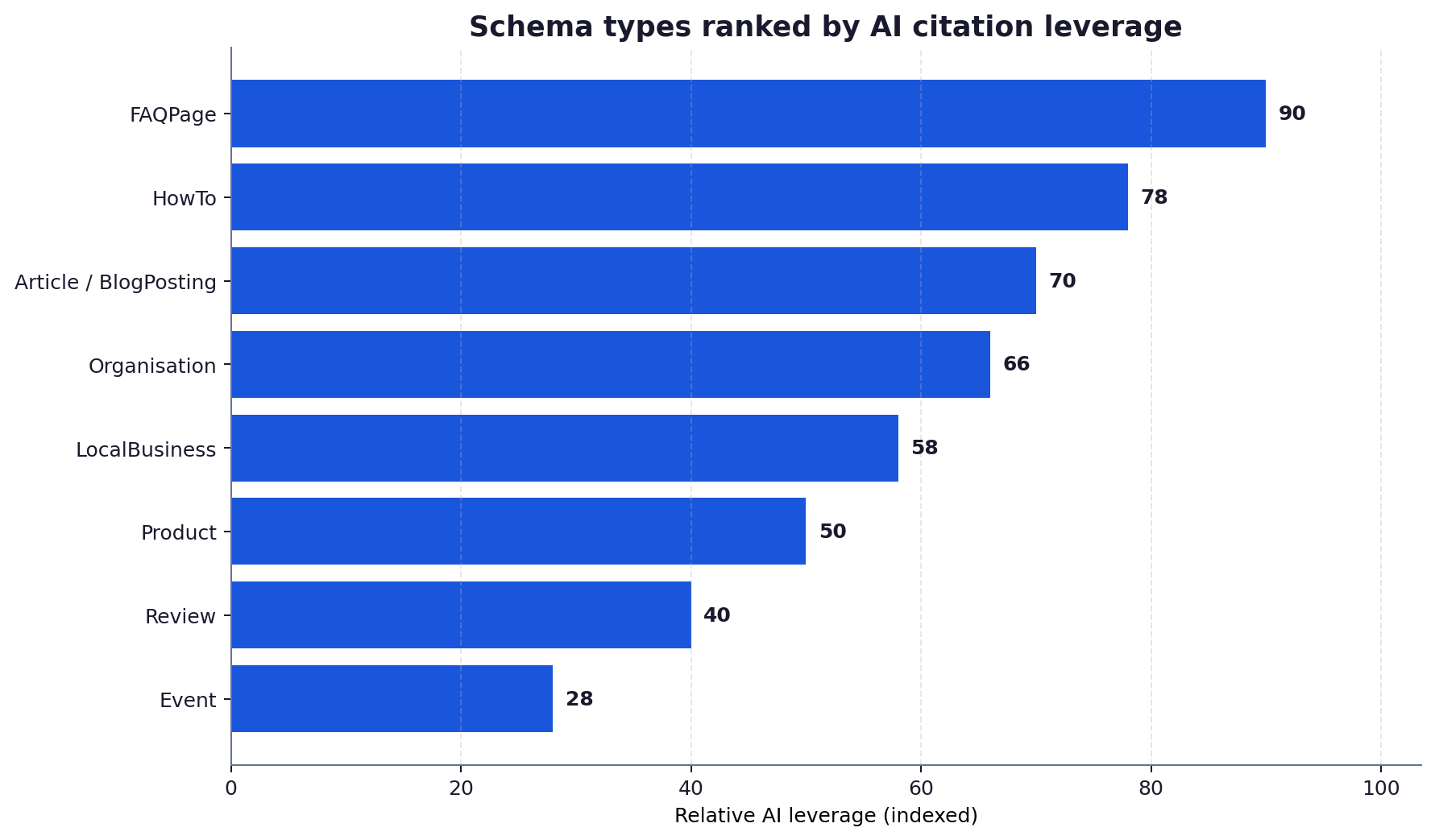
- Google removed FAQ rich results from Search on 7 May 2026 and deprecated HowTo earlier, but confirmed it still parses the markup, and Perplexity and Bing Copilot still read it (Google Search Central, 2026).
- So a schema you dropped for classic SEO can still earn AI citations. Priority should be set per engine, not by what shows a rich result in Google.
Key facts
- JSON-LD is the structured-data format Google, Bing, Perplexity and ChatGPT all rely on (BrightEdge, 2026).
- FAQPage is commonly the highest-leverage type for AI answers, with HowTo second for procedural queries (structured-data analyses, 2026).
- Google removed FAQ rich results from Search on 7 May 2026 and deprecated HowTo rich results on desktop back in 2023 (Google Search Central, 2026).
- Google confirmed it will keep parsing FAQ markup to understand pages, and AI systems such as Perplexity and Bing Copilot still read it (Google Search Central, 2026).
- Organisation, Article, Product and LocalBusiness round out the types that most affect AI visibility in 2026 (structured-data analyses, 2026).
- Structured, attributed content raises the odds a page is cited across engines (Aggarwal et al., arXiv, 2023).
Why one schema strategy is not enough
Structured data is usually treated as a single checkbox: add JSON-LD, move on. That misses a real difference. The engines that assemble AI answers do not value every schema type equally, and they do not value them the same way as each other. A page marked up for one engine’s preferences can be under-optimised for another, which means a blended schema plan quietly underperforms on at least one surface. The fix is a matrix: which schema type earns citations on which engine, so effort goes where it changes outcomes.
The shared foundation is the format. JSON-LD is the structured-data standard that Google, Bing, Perplexity and ChatGPT all rely on to extract signals, because it keeps machine-readable data separate from the visible HTML. So the format question is settled. The open question is type priority, and that is where engines diverge.
The type that matches how models think
FAQPage tends to carry the most AI leverage, and the reason is structural. A model is trained on vast amounts of question-and-answer text, so a page that presents clean question-and-answer pairs gives it a pattern it already recognises and can lift directly into a response. HowTo comes second, for the same reason applied to procedural queries: numbered, discrete steps map neatly onto how an engine wants to present a process. Organisation, Article, Product and LocalBusiness fill out the set that most affects AI visibility, each doing entity and context work that helps an engine understand what a page and a brand are.
The deprecation trap: dropped for SEO, alive for AI
Here is where most schema advice goes wrong in 2026. Google removed FAQ rich results from Search on 7 May 2026, and it deprecated HowTo rich results on desktop back in 2023. A team reading only classic-SEO guidance concludes those schema types are dead and strips the markup. That is a mistake for AI visibility. Google itself confirmed it continues to parse FAQ markup to understand pages, and AI systems including Perplexity and Bing Copilot still read it. The rich result went away. The machine-readability did not.
So the deprecation is a search-appearance decision, not a signal that the structure is worthless. For an engine deciding whether to cite your answer, a clean FAQPage or HowTo block is still a gift, because it hands the model exactly the shape it wants. Keeping that markup is now a GEO decision that classic-SEO checklists will tell you to reverse.
How to build the engine-by-schema matrix
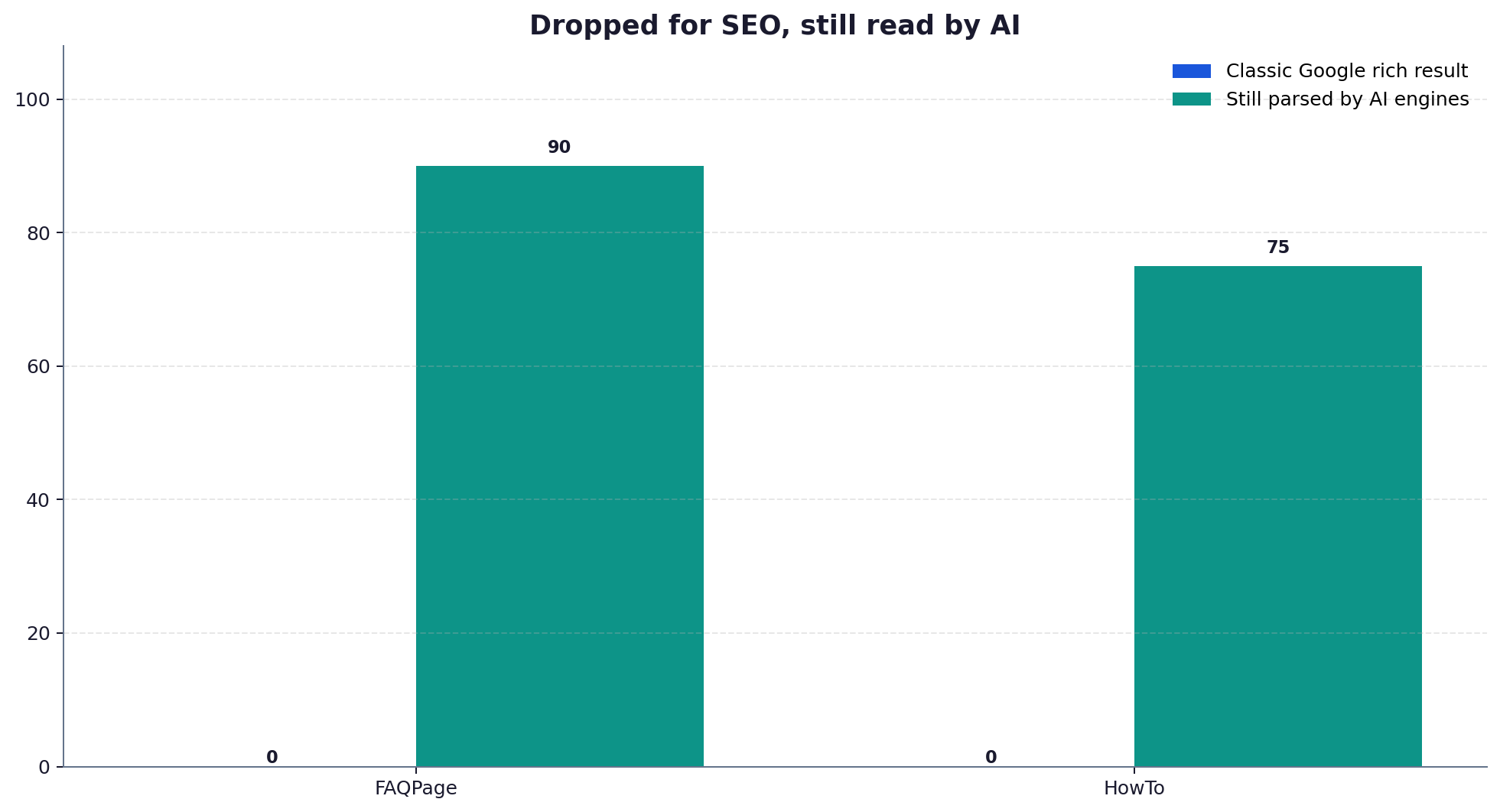
The matrix is straightforward to construct without special tooling. Take a set of around 30 queries that matter to your business, and a handful of pages you can mark up with different schema types. Run each query across ChatGPT, Perplexity and Gemini, note whether the marked-up page is cited, then compare citation rates by schema type within each engine. The output is a grid: rows are schema types, columns are engines, cells are how often that schema type accompanied a citation. Repeat runs matter here, because AI answers are noisy and a single run cannot separate a real effect from chance.
Directionally, the pattern that emerges is that FAQ and HowTo pull hardest on engines that quote passages closely, Article and Organisation do steady entity work everywhere, and LocalBusiness matters most for engines answering location queries. Treat the grid below as a starting hypothesis to test on your own pages rather than a fixed law.
What to prioritise, in order
For most UK businesses the order is clear. Start with Organisation and Article or BlogPosting, because they establish what your site and brand are and underpin everything else. Add FAQPage to your genuinely question-shaped pages and HowTo to your procedural ones, keeping the markup despite the loss of Google rich results, because AI engines still read it. Layer LocalBusiness where location is part of the query and Product where you sell things. Resist the urge to mark everything up as everything, since inaccurate or padded schema is a liability that engines can learn to distrust. A useful rule of thumb is to add a schema type only when the page genuinely is that thing: a real set of questions for FAQPage, a real step sequence for HowTo, a real product for Product. Markup that describes the page accurately compounds trust, while markup that overreaches invites the opposite.
Caveats and limitations
Two honest limits apply. First, the weightings here are directional. They synthesise 2026 structured-data analyses and the observable behaviour of each engine, and they are meant as a hypothesis to test on your own pages, not a measured constant, because engines change their handling of schema without announcement. Second, schema is a supporting signal, not a substitute for substance. Marking up a thin page does not make it citable, and the original GEO research is clear that the underlying content, its structure and its attribution, does the heavy lifting. Schema helps an engine read a good page. It cannot rescue a weak one.
Frequently asked questions
Which schema type matters most for AI search?
FAQPage tends to carry the most AI leverage, because its question-and-answer structure matches the pattern models are trained on, so an engine can lift a clean pair straight into an answer. HowTo comes second for procedural, step-based queries. Organisation, Article, Product and LocalBusiness round out the types that most affect AI visibility in 2026. The exact order varies by engine and query, which is why building a small matrix on your own pages is worthwhile.
Is FAQ schema still worth adding after Google removed the rich result?
Yes, for AI visibility. Google removed FAQ rich results from Search on 7 May 2026, but it confirmed it still parses the markup to understand pages, and AI systems such as Perplexity and Bing Copilot continue to read it. The rich result was a search-appearance feature. The machine-readable structure it relied on still helps engines cite your answer. Stripping FAQ markup because it no longer shows a rich result is a classic-SEO habit that hurts GEO.
What format should structured data use?
JSON-LD. It is the format Google, Bing, Perplexity and ChatGPT all rely on to extract structured signals, and it keeps the machine-readable data separate from the visible HTML, which makes it easier for AI crawlers to parse cleanly. Other formats exist, but JSON-LD is the practical standard across both classic search and AI engines in 2026, so there is little reason to use anything else for AI visibility work.
Do all engines weight schema the same way?
No. That is the whole point of the matrix. Engines that quote passages closely, such as Perplexity, tend to reward FAQ and HowTo structure most, while entity types like Organisation and Article do steady work everywhere, and LocalBusiness matters most for location queries. The differences are directional rather than exact and they shift over time, so the reliable approach is to test which schema type accompanies citations on each engine for your own queries.
Should I mark up every page with as much schema as possible?
No. Accurate, relevant schema helps, but padding pages with inaccurate or irrelevant markup is a liability, because engines can learn to distrust a source whose structured data does not match its content. Prioritise Organisation and Article first, add FAQPage and HowTo to genuinely question-shaped and procedural pages, and use LocalBusiness and Product where they truly apply. Quality and accuracy of markup beat sheer quantity every time.
How do I know if my schema is actually helping?
Build a small matrix. Take about 30 relevant queries and some marked-up pages, run the queries across ChatGPT, Perplexity and Gemini over repeated runs, and record whether your marked-up pages are cited and with which schema type. Comparing citation rates by schema type within each engine tells you what is working. Remember that schema supports good content rather than replacing it, so also check that the underlying pages are substantive enough to be worth citing.
Sources and references
- Structured data in the AI search era. BrightEdge, 2026
- FAQ and HowTo structured data documentation and rich-result changes. Google Search Central, 2026
- Structured data and schema markup AI actually uses. Globerunner, 2026
- Schema.org vocabulary. Schema.org, 2026
- GEO: Generative Engine Optimization. arXiv (Aggarwal et al.), 2023
- Which sources AI Overviews and chat engines cite. Search Engine Land, 2026
Check whether AI engines are reading and citing your structured pages.
Change log
- 2026-07-13: Initial publication.