TL;DR
- Founder-led content is the highest-return content channel for most early AI start-ups, and it doubles as an AI citation asset when the topics are structured for reuse.
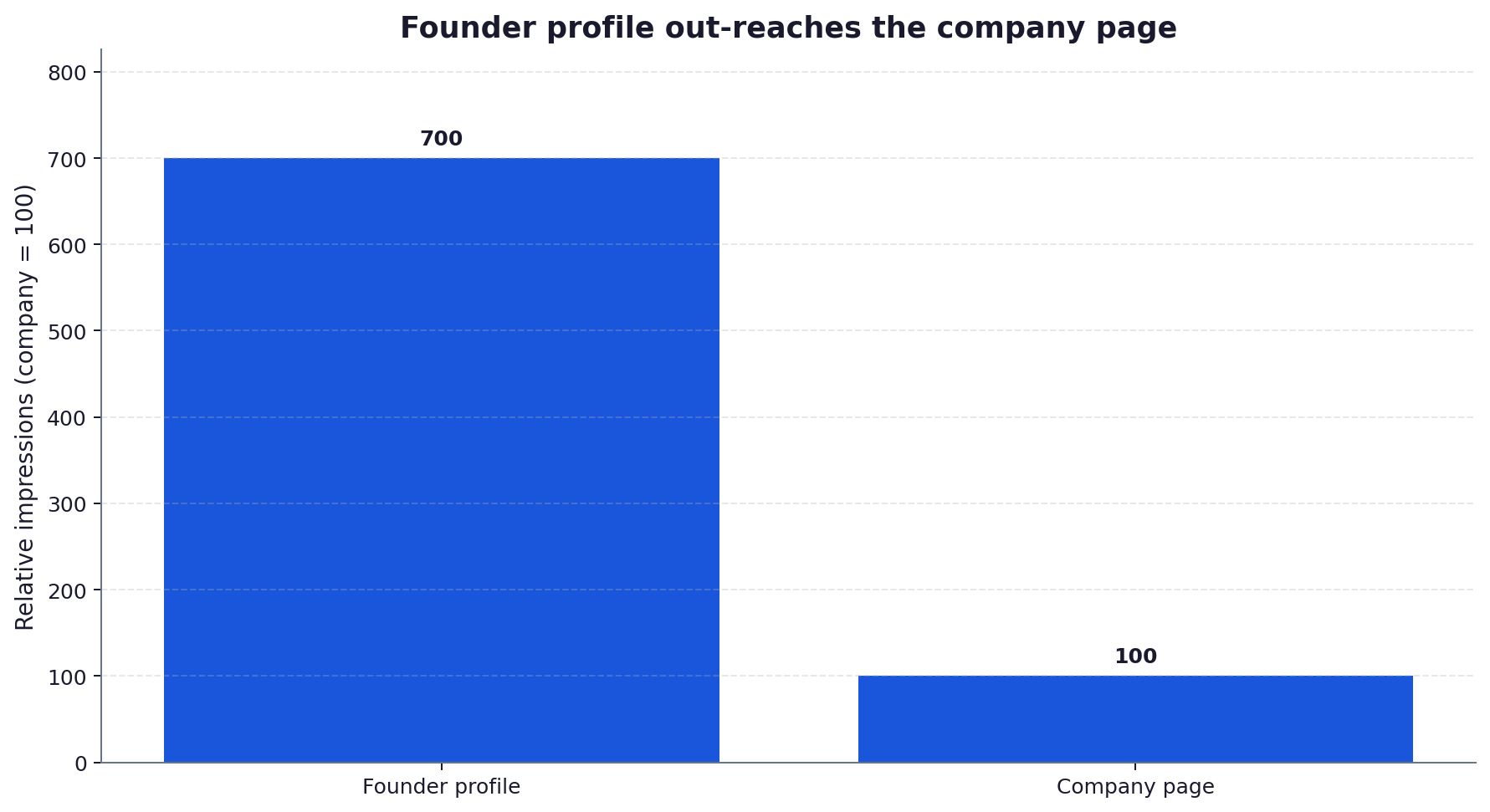
- Personal founder profiles earn roughly 7 times the impressions of company pages, and founder posts on the same topic draw about 3 to 5 times the engagement (2026 B2B content benchmarks).
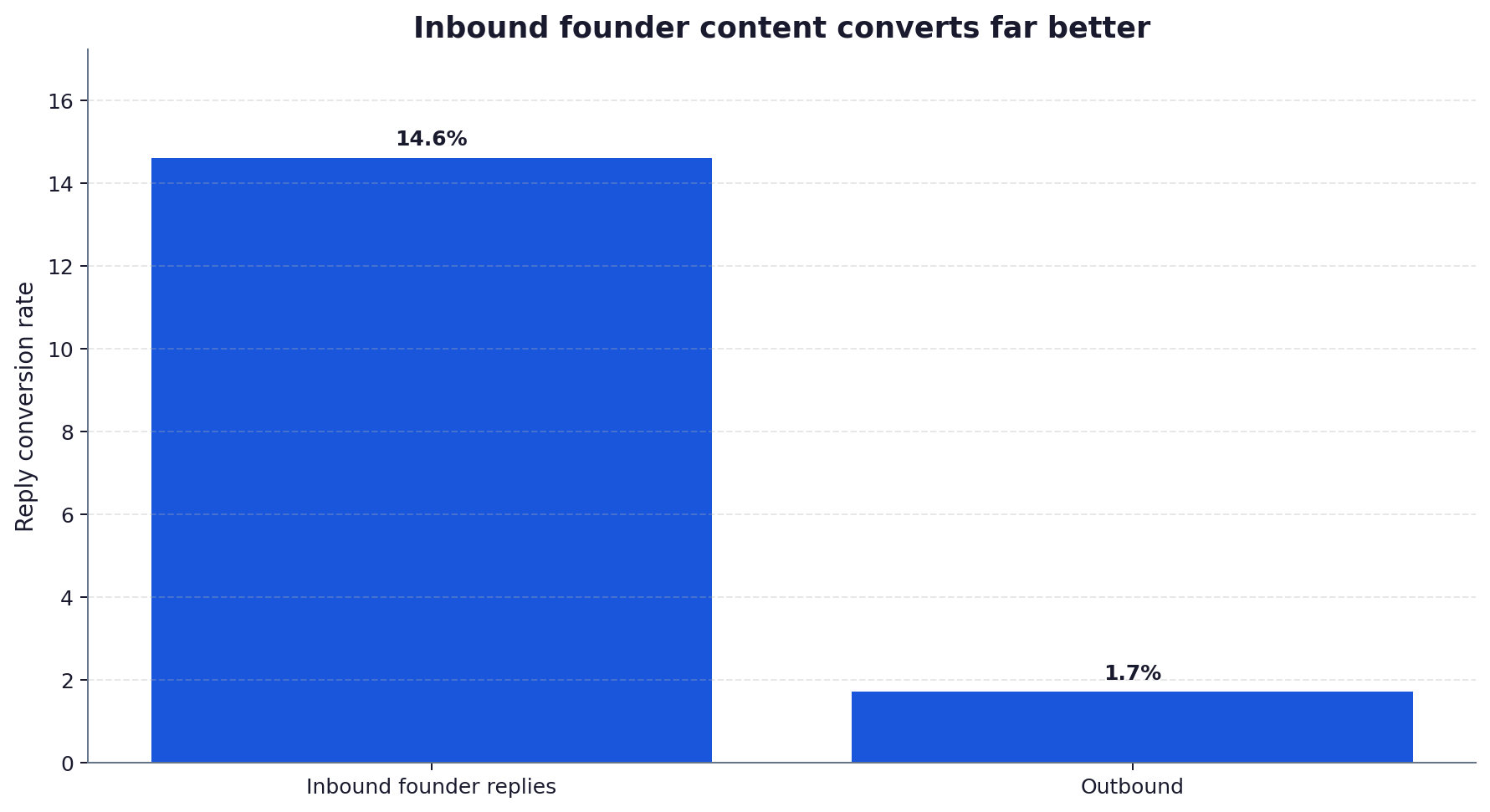
- Inbound replies to founder content convert at about 14.6% against roughly 1.7% for outbound (2026 B2B content benchmarks).
- The cadence that compounds is about 3 to 5 posts a week, with consistency mattering more than raw volume. A 36 to 48 hour gap dents the next day’s reach.
- Publish where reach is fast, then repurpose the best posts into structured, dated pages on your own domain, which is what AI engines can cite.
Key facts
- Personal founder profiles earn about 7 times the impressions of company pages (2026 B2B content benchmarks).
- Founder posts on identical topics draw roughly 3 to 5 times the engagement of company-page posts (2026 B2B content benchmarks).
- Inbound replies from founder content convert at about 14.6% versus roughly 1.7% for outbound (2026 B2B content benchmarks).
- A cadence of about 3 to 5 posts per week compounds for most founders, with 2 to 3 a sustainable floor (2026 B2B content benchmarks).
- A 36 to 48 hour gap between posts dents the following day’s reach (2026 B2B content benchmarks).
- Structured, attributed content is more likely to be cited by AI engines (Aggarwal et al., arXiv, 2023).
Why founder content out-performs the company page
For an early AI start-up with no brand recognition, the company page is the weakest place to publish. Audiences follow people, and platforms reward personal accounts. The 2026 B2B content benchmarks are blunt about the size of the gap: personal founder profiles pull roughly 7 times the impressions of company pages, and when a founder and their company post the same idea, the founder’s version draws about 3 to 5 times the engagement. The reason is trust and specificity. A founder can state an opinion, share a number from inside the business and take a position, which a corporate account rarely does convincingly.
The return shows up further down the funnel too. Inbound replies to founder content convert at about 14.6%, against roughly 1.7% for outbound. That is close to an order-of-magnitude difference in conversion, and it is why founder-led content is a distribution strategy rather than a vanity exercise for early-stage teams.
How often to publish
The cadence that compounds for most founders is about 3 to 5 posts a week, with 2 to 3 a sustainable floor and 1 a week compounding only slowly. The mechanism is momentum. A 36 to 48 hour gap between posts measurably dents the following day’s reach, so a steady three-a-week beats a burst of ten posts followed by a fortnight of silence. Predictability is what the platforms and the audience reward, more than the exact count.
The honest caveat is sustainability. Posting 3 to 5 times a week for two years is hard, and many founders hit voice fatigue somewhere around the second year, where the content starts to feel forced. That argues for a system rather than willpower: a small number of recurring formats, a running note of ideas, and repurposing that stretches one insight across several posts.
Where to publish, and why the answer is two places
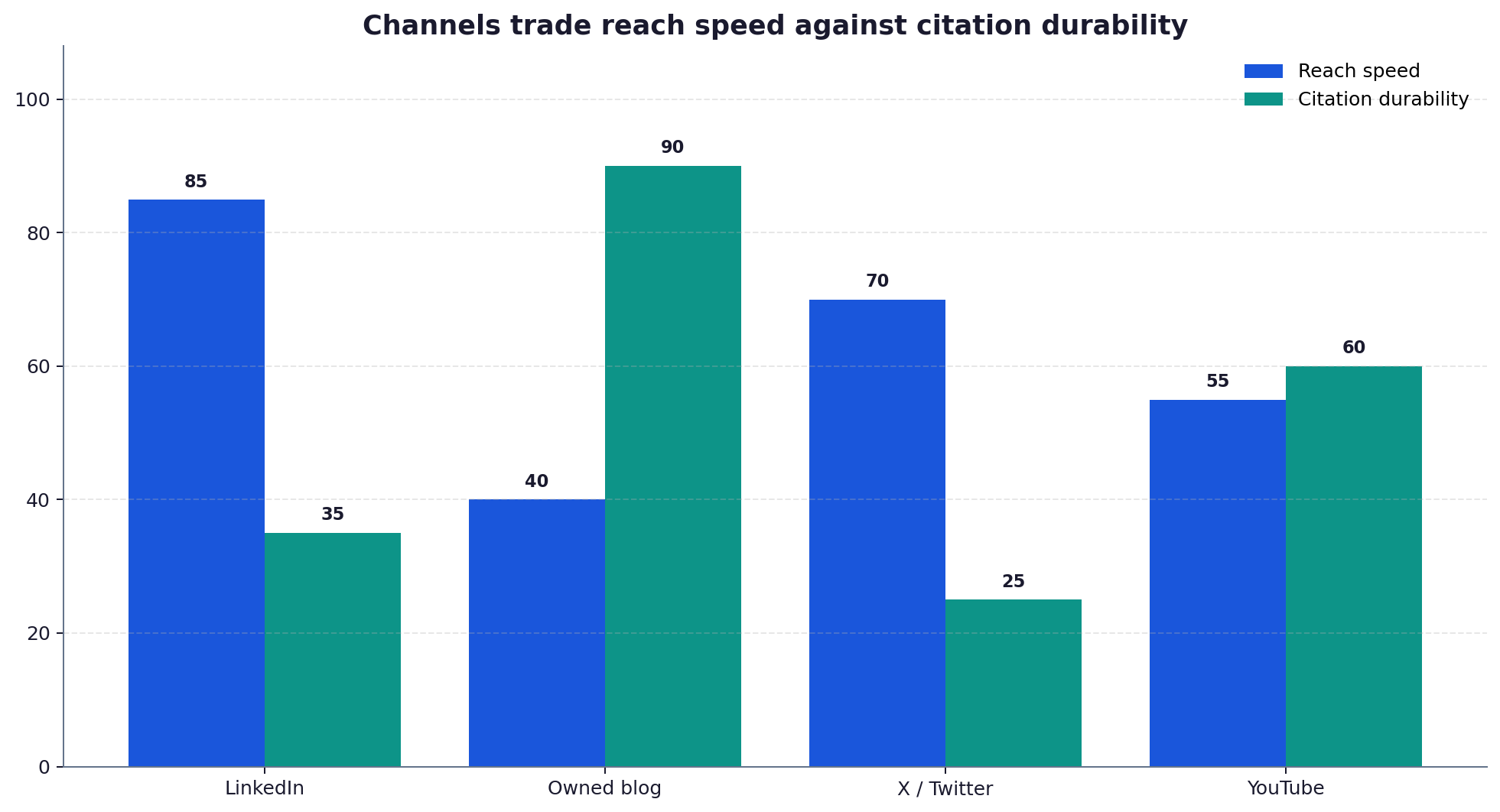
For reach, LinkedIn is the default for B2B AI start-ups, because that is where buyers, operators and investors already are, and where personal profiles get the impression multiplier. But reach is only half the job for a company that also wants to be found through AI search. LinkedIn posts are hard for AI engines to cite durably, since they scroll away and are not structured as reference pages. Your own domain is where a claim becomes a citable asset.
So the placement answer is two-part. Publish for reach where the audience is, then repurpose your strongest posts into structured, dated articles on your own site. The original GEO research found that structured, attributed content is more likely to be pulled into AI answers, so a LinkedIn thread that did well becomes a properly formatted article with a clear claim, a source and a date. One earns attention this week, the other earns citations for months.
What to post: three formats that earn both engagement and citations
Three formats do double duty. First, first-hand data: a number from inside your business, a benchmark from your users, a result from a small experiment. These earn engagement because they are specific and earn citations because engines favour concrete, attributable claims. Second, contrarian but defensible positions on your category, which spark discussion and give a model a clear stance to attribute to you. Third, plain-English category education that defines the space you operate in, which teaches both humans and models what your company is for.
What underperforms on both axes is generic commentary on other people’s news. It is easy to produce, but it neither differentiates you in the feed nor gives an engine anything specific to cite. If a post could have been written by any founder in your space, it is doing little for reach and nothing for AI visibility.
A repurposing loop that keeps the cadence sustainable
The way to hold a 3-to-5-a-week cadence without burning out is a loop. Start with one substantive idea a week, usually a piece of first-hand data or a clear position. Post it as a short opinion on Monday, expand it into a longer narrative midweek, then turn the strongest version into a structured article on your own site. That single idea has now produced two or three founder posts and one citable page. Over a quarter, that loop builds both a consistent presence in the feed and a growing library of pages AI engines can cite, without asking the founder to generate a brand-new thought every day.
When founder-led content matters most, and when to hand it off
The channel is at its most valuable early, when a company has no brand recognition and the founder’s credibility is the only authority it can borrow. In that phase the impression multiplier and the conversion advantage do the heavy lifting a company page cannot. As the business scales, the picture changes. Founder attention becomes scarcer, and the same benchmarks that make founder content compelling also show it plateauing once a company passes a few million in revenue, when a single voice can no longer carry all the demand.
The transition is not to abandon founder content but to broaden it. Bring other credible voices from the team into the feed, keep the founder on the highest-leverage posts, and lean harder on the owned, citable articles that keep working while attention moves elsewhere. The AI visibility asset you built by repurposing early posts compounds regardless of who is posting this week, which is the point of moving strong content onto your own domain in the first place.
Frequently asked questions
Is founder-led content really better than a company page for an AI start-up?
For most early-stage AI start-ups, yes. The 2026 B2B benchmarks show personal founder profiles earning about 7 times the impressions of company pages, and founder posts on the same topic drawing roughly 3 to 5 times the engagement. Inbound replies also convert far better, about 14.6% versus 1.7% for outbound. Audiences follow people and platforms reward personal accounts, so for a brand with little recognition the founder’s profile is the strongest distribution channel available.
How often should a founder post?
About 3 to 5 times a week is the range that compounds for most founders, with 2 to 3 a sustainable floor. Consistency matters more than the raw number, because a 36 to 48 hour gap dents the following day’s reach. A steady three posts a week beats a burst of ten followed by silence. Build a repeatable system of a few formats and a running idea list rather than relying on willpower, since many founders hit fatigue in the second year.
Where should founder content be published?
In two places. Publish for reach on LinkedIn, the default for B2B AI start-ups, where personal profiles get the impression multiplier and your buyers already are. Then repurpose your strongest posts into structured, dated articles on your own domain, because those are the pages AI engines can cite. LinkedIn posts scroll away and are hard to cite durably, so your own site is where a strong post becomes a lasting AI visibility asset.
Does founder content help with AI search visibility?
Indirectly, and directly once repurposed. The topics a founder covers and the way they define their category shape how models describe the company. But a LinkedIn post itself is hard to cite, so the direct AI visibility benefit comes when you turn that post into a structured, dated article on your own site. The original GEO research found structured, attributed content is more likely to be cited, so formatting matters as much as the idea.
What should a founder actually post about?
Three formats do double duty for engagement and citations: first-hand data such as a benchmark from your users or a result from a small experiment, contrarian but defensible positions on your category, and plain-English education that defines your space. These are specific and attributable, which humans engage with and models can cite. Generic commentary on other people’s news underperforms on both, because it neither differentiates you nor gives an engine anything concrete to attribute.
How does a founder keep this up without burning out?
Run a repurposing loop. Take one substantive idea a week, post it as a short opinion, expand it into a longer narrative midweek, then turn the best version into a structured article on your site. One idea becomes two or three posts and a citable page. Over a quarter that produces a consistent feed presence and a growing library of citable pages without demanding a brand-new thought every day, which is what makes the cadence survivable.
Sources and references
- Founder-led content for B2B SaaS: the 2026 playbook. StartupCookie, 2026
- Founder-led content for B2B SaaS: why the CEO’s voice builds more pipeline. a88lab, 2026
- How often should you post on LinkedIn in 2026, a data-backed guide. Postiv AI, 2026
- Most-cited domains and professional-source patterns. Profound, 2026
- GEO: Generative Engine Optimization. arXiv (Aggarwal et al.), 2023
- How AI engines source professional content. Search Engine Land, 2026
See whether AI engines cite your company for its category today.
Change log
- 2026-07-13: Initial publication.