TL;DR
- A GEO agency’s core work is making client content citable by AI search engines.
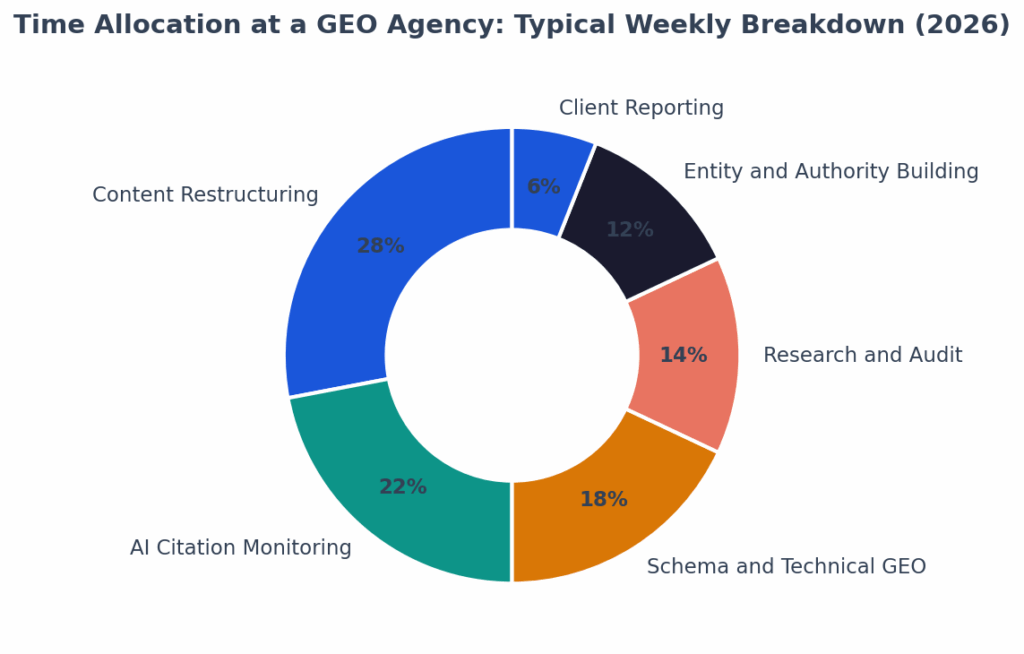
- Content restructuring and citation monitoring account for 50% of weekly activity.
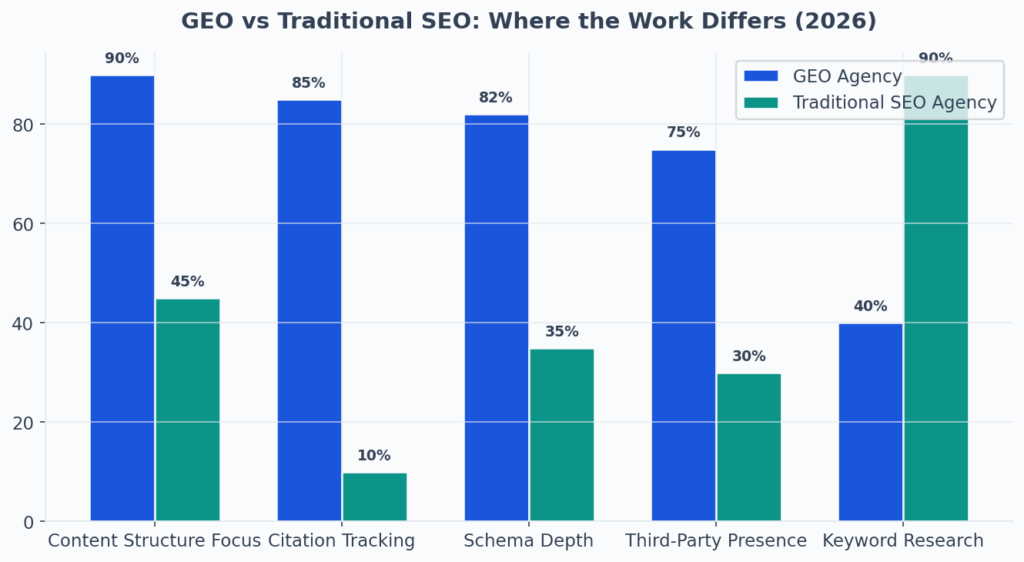
- The work differs significantly from traditional SEO in focus, tools, and metrics.
- First AI citations typically appear within 4 weeks of implementation.
- Monthly reporting tracks citation frequency, not just rankings and traffic.
Last November, a B2B software company came to us with 180 blog posts and zero appearances in ChatGPT answers. Their content was well-written. Their SEO was solid: they ranked on page one for several high-value keywords. But when their prospects asked ChatGPT “best project management tools for remote teams,” the company did not exist in the response.
The problem was not quality. It was structure. Their content was optimised for Google’s ranking algorithm, not for an AI engine that extracts and cites information passage by passage. Fixing that gap is what a generative engine optimisation agency does, and the work looks quite different from what most people expect.
Key Facts (2025 to 2026)
- Only 15% of pages retrieved by ChatGPT actually earn a citation in its answers (Zyppy, 2025).
- AI citations are binary: you are either cited or absent. There is no “position 3” in a ChatGPT answer.
- Content with 5 to 7 statistics earns a 20% higher citation likelihood in early-discovery queries (Growth Memo, 2026).
- ChatGPT uses definite language, question marks, high entity density, and simple writing structures as citation signals (Growth Memo, 2026).
- Earned media distribution can increase AI citations by up to 325% compared to publishing only on your own site (Stacker, 2025).
- Sites with over 32,000 referring domains are 3.5x more likely to be cited by ChatGPT (SE Ranking, 2025).
- Fewer than 25% of UK mid-market businesses have implemented any GEO strategy (MarGen, 2026).
Monday Morning: The Citation Check
Every week at a generative engine optimisation agency starts the same way. Before anything else, we run citation checks across ChatGPT, Perplexity, Google AI Overviews, and Gemini for every active client.
This means entering each client’s 20 to 35 target queries into each AI platform and recording whether they are cited, which competitors appear instead, and how the AI’s answer has changed since last week. The queries are the questions their ideal buyers would ask: “best marketing agency for B2B SaaS in London,” “how much does a GEO audit cost,” “what should I look for in an ai seo consultant.”
Citation monitoring is the GEO equivalent of rank tracking in traditional SEO, except the data is less stable. AI answers can shift daily as models update. A citation you held last Tuesday can disappear by Thursday if a competitor publishes fresher, better-structured content on the same topic. This volatility is why monitoring happens weekly, not monthly.
The weekly citation check is the pulse of GEO work. Everything else flows from what it reveals.
The Core Work: Content Restructuring
This is where a generative engine optimisation agency spends most of its time. It is also where most clients see the gap between what they thought GEO was and what it actually involves.
AI engines extract answers at the passage level. Each section of a page needs to function as a standalone, quotable response. That means rewriting existing service pages and blog posts with a specific architecture: direct answer in the first sentence, supporting evidence in the next two to three sentences, and a source citation inline. Every H2 heading should be phrased as a question or action that matches how buyers query AI engines.
For the software company mentioned earlier, we restructured their 12 highest-priority pages over 6 weeks. Each page went through the same process: identify the buyer question the page should answer, rewrite the opening to deliver that answer in the first 30 words, break the body into extractable sections, add FAQ schema with visible questions, and insert inline citations for every factual claim.
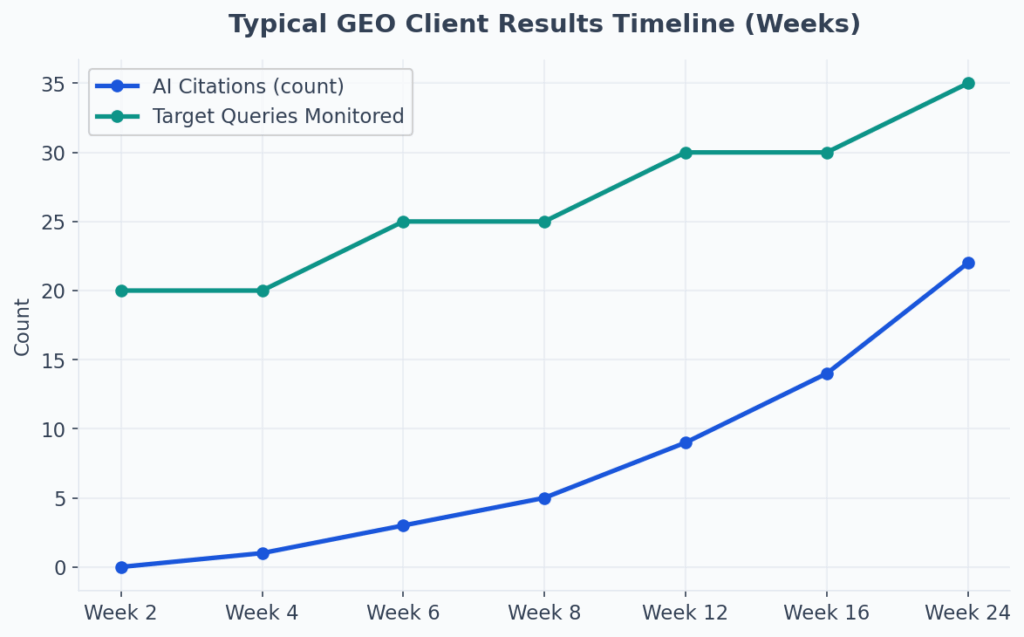
The before-and-after is tangible. Before restructuring, ChatGPT retrieved the pages but did not cite them (part of the 85% that get read but not referenced). After restructuring, 7 of the 12 pages earned citations within 4 weeks.
Understanding how generative engine optimisation works at the content level is the foundation of everything a GEO agency delivers.
That client went from zero AI citations to appearing in 14 Perplexity answers within three months. Every business we work with has a different starting point, but the process is the same. Find Out Where You Stand →
Technical GEO: Schema, Crawlability, and Entity Signals
Content restructuring makes pages citable. Technical GEO makes them findable and verifiable.
A typical week includes implementing or auditing Organisation, Article, FAQPage, and Person schema across client sites. Organisation schema with sameAs links to verified profiles helps AI engines resolve the client as a known entity. Article schema with datePublished and dateModified provides the freshness signals that ChatGPT weights in its citation decisions. FAQ schema maps visible questions to structured answers that AI can extract directly.
Crawlability matters differently for GEO than for traditional SEO. Most AI crawlers cannot execute JavaScript, which means any structured data added dynamically after page load is invisible to them. We check that schema is rendered in the raw HTML, not injected by JavaScript frameworks. This single technical detail causes more GEO failures than any content issue.
We also audit robots.txt to ensure AI crawlers (GPTBot, CCBot, PerplexityBot) are not blocked. Some WordPress security plugins block these bots by default. If AI engines cannot access your pages, no amount of content restructuring will help.
Entity and Authority Building
AI engines do not trust a single source. They cross-reference claims against multiple independent sources before citing a page. This is why entity and authority building is a consistent part of a generative engine optimisation agency’s workload.
In practice, this means building the client’s presence across platforms that AI engines actively cite. Stacker’s 2025 research found that distributing content to a range of publications can increase AI citations by up to 325% compared to publishing only on your own site. Reddit, LinkedIn, YouTube, G2, and industry-specific directories all serve as independent verification points.
For each client, we maintain a third-party presence plan: LinkedIn articles from the founder or senior team, YouTube videos answering the top 5 buyer questions, Google Business Profile optimisation, and review solicitation on relevant platforms. Each of these creates a data point that strengthens the AI engine’s confidence when deciding whether to cite the client’s website.
The relationship between public relations and GEO is increasingly important here. Earned media mentions in industry publications do not just build traditional authority; they create the independent references that AI engines rely on for citation decisions.
This overview covers how GEO strategy works alongside traditional SEO:https://www.youtube.com/watch?v=sQz8SFCNwkY
What an AI SEO Consultant Does Differently
The term “ai seo consultant” covers a range of roles in 2026. Some consultants focus on using AI tools to improve traditional SEO workflows. Others, and this is the GEO-specific role, focus on making businesses visible inside AI-generated answers.
A GEO-focused ai seo consultant typically handles strategy and advisory rather than hands-on implementation. They audit current AI visibility, identify which queries the client should target, map the content restructuring needed, and define the measurement framework. The implementation (rewriting content, adding schema, building third-party presence) is then executed by the agency’s production team or the client’s in-house team.
| Function | AI SEO Consultant | GEO Agency |
|---|---|---|
| AI visibility audit | Yes | Yes |
| Strategy and recommendations | Yes | Yes |
| Content restructuring execution | Advisory only | Full execution |
| Schema implementation | Specifications provided | Implemented and validated |
| Ongoing citation monitoring | Periodic reviews | Weekly tracking with reports |
| Entity and authority building | Strategic guidance | Managed execution |
For businesses exploring options, the right choice depends on internal capacity. If you have a content team that can execute but needs direction, a consultant works well. If you need the work done end-to-end, a full-service GEO agency is the better fit.
Measuring Results: What GEO Reporting Looks Like
GEO reporting looks different from SEO reporting. The primary metric is citation frequency: how many times the client’s content appears as a cited source across AI platforms for their target queries. Secondary metrics include competitor citation share, citation sentiment (how the AI describes the client), and AI referral traffic.
Monthly client reports typically include a citation dashboard showing which target queries returned citations and on which platforms, a competitor comparison showing who else is cited for the same queries, a list of content changes made during the period and their impact, and recommendations for the next month based on citation gaps and emerging queries.
Traditional SEO metrics (rankings, traffic, backlinks) are still tracked because they influence AI visibility. But the headline metric is always citation count. That is the number the client watches, and the number that ties directly to whether their prospects are seeing them in AI answers.
For a detailed breakdown of whether the investment is worth it, our cost-benefit analysis of AI SEO covers the ROI framework we use with clients.
Their story is not unusual. It is just well-documented. If your content should be performing better than it is in AI search, let us talk about why →.
This walkthrough covers GEO implementation for agencies and consultants:https://www.youtube.com/watch?v=E4Y3YKzMRYo
Frequently Asked Questions
What does a generative engine optimisation agency do?
A generative engine optimisation agency makes businesses visible in AI-generated search answers across ChatGPT, Perplexity, Google AI Overviews, and similar platforms. The core work includes content restructuring for AI extractability, schema markup implementation, entity and authority building across third-party platforms, and ongoing AI citation monitoring.
How is GEO different from traditional SEO?
Traditional SEO optimises for rankings on search engine results pages. GEO optimises for citations inside AI-generated answers. The work differs in focus: GEO prioritises content structure and passage-level extractability over keyword density and backlink volume. Only 15% of pages retrieved by ChatGPT earn a citation, making content quality and structure disproportionately important.
What does an AI SEO consultant do?
An AI SEO consultant audits current AI visibility, identifies target queries, maps content restructuring needs, and defines measurement frameworks. Consultants typically provide strategic guidance rather than hands-on implementation. Businesses with internal content teams benefit from consultants; those needing end-to-end delivery typically choose an agency.
How long does it take to see results from GEO?
Most clients see first AI citations within 4 weeks of content restructuring. Significant, compounding visibility typically develops after 3 to 6 months. The timeline depends on existing content quality, domain authority, and the competitiveness of target queries.
How much does a GEO agency charge?
GEO audits typically range from £1,500 to £5,000 GBP. Monthly retainers for ongoing GEO services range from £2,000 to £8,000 GBP depending on the number of target queries, content volume, and complexity. Most agencies offer combined SEO and GEO packages. Get in touch for a tailored quote based on your business.
Can I do GEO myself without an agency?
The fundamentals (answer-first content, FAQ schema, visible dates) can be implemented by any competent content team. The specialised work (AI citation tracking across platforms, entity graph building, passage-level content architecture) requires tools and expertise that most in-house teams do not yet have. Many businesses start with the basics themselves and bring in an agency for the technical and monitoring layers.
What tools does a GEO agency use?
Common tools include Profound, Otterly.ai, or Ahrefs Brand Radar for AI citation tracking; Google’s Rich Results Test for schema validation; manual AI platform queries for baseline audits; and standard SEO tools (Ahrefs, Semrush) for traditional metrics that influence AI visibility. The toolset is still maturing; most agencies combine automated tracking with significant manual monitoring.
Is GEO worth it for small businesses?
Yes, particularly because AI search is less competitive than traditional SEO for most sectors. Fewer than 25% of UK mid-market businesses have implemented any GEO strategy (MarGen, 2026). Small businesses with specialist expertise and well-structured content can outperform larger competitors in AI citations. The first-mover advantage is real and time-limited.
The work is not glamorous. It is structured, methodical, and repetitive. But it compounds. Every week of citation monitoring, content restructuring, and entity building adds to a foundation that gets progressively harder for competitors to match. If you want that foundation built for your business, Request a GEO Strategy Session →.
Pavel Uncuta is the founder of AiBoost, a UK AI marketing agency that builds visibility audit tools for professional services firms. He researches how Large Language Models cite brands across ChatGPT, Perplexity, and Google AI Overviews.
Want to know whether ChatGPT, Perplexity, or Google AI Overviews mention your firm? Run a free first-party visibility audit on your domain in under a minute and see exactly which queries cite you and which do not.