
TL;DR
- The trades marketing terms are small and cheap: marketing for roofers at 70 UK searches a month, seo for landscapers at 50, seo for kitchen fitters and lead generation for builders at 20 each (UK Google Ads pulls, 11 and 12 September 2026).
- Top-of-page bids run $4.65 to $16.08 for roofing and $4.63 to $10.77 for landscaping, a fraction of the $22 to $40 range on legal terms.
- What nobody can hand you is a cost per lead. Cost per lead is click price divided by your conversion rate, and only you hold the second number. This post gives you the first half honestly and shows the arithmetic for the second.
- Seasonality is the finding the annual averages hide. Roofing demand peaks in March at 170 searches. Landscaping spikes in July at 170. Kitchen fitting is flat at 10 to 30 all year after an autumn 2025 reading.
- Roofers, landscapers and kitchen fitters are three different advertising problems. Roofing is reactive and weather-triggered, landscaping is visual and seasonal, kitchen fitting is a six-month consideration with a high ticket.
- Before-and-after creative is the natural format for two of the three, and CAP requires marketers to “hold signed and dated proof that the photos are genuine and have not been manipulated”.
Key facts
- marketing for roofers: 70 UK searches a month, MEDIUM competition (index 45), top-of-page bids $4.65 to $16.08 (UK Google Ads pull via DataForSEO, 12 September 2026).
- seo for landscapers: 50 a month, LOW competition (index 12), top-of-page bids $4.63 to $10.77.
- seo for kitchen fitters: 20 a month, LOW competition (index 33), bids $7.29 to $15.30. lead generation for builders: 20 a month, MEDIUM (index 47), bids $6.77 to $15.41.
- facebook ads for tradesmen and facebook ads for builders both record 10 UK searches a month. Trades are not researching paid social; they are researching organic.
- Seasonal peaks: roofing 170 searches in March 2026, landscaping 170 in July 2026, against annual averages of 70 and 50.
- CAP advice on before and after photos: marketers “should hold signed and dated proof that the photos are genuine and have not been manipulated”, under rules 3.47 to 3.50 of the CAP Code.
What the trades keyword data measures, and what it does not
These figures are the prices advertisers pay for clicks on keywords about marketing services for trades. That is the auction a roofing firm enters when it goes looking for an agency, and it is a useful read on how contested that advice market is. It is not the price of a click on roof repair Bristol, and it is certainly not a Facebook cost per click, because Meta runs a separate auction with its own dynamics.
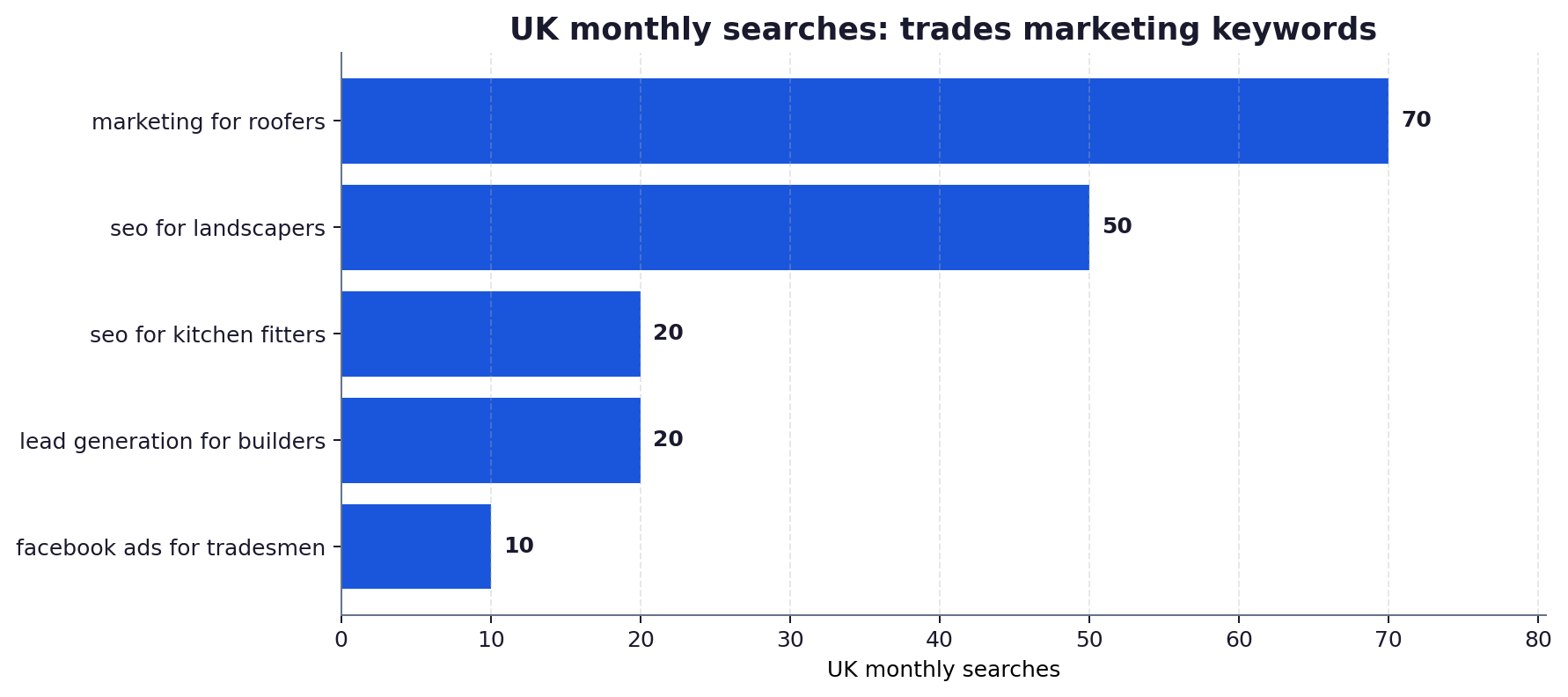
What the cluster does establish is a price floor. Top-of-page bids on marketing for roofers run $4.65 to $16.08 and on seo for landscapers $4.63 to $10.77. Set that against the legal cluster, where ppc for law firms runs $22.26 to $40.31, and the gap is roughly three to one. Advertisers bid what they expect the work behind the click to be worth, and a roofing job is worth less than a personal injury instruction. That is the whole explanation.
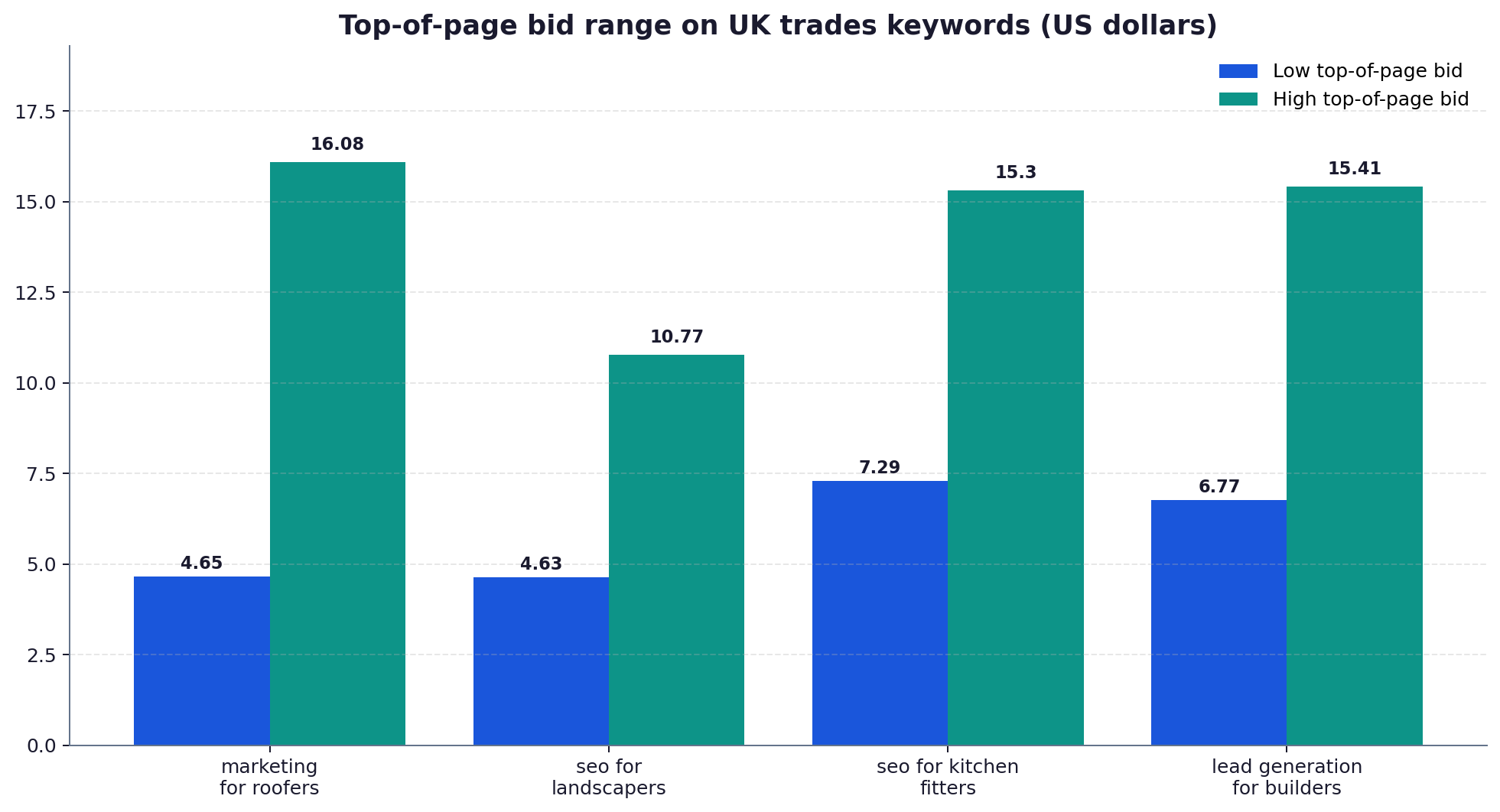
One oddity is worth naming rather than hiding. The reported average CPC for marketing for roofers is $21.94, which is higher than the reported high top-of-page bid of $16.08 for the same keyword. Those two figures are computed over different windows and different ad positions, so they can diverge, but a reader who noticed the inconsistency would be right to. We are not going to reconcile it by picking whichever number suits the argument.
Cost per lead is your number, not ours
The question every trade asks is what a lead costs. The honest answer is that the platforms measure clicks, and a lead is a click multiplied by a conversion rate that varies more between two roofing firms than between two industries.
The arithmetic is simple enough to do on the back of an invoice. Take your click price. Divide by your landing page conversion rate to get cost per enquiry. Divide again by your enquiry-to-quote rate and your quote-to-job rate to get cost per job. A firm converting 10 per cent of clicks into enquiries at a £5 click pays £50 an enquiry. A firm converting 2 per cent pays £250 for the same traffic. The click price is identical. The difference is entirely in the page and the follow-up. It is worth knowing that the page affects the click price as well: Google’s Quality Score rates landing page experience alongside expected clickthrough rate and ad relevance, so a better page tends to lower both halves of the calculation at once.
This is why we publish no cost-per-lead benchmark for UK trades. We hold no first-party conversion data across roofing, landscaping or kitchen fitting firms, and a made-up benchmark would do more harm than an absent one, because firms budget against it. What we will say from auditing accounts is that the conversion rate is nearly always the cheaper lever. Halving your cost per lead by doubling conversion costs a page rebuild. Halving it by finding cheaper clicks usually means accepting worse ones. The same reasoning drives how we build landing pages for trades accounts.
Three trades, three different advertising problems
Roofing is reactive. Demand arrives with weather and with visible failure: a slipped tile, a leak after a storm, a survey on a house purchase. The buyer is not browsing. They want somebody who can come this week, and they want reassurance that the firm is real, insured and local. Paid social works for roofing mainly as a familiarity layer: the firm the homeowner half-recognises when the leak starts is the one they call. Chasing immediate roofing enquiries through Meta alone tends to disappoint, because the trigger is not under your control.
Landscaping is visual and planned. Nobody has a landscaping emergency. Demand builds through spring, people look at pictures for weeks, and the decision is made months before work starts. That is close to an ideal Meta profile: strong creative, a long consideration window, and a product where photographs do most of the selling. Landscaping is the trade in this group where paid social should earn the largest share of budget.
Kitchen fitting is a considered high-ticket purchase. The cycle runs months, several people are involved in the decision, and the search happens alongside showroom visits and builder recommendations. Meta’s job here is to stay present across that window rather than to generate an enquiry from a single view. Firms that judge kitchen campaigns on a fortnight of data usually switch them off just before they would have worked.
What the three share is that the buyer is spending a meaningful amount of money on their own home with a stranger. Proof of trade registration, real project photography, named people and a local address do more work in this sector than clever copy, which is the argument we made in our piece on building trust online for a local trades business.
The seasonality the annual average hides
Annual figures flatten the thing that matters most to a trade. Pull the twelve-month series and the three trades move on completely different cycles.
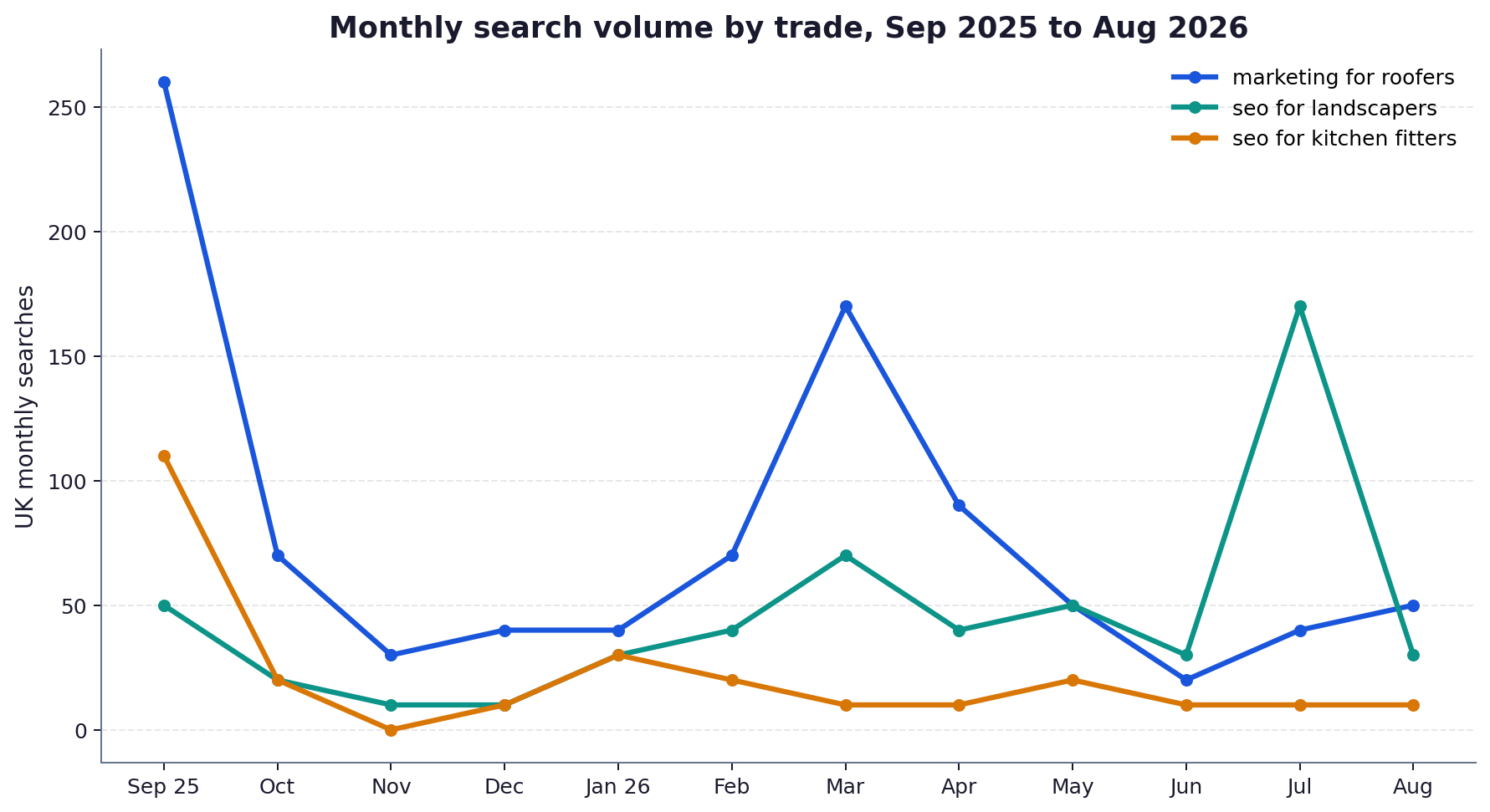
marketing for roofers runs at 20 to 50 a month through the summer, climbs through February and peaks at 170 in March. That is roofing firms thinking about their season before it starts. seo for landscapers does the opposite, sitting at 10 to 50 for most of the year then spiking to 170 in July, which reads as firms reacting to a busy summer rather than preparing for one. seo for kitchen fitters barely moves, holding between 10 and 30 from October 2025 onwards.
For a marketing plan the implication is about timing, not volume. If you are a roofing firm, the month your competitors are all reviewing their marketing is March, which is also when agency attention is scarcest and when your own diary fills. Doing that work in November, when the term runs at 30, is easier in every respect. The same logic applies in reverse to landscaping: the planning should happen in the winter, not in the July panic the data shows.
What a trades Meta ad has to show
Before-and-after creative is the obvious format for landscaping and kitchen fitting, and it comes with rules. CAP’s advice on before and after photos requires that marketers “should hold signed and dated proof that the photos are genuine and have not been manipulated”, under rules 3.47 to 3.50 of the CAP Code, and that they “retain appropriate material to be able to demonstrate whether any re-touching has been carried out, in the event of an investigation”. The underlying principle is that visual claims “should not mislead by exaggerating the effect the product is capable of achieving”. A sky replaced in editing on a garden photo is a retouch that changes the impression the image creates.
The practical version of this for a trade is simple. Photograph your own jobs, keep the originals with dates, get the customer’s written permission at handover rather than months later, and keep the editing to cropping and exposure. A firm with a year of properly consented project photography has an advertising asset its competitors cannot copy, and the same library feeds the project pages that do the organic work.
Trust signals belong in the creative as well as on the page. Registration with a scheme such as TrustMark, described on its own site as “the Government Endorsed Quality Scheme that covers work a consumer chooses to have carried out in or around their home”, is the kind of verifiable third-party detail that reduces the risk a homeowner feels. Insurance, guarantees you actually honour, and a real street address do the same job. Our list of mistakes businesses make with Meta ads covers the creative failures we see most, and the Meta ads service page sets out how we run campaigns.
Where paid social ends and search begins
Our study of construction Meta ads in the UK covers the contractor side of this market, and it is the strongest-performing page on this site for trades paid-social terms, holding construction facebook advertising at an average position of 21.4 on 442 impressions in Google Search Console over the month to 11 September 2026. This post covers the domestic trades next door to it: roofers, landscapers and kitchen fitters selling to householders rather than to developers and main contractors.
The split between channels follows the buying trigger. Where the customer has a problem now, search wins, because they are typing the problem into Google at the moment it happens. Where the customer is imagining a better garden or kitchen, paid social wins, because the ad creates the thought rather than answering it. Roofing leans to the first, landscaping and kitchens to the second, and every firm in all three trades needs the organic foundation underneath both, which is what our SEO for construction trades work builds.
Adjacent trades are covered in our studies of SEO for UK plumbers and electrician SEO in the UK, and the commercial contractor side in construction SEO in the UK. For firms weighing the two paid channels on price, the benchmarks sit in UK Facebook ads costs for 2026 and UK Google Ads costs for 2026, and our older piece on how builders and contractors get more leads online covers the basics. One newer channel is worth a look too: homeowners increasingly ask an assistant to suggest local firms before they search, and a free GEO audit will tell you whether yours gets named.
How we compiled these numbers
Search volumes, competition indices, average CPCs and top-of-page bid estimates come from UK Google Ads search-volume pulls run through DataForSEO on 11 and 12 September 2026, location United Kingdom, language English, saved in Prism/data/. Trades terms were captured in the same two sessions as 50-plus other service verticals, so the comparison with legal and clinic costs reads across one consistent snapshot rather than numbers assembled from different tools on different dates. Twelve-month series come from the same response objects, and the seasonality section reads them directly rather than through any smoothing. Impression and position figures for the construction Meta ads post come from Google Search Console for aiboost.co.uk, 14 August to 11 September 2026. The CAP and TrustMark statements are quoted from those organisations’ own published pages.
Limitations and caveats
Google Ads search volumes are rounded buckets rather than counts, and they measure advertiser demand, not organic ranking difficulty. A LOW competition label means few advertisers bidding and tells you nothing about the organic first page. At 20 to 70 searches a month, the rounding is proportionally large, so read these as order-of-magnitude figures. The reported CPC for marketing for roofers exceeds its own reported high top-of-page bid, which we have flagged above rather than resolved. Across the 60 keywords in these pulls carrying a twelve-month series, 39 show a September 2025 reading at least three times the median of their other eleven months, including every trade discussed here; that pattern spans unrelated verticals and looks like a reporting artefact, so annual averages in this dataset run high and the September 2025 points on the seasonality chart should be read with that in mind. All cost figures are Google Ads figures, reported by the source in US dollars, and none of them are Meta costs; Meta runs a separate auction that this data does not describe. We publish no cost-per-lead figure because we hold no first-party trades conversion data and will not estimate one. Nothing here is regulatory advice.
Frequently asked questions
What does a lead cost a UK roofer on Facebook?
No published figure is reliable, including ours. Cost per lead is your click price divided by your conversion rate, and conversion rates vary more between two roofing firms than between two industries. A firm turning 10 per cent of clicks into enquiries at a £5 click pays £50 an enquiry; a firm turning over 2 per cent pays £250 for identical traffic. What we can tell you from the September 2026 UK data is the search-side price floor: top-of-page bids on marketing for roofers run $4.65 to $16.08. Work out the rest from your own last twelve months.
Is Facebook or Google better for a roofing company?
Google, mostly. Roofing demand is triggered by a specific event, usually weather or visible damage, and the customer types the problem into a search engine at the moment it happens. Paid social works for roofing as a familiarity layer, so the firm a homeowner half-recognises is the one they call when the leak starts. Judge a roofing Meta campaign on brand recall and cheap reach in your catchment, not on same-week enquiries, or you will switch it off for the wrong reason.
Which trade is the best fit for Facebook advertising?
Landscaping, clearly. There is no landscaping emergency, the decision is made weeks or months ahead, and the product sells through photographs. That combination of a long consideration window and strong visual proof is close to the ideal Meta profile. Kitchen fitting works too but needs patience, because the cycle runs months and involves several decision makers. Roofing is the weakest fit of the three, because its demand trigger is outside your control.
When should a trade plan its marketing?
The opposite of when everyone else does. UK searches for marketing for roofers peak at 170 in March, when roofing firms are already getting busy and agency attention is scarce. Landscaping spikes to 170 in July, which is firms reacting to a busy summer rather than preparing for one. Both would be better served by doing the work in the quiet months, November for roofing and winter for landscaping, when the site, the photography and the tracking can be fixed before the season starts.
What do I need before I can use before and after photos in ads?
Written, dated permission and the original files. CAP requires marketers to hold signed and dated proof that the photos are genuine and have not been manipulated, under rules 3.47 to 3.50 of the CAP Code, and to retain material showing whether any retouching has been done in case of an investigation. Keep editing to cropping and exposure. Replacing a grey sky with a blue one in a garden photo is a retouch that changes the impression created, and the principle CAP applies is that visual claims should not exaggerate the effect achieved.
Why do so few people search for “facebook ads for tradesmen”?
Both facebook ads for tradesmen and facebook ads for builders record 10 UK searches a month, while marketing for roofers records 70 and seo for landscapers 50. Trades research marketing in general terms and organic search in particular. They are not searching for paid social advice. That is a gap rather than a verdict on the channel: the absence of research demand says nothing about whether the ads work, only that nobody is writing about it and almost nobody is competing for the term.
Are trades keywords cheaper than other industries?
Substantially. Top-of-page bids in this cluster run from $4.63 to $16.08, against $22.26 to $40.31 on ppc for law firms in the same September 2026 data. Advertisers bid what they expect the work behind a click to be worth, and a domestic roofing or landscaping job is worth less than a legal instruction. The practical consequence is that a trades budget buys three or four times as many clicks as a legal budget of the same size, which makes conversion rate the number that decides whether the account works.
Sources and references
- Advertising advice: before and after photos. Advertising Standards Authority and CAP, 2026
- TrustMark: the Government Endorsed Quality Scheme. TrustMark, 2026
- UK Google Ads search volume and cost data, September 2026 pulls. DataForSEO, 2026
- About Quality Score for Search campaigns. Google Ads Help, 2026
If you are already spending on Facebook or Google and cannot say what an enquiry costs you, that is the gap worth closing first. Our free paid ads audit reads the account and the pages behind it, and tells you where the money is going.
Change log
- 2026-10-02: Initial publication.