TL;DR
- Generative Engine Optimisation (GEO) is now a distinct service clients expect from agencies.
- White-label GEO partnerships deliver 55% gross margins versus 25% for in-house teams.
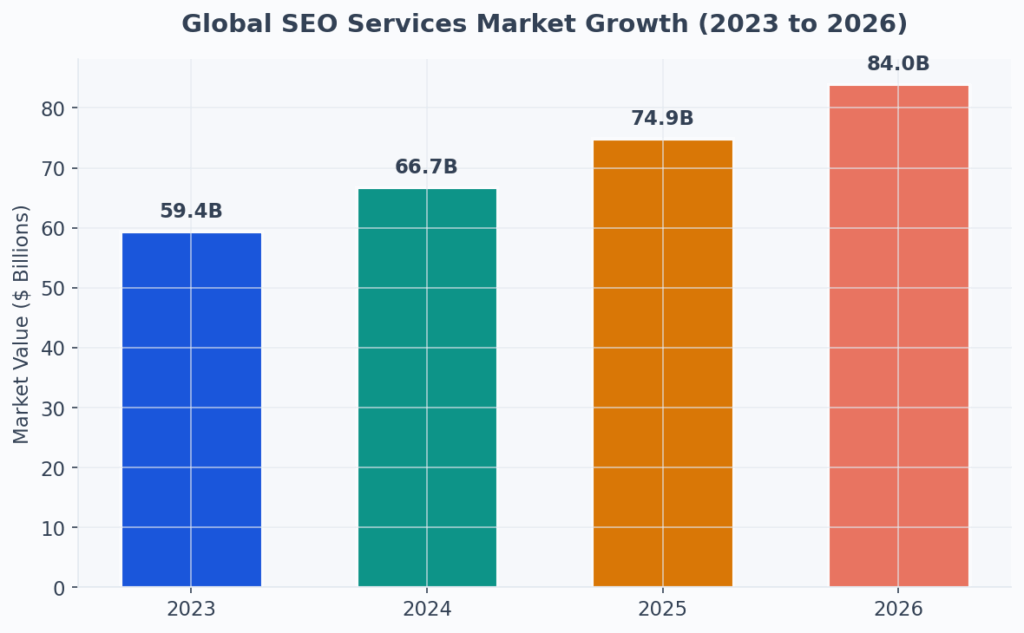
- The global SEO services market hit $84 billion in 2026, growing at 12.3% annually.
- Agencies that add GEO services retain clients longer and win higher-value contracts.
- A white-label partner lets you launch generative engine optimisation services in weeks, not months.
Your clients are starting to ask a question you might not have a confident answer for yet: “Why aren’t we showing up in ChatGPT?” That question is becoming as common as “Why aren’t we ranking on Google?” was five years ago. The difference is that most agencies do not yet have the team, tools, or processes to answer it.
Generative Engine Optimisation (GEO) is the discipline of making content visible in AI-generated answers across ChatGPT, Perplexity, Google AI Overviews, and similar platforms. It overlaps with traditional SEO but requires distinct skills in content structuring, schema implementation, entity building, and AI citation monitoring. For agencies, the question is not whether to offer generative engine optimisation services. It is how to do it without overstretching your team or undercutting your margins.
Key Facts (2025 to 2026)
- The global SEO services market reached an estimated $84 billion in 2026, up from $74.9 billion in 2025 (ALM Corp, 2026).
- Digital marketing outsourcing is projected to grow from $25.4 billion in 2024 to $74.76 billion by 2034 (ALM Corp, 2026).
- White-label SEO partnerships routinely achieve 40% to 60% gross margins (ALM Corp, 2026).
- 37% of marketers are already prioritising GEO and AI search visibility investment (Demand Gen Report, 2025).
- 73% of B2B buyers use AI tools in their purchase research process (Averi/Loganix, 2026).
- 94% of B2B buyers used large language models during their purchase journey in 2025 (6Sense, 2025).
- Only 22% of marketers currently track AI visibility, leaving a wide gap for agencies to fill (Loganix, 2026).
Why Your Clients Are About to Ask for GEO
The shift is already measurable. 94% of B2B buyers used large language models during their purchase journey in 2025 (6Sense, 2025). Forrester reports that 89% of B2B buyers have adopted generative AI as a key source of self-guided information. When your client’s prospects ask ChatGPT “which agencies handle B2B lead generation in Manchester,” the firms that appear in the AI’s answer win the shortlist. The firms that do not appear lose that prospect entirely.
This is not a niche concern for tech companies. Law firms, accountants, consultancies, and healthcare providers all face the same dynamic. Clio’s 2025 Legal Trends Report found that 57% of consumers have either used AI for legal questions or would consider doing so. The pattern repeats across every professional services vertical.
Your clients will ask for AI visibility. The agencies that can deliver it will keep those clients. The ones that cannot will lose them to agencies that can.
We have seen this play out with clients across sectors. The firms that started building generative engine optimisation programmes early in 2025 are now appearing in AI answers consistently, while their competitors remain invisible.
The Build vs Partner Decision
Agencies face a familiar choice: build an in-house GEO team or partner with a specialist provider who delivers the work under your brand. Both options work. The economics differ significantly.
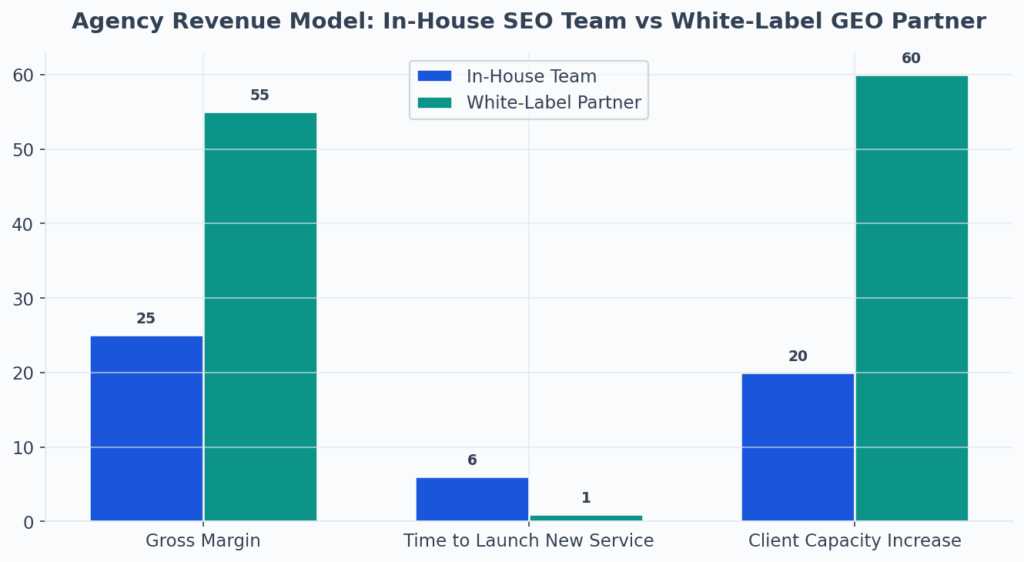
Building in-house means hiring specialists in schema markup, AI citation tracking, content architecture for extractability, and cross-platform monitoring. That is 2 to 3 senior hires at a minimum, plus tool subscriptions, plus 4 to 6 months of training and process development. Your gross margin on those services will sit around 25% while you absorb the overhead.
A white-label partnership inverts those numbers. You sell generative engine optimisation services under your brand at your pricing. The specialist partner delivers the work: audits, content restructuring, schema implementation, citation monitoring, and reporting. Your margin sits at 40% to 60% because you carry no specialist headcount. You can launch within weeks, not months.
White-label GEO lets agencies add a high-demand service without the hiring risk or training lag of building in-house.
If your clients are asking about AI visibility and your team is not set up to deliver, we can work behind the scenes under your brand. We handle the GEO audits, content restructuring, and citation monitoring. You present the results to your clients. Talk to Us About White-Label GEO →
What Generative Engine Optimisation Services Actually Include
GEO is not a single tactic. It is a set of interconnected services that together make a business visible in AI-generated answers. Here is what a complete generative engine optimisation services package looks like in 2026.
GEO Audit
The starting point: query ChatGPT, Perplexity, Google AI Overviews, and Gemini with 20 to 30 prompts relevant to the client’s industry and services. Document which competitors are cited. Identify where the client is absent. This baseline tells you exactly what needs to change and gives the client a concrete picture of their current AI visibility.
Content Restructuring for AI Extractability
AI engines extract answers at the passage level, not the page level. This means rewriting service pages and blog posts with answer-first structure: direct response in the first sentence of each section, followed by supporting detail. Add FAQ sections with questions phrased the way real buyers ask them. Ensure every section functions as a standalone, quotable passage.
Schema Markup Implementation
Organisation, Article, FAQPage, Person, and Service schema provide AI engines with the structured signals they need to classify, verify, and cite content. This is technical work that most content teams cannot do on their own, which is precisely why it is a strong white-label service: the value is clear, the delivery is specialised, and the results are measurable.
Entity and Authority Building
AI engines cross-reference website claims against third-party sources. This means building the client’s presence on LinkedIn, YouTube, G2, industry directories, and review platforms. Each independent mention strengthens the AI’s confidence in recommending the client. This is where GEO overlaps with digital PR, and where the role of PR in GEO becomes commercially important.
AI Citation Monitoring
Track the client’s appearance across AI platforms monthly. Report on citation frequency, competitor mentions, and changes in AI answer content. This ongoing monitoring justifies recurring retainers and demonstrates measurable ROI, which is exactly what keeps clients paying month after month.

For agencies comparing the investment, our analysis of the cost-benefit of AI SEO breaks down the numbers in detail.
This overview covers how agencies are building AI marketing services into their portfolios:https://www.youtube.com/watch?v=sQz8SFCNwkY
How to Choose a White-Label GEO Partner
Not every SEO provider that has added “GEO” to their service list can actually deliver results. The field is new enough that some providers are repackaging traditional SEO under a GEO label. Here is what to look for.
| Signal | Genuine GEO Provider | Repackaged SEO |
|---|---|---|
| Baseline audit | Shows your current AI citation status across platforms | Runs a standard SEO audit only |
| Reporting metrics | Citation frequency, AI share of voice, competitor mentions | Rankings, traffic, backlinks only |
| Content approach | Answer-first restructuring for passage-level extraction | Keyword-focused blog posts |
| Technical work | Full schema stack with entity verification | Basic on-page SEO fixes |
| Platform coverage | ChatGPT, Perplexity, Google AI Overviews, Gemini | Google only |
Ask one question: can they show you exactly where a sample client currently appears (or does not appear) in AI-generated answers? If they cannot demonstrate that capability before you sign, they are not ready to deliver GEO.
Pricing White-Label GEO for Your Clients
GEO is a premium service. The clients asking about AI visibility are typically the ones with the budget to invest in it. Here is how agencies are structuring GEO pricing in 2026.
One-off GEO audit: a standalone deliverable that maps the client’s current AI visibility, identifies gaps, and provides a prioritised action plan. Agencies typically price these between £1,500 and £5,000 GBP depending on scope and industry complexity.
Monthly GEO retainer: ongoing content restructuring, schema maintenance, entity building, and citation monitoring. Retainers range from £2,000 to £8,000 GBP per month depending on the number of target queries and content volume. This is where the recurring revenue sits.
GEO + SEO bundle: combining traditional SEO with GEO into a single package. This is the strongest positioning because it addresses both search channels without asking the client to manage two separate providers. Bundle pricing typically adds 30% to 50% on top of a standard SEO retainer.
The key to pricing is demonstrating the commercial value of AI visibility. When AI search referrals convert at 14.2% compared to 2.8% for Google organic (Loganix, 2026), the ROI case writes itself.
For agencies serving tech and B2B clients, GEO is especially relevant because these buyers are the most likely to use AI tools during their purchase research.
We work with agencies across the UK as a white-label GEO partner. We deliver the audits, content work, schema implementation, and monthly reporting. Your clients see your brand, your reports, your results. Request a Partner Quote →
This walkthrough explains how GEO strategy works alongside traditional SEO for agency clients:
https://www.youtube.com/watch?v=E4Y3YKzMRYo
Frequently Asked Questions
What are generative engine optimisation services?
Generative engine optimisation services focus on making a business visible in AI-generated answers across ChatGPT, Perplexity, Google AI Overviews, and similar platforms. They include GEO audits, content restructuring for AI extractability, schema markup implementation, entity building across third-party platforms, and ongoing AI citation monitoring.
How does white-label GEO work for agencies?
A white-label GEO partner delivers the specialist work behind the scenes while the agency maintains the client relationship. The agency sells GEO under its own brand, sets its own pricing, and presents branded reports. The white-label partner handles audits, content, technical implementation, and monitoring.
What margins can agencies expect from white-label GEO services?
White-label SEO and GEO partnerships routinely achieve 40% to 60% gross margins (ALM Corp, 2026). The margin is higher than in-house delivery because the agency carries no specialist headcount or tool costs for GEO-specific platforms.
How is GEO different from traditional SEO?
Traditional SEO optimises for rankings in search engine results pages. GEO optimises for citations in AI-generated answers. The ranking signals differ: GEO prioritises content structure, entity identity, freshness, and passage-level extractability over backlinks and keyword density. Only 12% of ChatGPT citations match Google’s top 10 results.
Do my clients need both SEO and GEO?
Yes. SEO provides the foundation that AI engines often draw from. GEO adds the structural and entity signals needed to earn citations in AI answers specifically. The most effective approach is a combined SEO and GEO strategy, which is also the strongest revenue opportunity for agencies.
How do I know if my ai marketing agency is ready to offer GEO?
If your team can run AI citation audits, implement full schema stacks, restructure content for passage-level extraction, and monitor AI visibility across platforms, you are ready. If any of those capabilities are missing, a white-label partnership fills the gap without the hiring timeline. Talk to our team about partnership options.
What results should clients expect from GEO services?
Initial AI citation improvements typically appear within 8 to 12 weeks. Consistent, compounding visibility develops after 4 to 6 months. Clients should expect to see their brand mentioned in AI-generated answers for target queries, with measurable increases in citation frequency over time.
How do I pitch GEO to clients who only understand SEO?
Frame it around where their buyers are going. 73% of B2B buyers now use AI tools in purchase research. AI referrals convert at 5.1x the rate of Google organic. Position GEO as the next layer of search visibility, not a replacement for SEO. Show them a live AI search for their industry and let the absence of their brand make the case.
The shift from SEO to GEO is not theoretical anymore: it is happening in search results right now. If you would like a clear picture of how white-label GEO could fit into your agency’s service offering, Request a Partnership Overview →. We will walk you through it.
Pavel Uncuta is the founder of AiBoost, a UK AI marketing agency that builds visibility audit tools for professional services firms. He researches how Large Language Models cite brands across ChatGPT, Perplexity, and Google AI Overviews.
Want to know whether ChatGPT, Perplexity, or Google AI Overviews mention your firm? Run a free first-party visibility audit on your domain in under a minute and see exactly which queries cite you and which do not.