TL;DR
- A brand mention and a citation are different events. A mention is your name appearing in the AI answer. A citation is your page being used as the source. They do not move together.
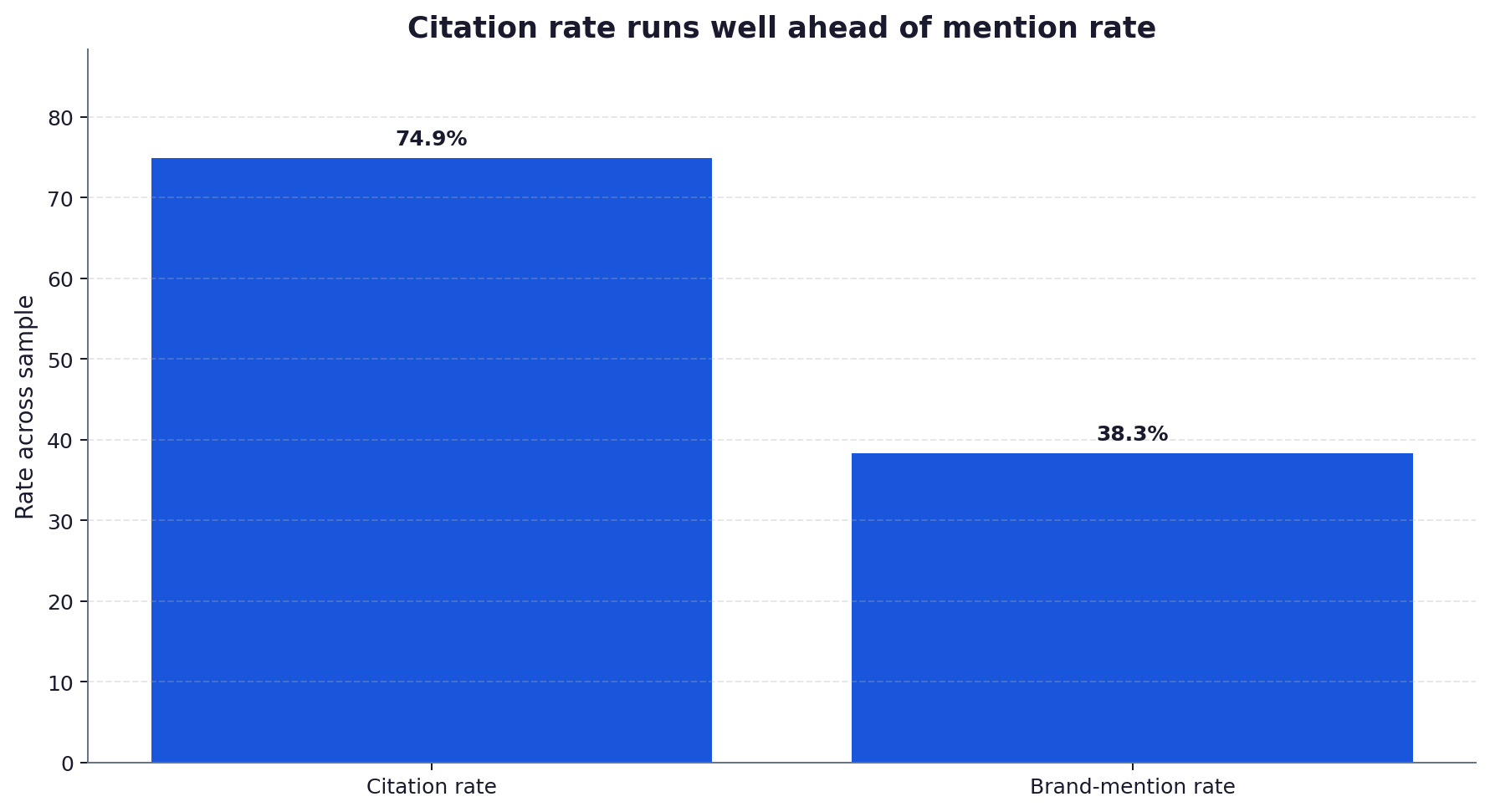
- Semrush’s 2026 Ghost Citations study found about 62% of AI citations never mention the brand behind the page, with a citation rate of 74.9% against a brand-mention rate of 38.3%.
- Any AI visibility report that does not separate the two can overstate brand impressions by up to about 2.6 times (Semrush, 2026).
- On Gemini, the overlap between mentioned brands and cited domains can be as low as 30%, so the divergence is engine-dependent (Semrush, 2026).
- The gap is a diagnosis. High mentions with low citations points to thin first-party content. High citations with low mentions means you are feeding answers that name someone else.
Key facts
- About 62% of AI citations do not mention the brand behind the cited page (Semrush Ghost Citations, 2026).
- Semrush measured a 74.9% citation rate against a 38.3% brand-mention rate across its sample (Semrush, 2026).
- Reports that conflate the two can overcount brand impressions by up to about 2.6 times (Semrush, 2026).
- On Gemini, mentioned-brand and cited-domain overlap can fall to around 30% (Semrush, 2026).
- Semrush analysed roughly 126 million AI search prompts for its 2026 AI Visibility Index (Semrush, 2026).
- About 45% of marketing leaders cannot measure brand visibility in AI answers, and only around 9% have tools to track it across platforms (Semrush, 2026).
Two events that a single number hides
When a marketer says a brand is “showing up in ChatGPT,” they usually mean one of two very different things. Either the brand name is written into the answer the user reads, or one of the brand’s pages sits underneath the answer as a linked source. The first is a mention. The second is a citation. Treating them as one metric is the most common measurement error in AI search right now, and it hides the information you actually need to act.
The two events can occur together, but often they do not. A page can be cited as the authority for an answer while the answer names a competitor. A brand can be named repeatedly while its own site is never the source, because the engine is pulling from a directory, a review site or a news article that discusses the brand. Once you separate mention count from citation count, the relationship between them becomes a working diagnosis of what is wrong and what to fix.
The ghost citation, quantified
The clearest 2026 evidence comes from Semrush’s Ghost Citations study, which found that roughly 62% of AI citations never mention the brand behind the cited page. In the same sample, the citation rate ran at 74.9% while the brand-mention rate sat at 38.3%. The practical warning Semrush draws is direct. A report that does not distinguish domain citations from brand-name mentions can overstate brand impressions by up to about 2.6 times, because it counts every source link as if it were a moment of brand recognition for the reader.
That gap is not a rounding error. It is roughly the difference between believing your brand is visible to three quarters of an audience and knowing it is named to closer to a third. Any budget or board conversation built on the inflated number is built on sand.
The divergence is engine-dependent
The size of the gap changes by engine. Semrush reports that on Gemini the overlap between mentioned brands and cited domains can fall to around 30%, which means a brand can dominate the citations feeding an answer while barely appearing in the answer text a reader sees. Engines that lean on knowledge-graph and directory sources widen the gap, because those sources describe brands without being owned by them. Engines that quote source pages more literally narrow it.
The implication is that you cannot read a single blended figure across ChatGPT, Perplexity and Gemini and expect it to mean anything consistent. Mention-to-citation divergence has to be measured per engine, then compared, because the same brand can look strong on one axis and weak on the other depending on where you look.
The four positions and what each one means
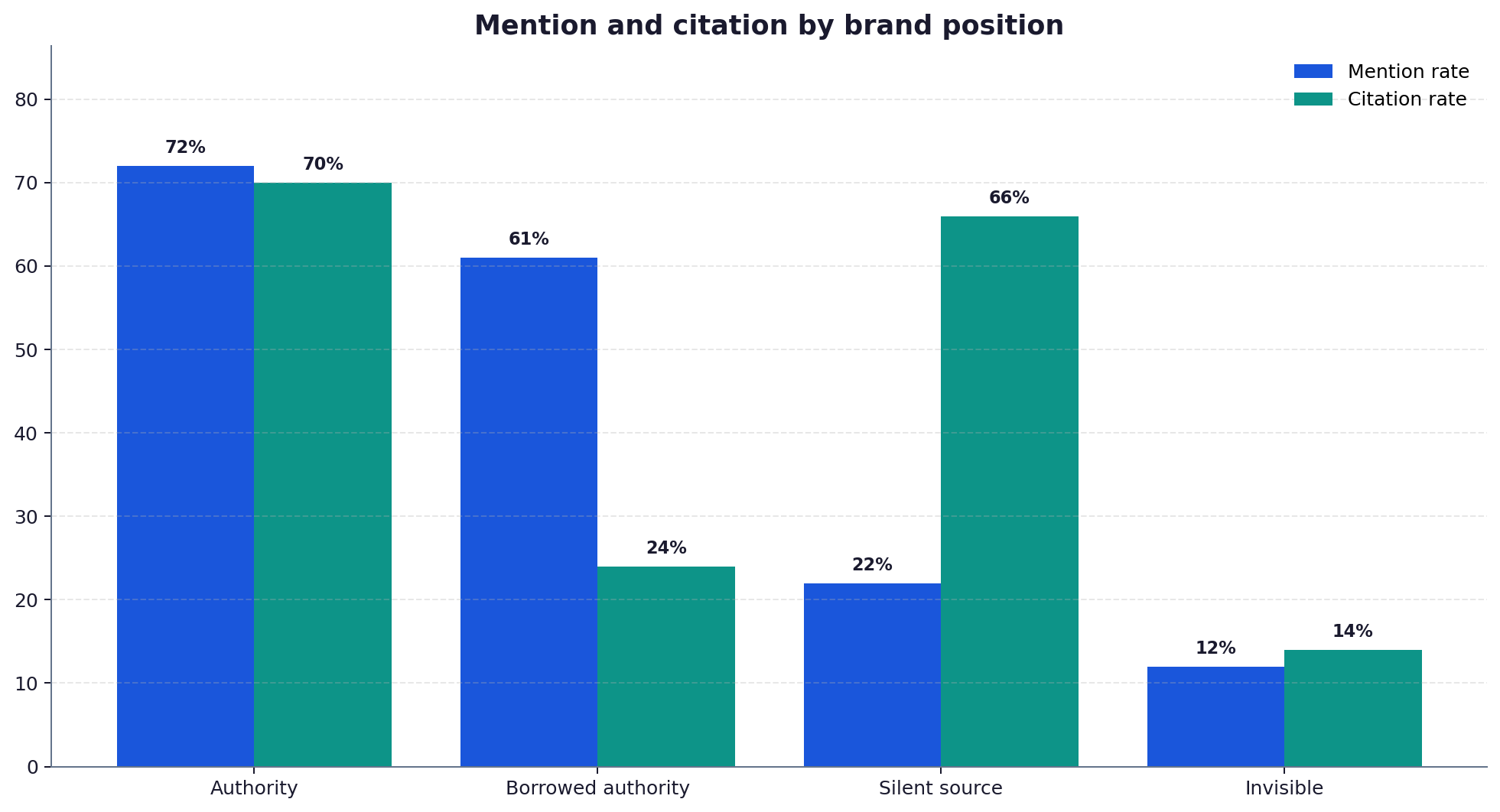
Plotting mention frequency against citation frequency gives four positions, and each one prescribes a different fix. High mention and high citation is the authority position, where the brand is both named and used as the source. High mention and low citation is the borrowed-authority position, common for brands with strong PR but thin first-party content, where engines talk about you using other people’s pages. Low mention and high citation is the silent-source position, where your content does the work but the answer credits a category or a competitor. Low mention and low citation is simple invisibility.
The value of the grid is that it turns two numbers into an instruction. It tells a PR-heavy brand to stop buying coverage and start publishing citable first-party pages. It tells a well-structured but under-marketed brand to build the brand-name associations that make engines willing to name it, not just quote it.
Why 2026 widened the gap
Two shifts pulled mentions and citations apart this year. First, engines increased their reliance on structured directory and reference sources, which mention brands heavily without being owned by them, inflating mentions relative to owned citations. Second, the pool of citable pages grew as more brands published GEO-aware content, so an engine can cite a well-structured page while naming whichever brand its training and knowledge graph most strongly associate with the query. The original GEO research by Aggarwal and colleagues already showed that structure and attribution drive whether a page is used as a source, which is a separate mechanism from whether a brand is named.
How to measure both, per engine
Measuring the gap does not need enterprise tooling. Take 20 to 30 commercial queries, run each across ChatGPT, Perplexity and Gemini, and record two things separately for every response. One, does the answer text name your brand. Two, is one of your pages listed as a source. Divide by the number of queries to get a mention rate and a citation rate per engine. The difference between them, and which one is higher, places you in one of the four positions and tells you where the next unit of effort should go.
Repeat monthly. Because Semrush found that about 45% of marketing leaders cannot measure AI brand visibility at all, and only around 9% track it across platforms, even a simple two-column count puts a firm ahead of most of its market on the one distinction that changes what you build next.
Frequently asked questions
What is the difference between a brand mention and a citation in AI search?
A mention is your brand name appearing inside the AI-generated answer a user reads. A citation is one of your own pages being used and usually linked as the source for that answer. They are separate events. An answer can cite your page without naming your brand, or name your brand while sourcing a directory or news article rather than your site. Measuring them separately is the point.
What is a ghost citation?
A ghost citation is when an AI answer uses your page as a source but never names your brand in the text the reader sees. Semrush’s 2026 study found about 62% of citations behave this way. You get the retrieval credit but no brand recognition in the answer, which is why citation counts alone overstate how visible your brand actually is to the person reading the response.
Why does conflating mentions and citations inflate reporting?
Because most source links do not carry a brand name. Semrush measured a 74.9% citation rate against a 38.3% mention rate, so counting every citation as a brand impression overstates visibility by up to about 2.6 times. A report that blends the two tells leadership the brand reaches three quarters of an audience when it is actually named to closer to a third, which distorts budgeting and forecasting.
Which position is worst, high mentions with low citations, or the reverse?
Neither is strictly worse, they prescribe different fixes. High mentions with low citations usually means strong PR but thin first-party content, so the fix is to publish citable, well-structured pages. High citations with low mentions means your content does the work while the answer credits a competitor or category, so the fix is to build the brand-name associations that make engines willing to name you, not only quote you.
Does this gap vary by AI engine?
Yes. Semrush reports that on Gemini the overlap between mentioned brands and cited domains can fall to around 30%, while engines that quote source pages more literally show a narrower gap. Engines that lean on knowledge-graph and directory sources mention brands without owning the pages, which widens the divergence. Measure mention rate and citation rate per engine rather than blending them into one figure.
What is the minimum I need to track this?
A list of 20 to 30 commercial queries and a two-column tally. For each query and engine, record whether the answer names your brand and whether one of your pages is cited, then divide by the query count. That yields a mention rate and a citation rate per engine. Semrush found only about 9% of marketing leaders track this across platforms, so even a manual count is a competitive advantage.
Sources and references
- Why 62% of AI citations don’t lead to brand mentions (Ghost Citations study). Semrush, 2026
- Semrush releases expanded 2026 AI Visibility Index, analysing 126 million AI search prompts. Semrush, 2026
- Most-cited domains and brand mentions across AI answer engines. Profound, 2026
- GEO: Generative Engine Optimization. arXiv (Aggarwal et al.), 2023
- How AI search engines choose their sources. Search Engine Land, 2026
Separate how often AI mentions your brand from how often it cites your pages.
Change log
- 2026-07-13: Initial publication.